Simons Observatory Fully Online in Chile: Stanford and SLAC Help Build 63,000-Sensor Camera to Map the Universe's Oldest Light
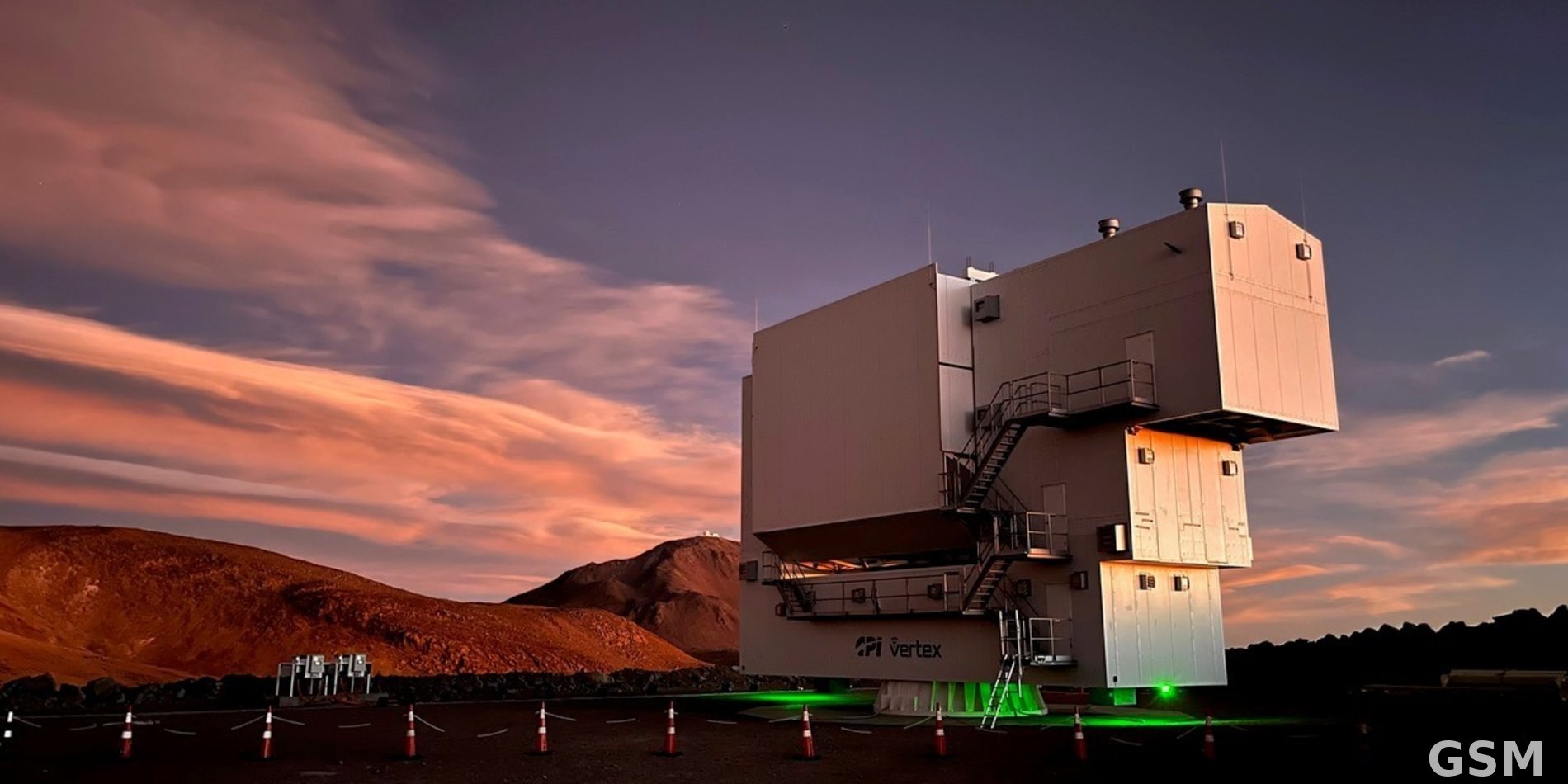
Stanford University announced on November 12 that the Simons Observatory in Chile's Atacama Desert is fully online and conducting science operations after two years of calibration. Researchers at Stanford and SLAC National Accelerator Laboratory, through the Kavli Institute for Particle Astrophysics and Cosmology (KIPAC), have had a hand in nearly every part of the observatory.
The observatory's four telescopes sit at 17,000 feet (5,200 meters), where they map the cosmic microwave background, the oldest light in the universe, and the millimeter-wave sky in front of it. The data will help reveal what interstellar dust is made of, how magnetic fields shape star-forming regions, and where stellar explosions and other transient events are occurring. It will also trace how galaxies and dark matter are arranged across the universe, the large-scale structure that holds clues to dark energy. Stanford said early data are already competitive with the best cosmic microwave background maps, including those from the European Space Agency's Planck satellite.
At the center of the Stanford and SLAC contribution is the receiver, or camera, of the 6-meter Large Aperture Telescope (LAT). It now holds 63,000 superconducting sensors, making it the largest cryogenic camera for cosmology to date. The team deployed the first 31,000 detectors in February 2024 and the final 32,000 earlier this year. The SMuRF readout electronics that make the detectors work were developed by the KIPAC and SLAC group led by Zeesh Ahmed, associate professor of particle physics and astrophysics, working with SLAC engineers Gunther Haller, Ryan Herbst and Larry Ruckman, while postdocs, students and staff scientists spent months at the site assembling and deploying the receiver.
The LAT has already produced the most comprehensive images of the Milky Way in polarized microwave light, revealing the structure of the galaxy's magnetic fields, which matter for understanding star formation and galactic evolution. Susan Clark, assistant professor of physics, co-led two forecasting papers that shaped the observatory's Galactic science plans, and her graduate student Kaitlyn Karpovich is one of the key people mapping and analyzing the polarized emission from the Galactic center. Clark said polarized light at these wavelengths helps reveal the invisible magnetic fields in the space between the stars, and that the observatory gives researchers a new view of the Milky Way.
KIPAC scientists are also preparing to study how matter is distributed across the cosmos. Emmanuel Schaan, assistant professor of particle physics and astrophysics, helped develop the observatory's initial science case, and his group focuses on the kinematic Sunyaev-Zel'dovich (kSZ) effect, a tiny shift in cosmic microwave background light as it scatters off moving gas. Frank Qu, a NASA Hubble Fellow who leads cosmic microwave background lensing for the observatory, said the team is already seeing, within the observatory's first observations, the faint distortions that all the matter in the universe imprints on the oldest light, and that the maps will chart the universe's dark matter to subpercent precision.
With the upgrade now complete, the observatory has added three more small-aperture telescopes funded by the United Kingdom and Japan, along with new National Science Foundation-funded instrumentation that doubles the LAT's mapping speed, and it will regularly release data to the broader astronomy community. Observatory co-director Mark Devlin said he expects so many scientific discoveries in the next few years that it will be hard to keep up.
Source: Stanford University
Published by GSM · USA (original Chinese edition)
Photo: 图:智利阿塔卡马沙漠日落时分的西蒙斯天文台6米大口径望远镜。Toby Satterthwaite 摄,斯坦福大学 KIPAC 官方发布。 / Photo: The Simons Observatory's 6-meter Large Aperture Telescope at sunset in Chile's Atacama Desert. By Toby Satterthwaite, via KIPAC, Stanford University.