University of Tartu Study on November 12: About 8,500 Everyday-Camera Photos Rebuilt a Fern's 15 Days of Growth, and About 20,000 Photos Covered a Greenhouse
Researchers at the University of Tartu in Estonia have shown that everyday cameras can create detailed, explorable 3D models of plants, in a study by Toivo Aukusti Ylinampa and Urmas Kõljalg published in the Biodiversity Data Journal and introduced on November 12. The work gives botanical gardens and museums an affordable way to document and preserve living collections.
The team combined photogrammetry, which reconstructs measurable 3D shapes from overlapping photographs, with 3D Gaussian splatting, a newer method that produces photorealistic models in real time and handles thin, tangled foliage well. Working mostly with a compact Olympus TG-6 camera, supplemented by a macro-lens camera, a smartphone and a drone, the researchers digitized subjects ranging from a single orchid flower to a tree.
Two datasets stand out. About 8,500 photographs of a fern, taken on 12 days across a 15-day period, were aligned using stable background features, so each day's model shares the same scale and orientation and growth can be compared directly over time. About 20,000 photographs of the University of Tartu Botanical Garden's tropical greenhouse were processed in 14 overlapping sections and assembled into an interactive virtual walkthrough.
The team noted limitations. Even gentle wind noticeably reduced model quality, and the greenhouse sections were assembled manually, so the walkthrough suits visual exploration rather than precise measurement. In a macro test, however, a measurement taken on the model, 13 mm, closely matched a caliper reading of 13.2 mm.
Source: University of Tartu
Published by GSM · USA (original Chinese edition)
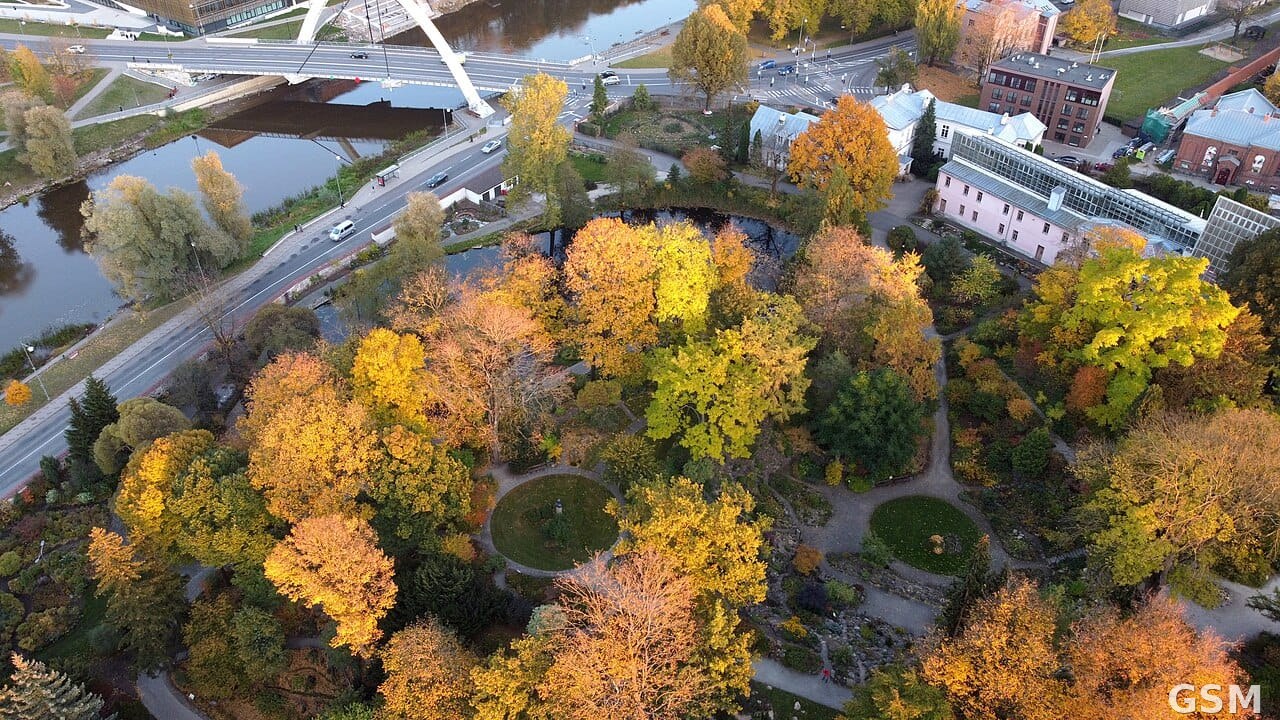
Photo: Wikimedia Commons, File:Aerial view of Tartu University Botanical Garden (0818).jpg — Author: Sillerkiil. Licensing: CC BY-SA 4.0.