
Scientific Reports Paper, November 16: in 2,329 Korean Children, Each Doubling of Seafood Intake Was Linked to About 13.2 Percent Higher Urinary Total Mercury, and Urine Cannot Stand in for Blood Mercury in an Individual Child
A team from Soonchunhyang University and Chungbuk National University in South Korea has published a paper in Scientific Reports on November 16. Using three probability samples from Cycle 5 (2021-2023) of the Korean National Environmental Health Survey (KoNEHS) — 648 preschoolers, 780 schoolchildren and 901 adolescents, 2,329 children in total — the study addressed an unresolved question: whether urine carries a measurable seafood signal for mercury exposure in children, since national programs rarely draw blood from young children.
Fitting survey-weighted log-linear models of habitual seafood intake against spot urine, the team found that each doubling of animal seafood intake was associated with 13.5 percent, 11.8 percent and 15.0 percent higher creatinine-corrected total mercury in the three samples, pooling to 13.2 percent (95% CI, 11.0 to 15.5) with no detectable heterogeneity. Seaweed, used as an internal negative control, showed no positive association.
In 812 adolescents, dietary slopes did not differ detectably between urine and blood (ratio 0.99; 0.72 to 1.28) and category profiles were similar. At the individual level, however, agreement within 872 paired participants stayed moderate (weighted Spearman ρ = 0.50, κ = 0.33), and adjusting for blood total mercury halved the urinary dietary slope.
The authors conclude that spot urinary total mercury tracks seafood-related mercury exposure at population scale, but that without speciation the signal cannot be assigned to methylmercury or inorganic mercury, and urine cannot stand in for blood mercury in one child. This report presents the study findings only and offers no dietary advice to any family.
Published by GSM · USA (original Chinese edition)
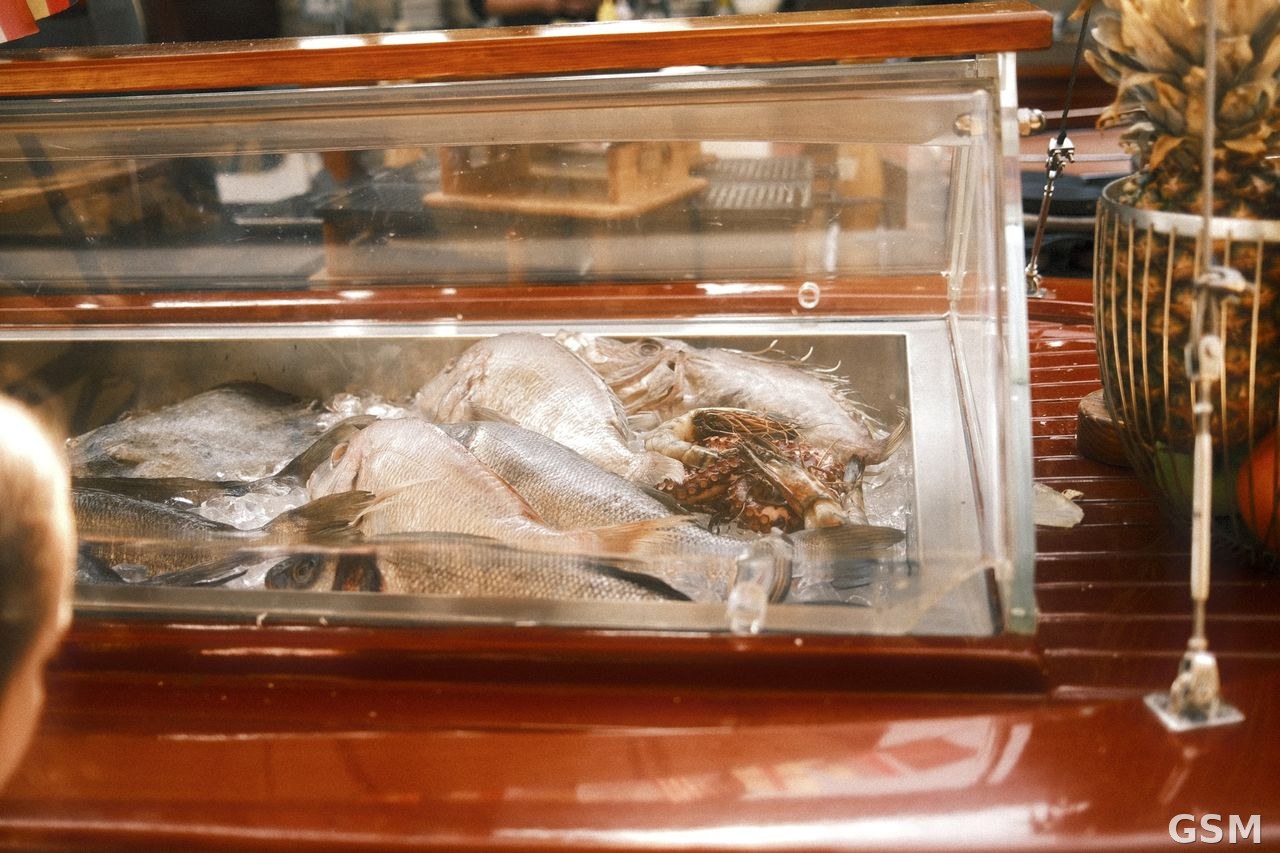
Photo: Wikimedia Commons, File:Fresh fish display at a local market undefined.jpg — Author: Shixart1985. Licensing: CC BY 2.0.
 STEP Young Phase 3 Trial in The New England Journal of Medicine, Announced November 16: BMI Fell 17.4% at Week 68 in 167 Children Aged 6 to Under 12, Versus a 2.2% Rise on Placebo2026-11-16
 FDA Approves MYQORZO Label Update on November 16: Phase 3 MAPLE-HCM Data Added, With the Week 24 Peak Oxygen Uptake Endpoint Met and Five of Six Secondary Endpoints Significantly Improved2026-11-16