Scientific Reports Paper on November 16: Motions at the Top of the Organ of Corti Are Amplified Over a Wide Frequency Range in the Mouse Cochlear Apex, Recorded by Optical Coherence Tomography
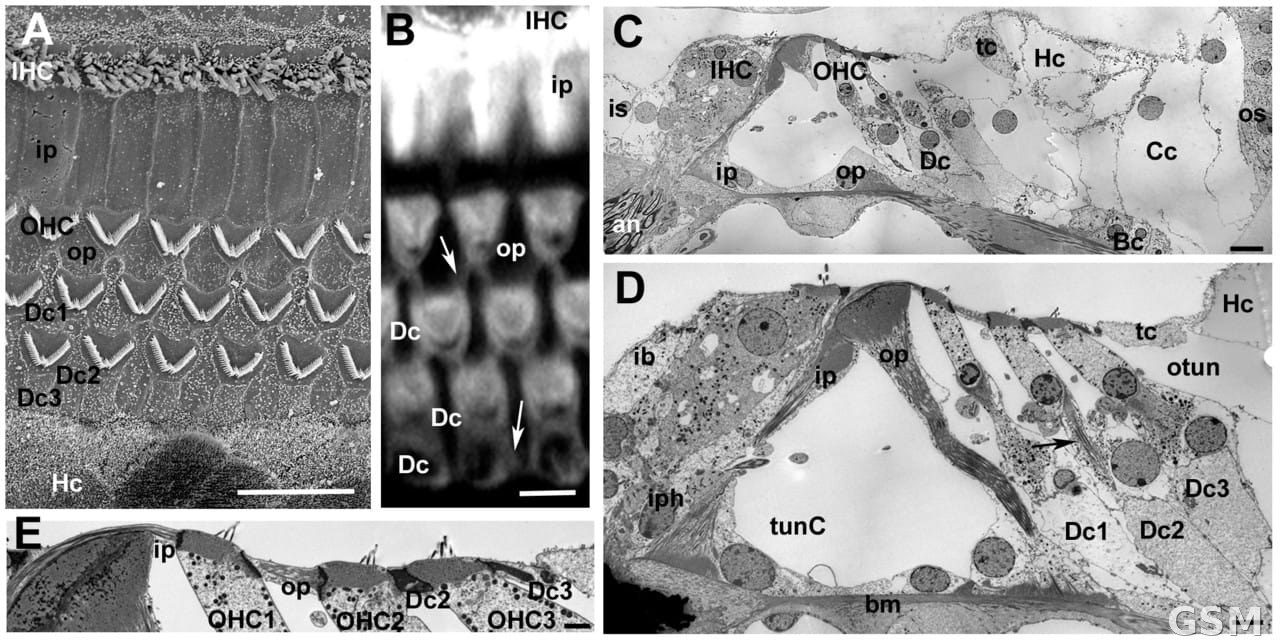
James B. Dewey published a paper on November 16 in Scientific Reports using optical coherence tomography to measure motions in the mouse cochlear apex, reporting that outer hair cells amplify motions near the top of the organ of Corti over a wide frequency range, unlike the narrow-band amplification of basilar membrane motion.
Hearing sensitivity and frequency selectivity in mammals depend on mechanical amplification mediated by outer hair cells. In the prevailing view, outer hair cells at a given location only amplify basilar membrane motion for a narrow frequency range, while recent measurements show that amplification of motions deeper within the organ of Corti is much more broadband.
Using optical coherence tomography, the study demonstrated that outer hair cells nonlinearly amplify motions near the top of the organ of Corti, including at the reticular lamina and tectorial membrane, over a wide frequency range in the mouse cochlear apex. Responses at all frequencies were physiologically vulnerable and grew compressively with stimulus level.
Low-frequency responses also exhibited non-monotonic features, which the author attributes to interference between amplified motion and the underlying traveling wave. The data suggest that broadband amplification of motions at the top of the organ of Corti likely explains certain phenomena observed in auditory nerve responses.
The work was supported by grant R01 DC021006 from the National Institute on Deafness and Other Communication Disorders of the US National Institutes of Health. It is a basic measurement study in the mouse cochlea, and its conclusions are limited to that model and imaging setup.
Published by GSM · USA (original Chinese edition)
Photo: Wikimedia Commons, File:The organ of Corti of the mouse.png — Author: Taylor RR, Jagger DJ, Forge A. Licensing: CC BY 4.0.