[Video] Warsh Lays Out Three Super Intelligence Scenarios in San Francisco: Shared Productivity Gains, Job Disruption or Disappointment
Federal Reserve Chair Kevin Warsh delivered opening remarks on November 16 at the Federal Reserve's Productivity and Jobs Task Force Conference at the Federal Reserve Bank of San Francisco, laying out three scenarios for what super intelligence (SI) could mean for the U.S. economy. It was his first visit to a Reserve Bank since becoming Chair in May. The conference, hosted jointly by the Board of Governors and the San Francisco Fed and livestreamed to the public, examines the impact of new general-purpose technologies, including super intelligence, on productivity, jobs and monetary policy.
The Productivity and Jobs Task Force is led by Marc Andreessen, Chad Jones and Asha Sharma, and is one of five task forces Warsh has convened as Chair. He said the groups are a way of broadening the Fed's thinking and inviting robust discussion that goes further than fleeting data points or daily market moves, an intellectual investment to equip the Fed for the next policy conjuncture and beyond. The conference, he said, opens the task force's discussion to a wide cross section of stakeholders.
Warsh called super intelligence an entirely new force in economic life and society. The idea that people could have, in their pockets, instant access to genius-level intelligence on almost any subject would have seemed far fetched a few years ago, he said, but with the advances of SI it is happening, and the marginal cost of satisfying limitless curiosity is falling fast, perhaps even trending toward zero. Citing endogenous growth theory, he said ideas are the ultimate resource, and that living standards advance when conditions favor the generation of new ideas, which is why the United States is leading. But breakthrough ideas have become harder to find: by some estimates, research efforts have increased more than 20 times since the 1930s, while research productivity has fallen by an even larger amount. Productivity growth in recent quarters has been reasonably strong, he said, but has not yet broken out definitively and structurally to the upside.
Super intelligence may differ from general-purpose technologies of the past, such as the internal combustion engine or electricity, Warsh said: those inventions drove decades of follow-on innovation but did not themselves automate the creation of ideas, while SI could supercharge idea generation and change the method and the speed of innovation. Humans should not be underestimated, he added: machines that can amass or even exceed human knowledge are still machines and do not take the place of human judgment, morality or responsibility. "Humans are the designers and the builders, and humans must be the deciders." He also asked: can you be a superpower without super intelligence?
Warsh then walked through illustrative scenarios that Board staff have begun to evaluate with stylized, model-based frameworks, stressing that they are not forecasts. In the first, SI raises productivity and the gains are shared broadly across labor and the owners of capital; real GDP growth rises persistently above its long-run average and the U.S. stays close to full employment. In the second, an SI-driven expansion brings substantial labor market disruption as some jobs are displaced rather than complemented by technology; GDP growth still rises above its long-term average, but widespread automation combined with labor market frictions could push the jobless rate above levels consistent with full employment. In the third, SI disappoints: after significant capital investment and stock market gains, expected returns turn down and equity valuations fall, leading to an economic slowdown and a more notable rise in unemployment, and the economy eventually recovers without the productivity gains.
Great opportunities rarely come risk free, Warsh said, and SI empowers all, including bad actors, so the Fed is thinking especially about critical infrastructures and their potential vulnerabilities. The Fed's role, he said, is neither advocacy nor opposition; its responsibility is to recognize that widespread adoption of the technology will have a significant impact on the economy, with important implications for monetary policy down the road. The big questions are about magnitude, scope and timing: whether the technology delivers a rise in total factor productivity, whether the democratization of specialized knowledge significantly raises living standards, when the surge starts and when it tapers, whether it happens sooner and faster in the United States than in other countries, and whether adversaries race to deploy SI intending harm to the U.S. economy. The remarks did not address interest-rate decisions or the path of the December policy meeting. "Our job is to prepare for whatever comes next," Warsh said.
(Source: Federal Reserve)
Source: Federal Reserve
Published by GSM · USA (original Chinese edition)
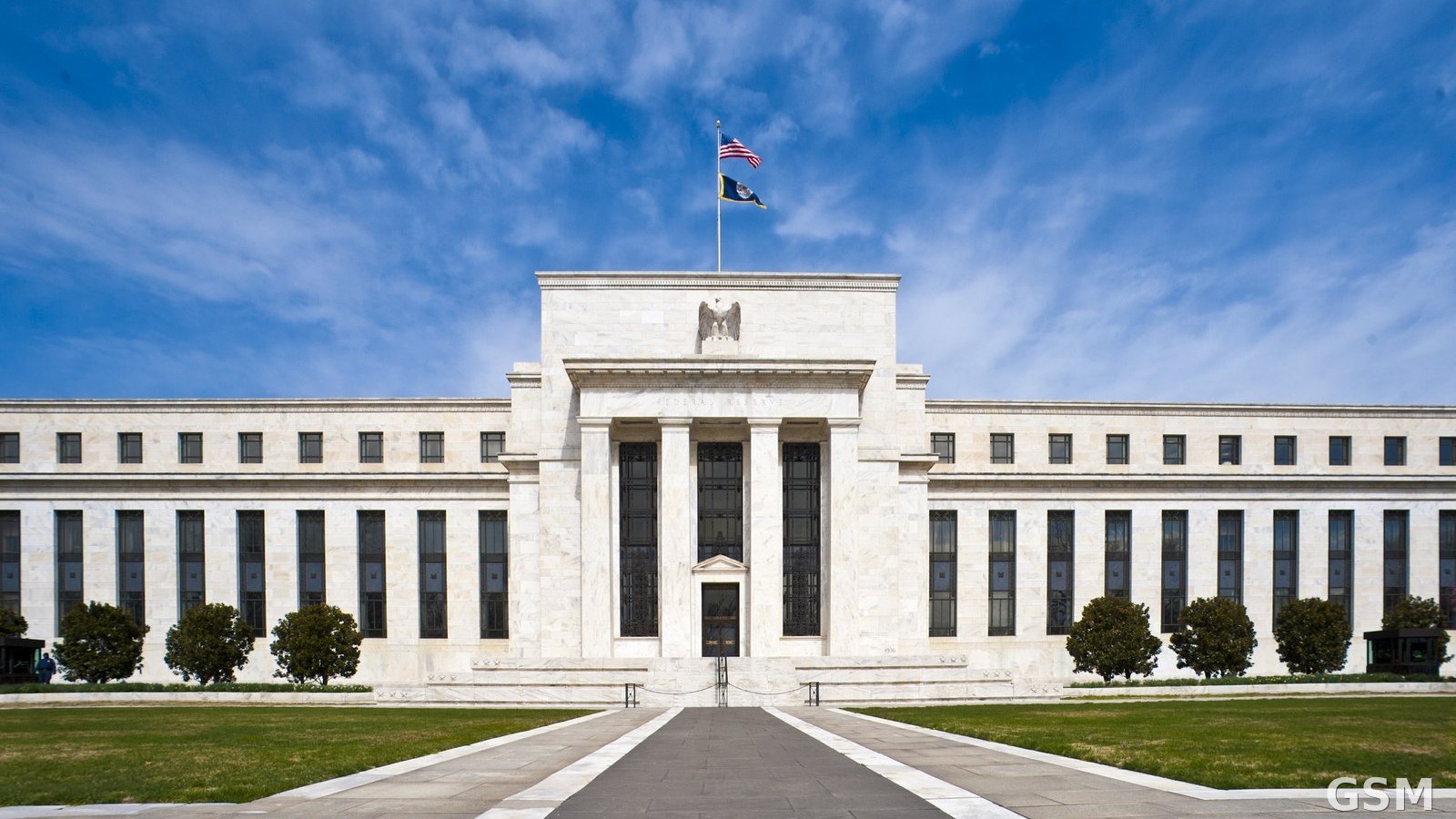
Photo: 图:位于华盛顿的美联储总部埃克尔斯大楼。GSM联邦固定图库。 / Photo: The Eccles Building, headquarters of the Federal Reserve in Washington. GSM federal asset pack.