Pompeii Funeral Bed Study Published November 13: More Than 2,000 Bone Fragments Rebuild First-Century Beds With Soldiers, Shields and Gold Leaf
A study of the carved bone decoration of Pompeii's funeral beds was published online on November 13, 2026, in the Journal of Roman Archaeology. Pilar Mas Hurtuna, Llorenç Alapont Martín and Agustín Ángel Diez Castillo of the Universitat de València in Spain analyzed more than 2,000 bone fragments that once decorated the wooden couches on which some wealthy residents were laid out and cremated; the wood has not survived, while the bone endured in cremation ashes and burial deposits.
The material comes mainly from the Porta Nola necropolis excavations of 2015, 2016 and 2017: about 450 pieces from the tomb of Marcus Obellius Firmus, roughly 540 fragments from another tomb called Tomb A, and about 500 more from a cremation deposit, including an almost complete bed leg; a further 91 elements came from an urn in the tomb of Lucius Betutius Niger, in the cemetery area of the Praetorian guard. At the Casa del Fabbro, one room held 20 decorative plaques and 322 strip fragments, including 13 shields.
The carvings show helmeted heads in profile and miniature shields mainly in hexagonal and crescent shapes (the typology also lists a rectangular form, which is unattested at Pompeii), with helmets in Attic and Boeotian styles. Red pigment survives in the carved grooves of pieces from the Casa del Fabbro, and a garland from the Obellius Firmus tomb keeps traces of gold leaf. The authors link the two groups through shared themes and production methods and suggest a common Pompeii workshop in the later Julio-Claudian period, broadly Tiberian through Neronian, while noting that the workshop link remains a hypothesis rather than proof.
Source: Journal of Roman Archaeology
Published by GSM · USA (original Chinese edition)
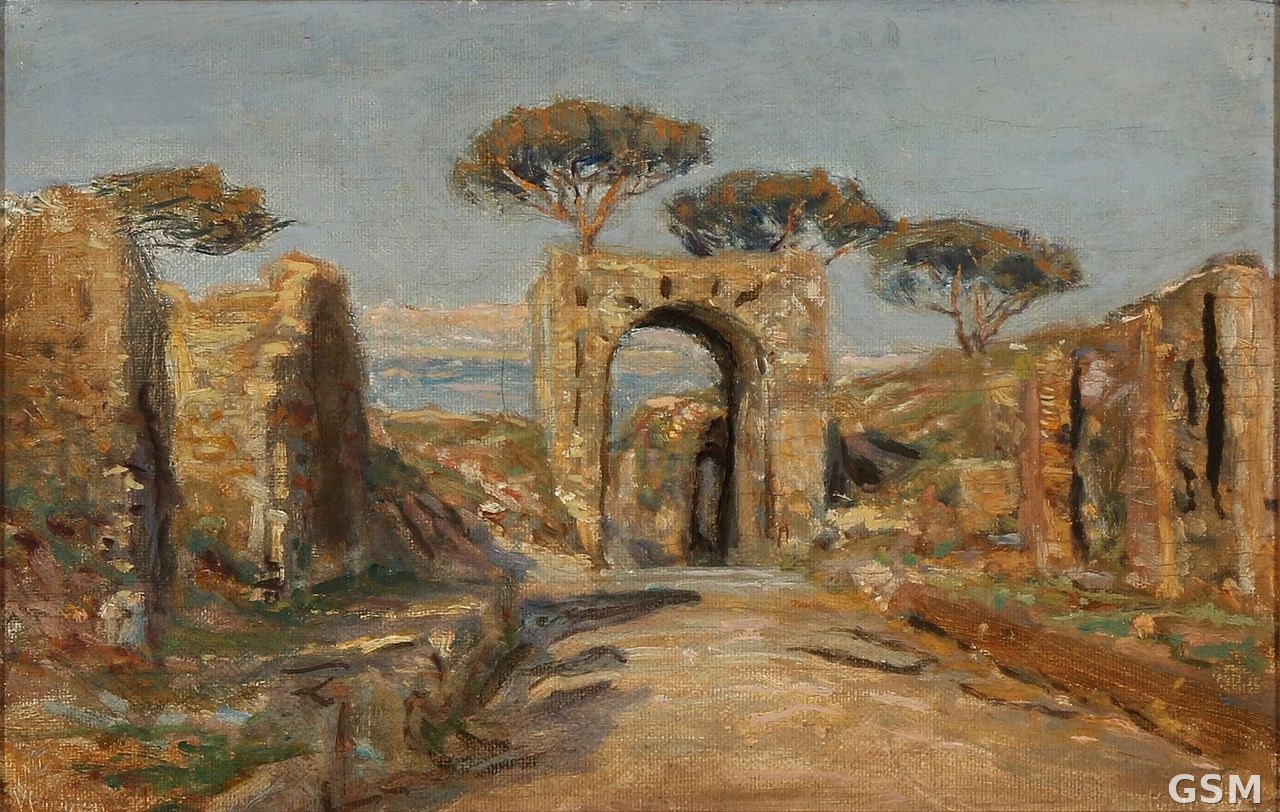
Photo: 图:Viggo Johansen 画作中所绘的 Pompeii Porta Nola 城门内侧。来源:Viggo Johansen,Wikimedia Commons,公共领域。 / Photo: The inside of the Porta Nola gate at Pompeii, painted by Viggo Johansen. Source: Viggo Johansen, Wikimedia Commons, public domain.