
Columbia Study in Science: Electron Waves Trapped for the First Time in Metal Pd5AlI2 by Quantum Interference
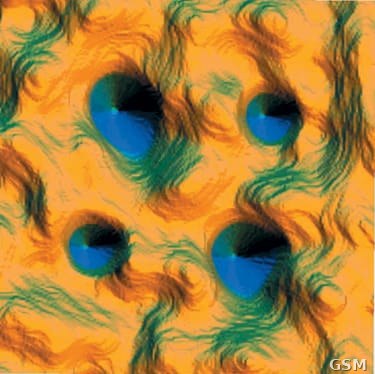
A team of Columbia University researchers reported in Science that waves of electrons became trapped for the first time in a metal called Pd5AlI2. Theoretical physicist Raquel Queiroz said quantum mechanics predicts that an electron wave can theoretically remain trapped even when there are infinitely many paths for it to escape, an effect known from light waves but never before seen for electrons.
Pd5AlI2 was made a few years ago in Xavier Roy's chemistry lab at Columbia and can be peeled into two-dimensional layers while retaining its metallic characteristics. Working with experimental physicists Cory Dean and Aravind Devarakonda, the team had published results on frustrated electron hopping in the material in Nature Physics last year. Physicist Abhay Pasupathy's lab, using scanning and spectroscopy instruments that image materials with atom-scale accuracy, noticed unexpected patterns that turned out to be electron waves bound in place near atomic defects in the crystal lattice.
The team said the observation is the first clear evidence of a bound state in the continuum, or BIC, in a metal. Electronic BICs are currently random, resulting from defects arising during the growth of Pd5AlI2 in the lab, and Roy and Pasupathy are exploring ways to deliberately introduce defects into specific places in the metal to fine-tune the resulting interference patterns. The team said other classes of metals with similar frustrated lattice structures should also be able to host electronic BICs.
Source: Columbia University
Published by GSM · USA (original Chinese edition)
Photo: 图中是一台扫描隧道显微镜的结构,该类仪器可对材料作原子尺度成像,本研究团队用扫描与光谱仪器观察到被束缚的电子波。来源:Wikimedia Commons, File:Scanning Tunneling Microscope Structure (5941082310).jpg, National Institute of Standards and Technology, Public domain。

