
Northwestern's New Nature Algorithm FLIP Boosts Webb Sensitivity 2 to 15 Times, Recovers 51 Eridani b from Old Observations
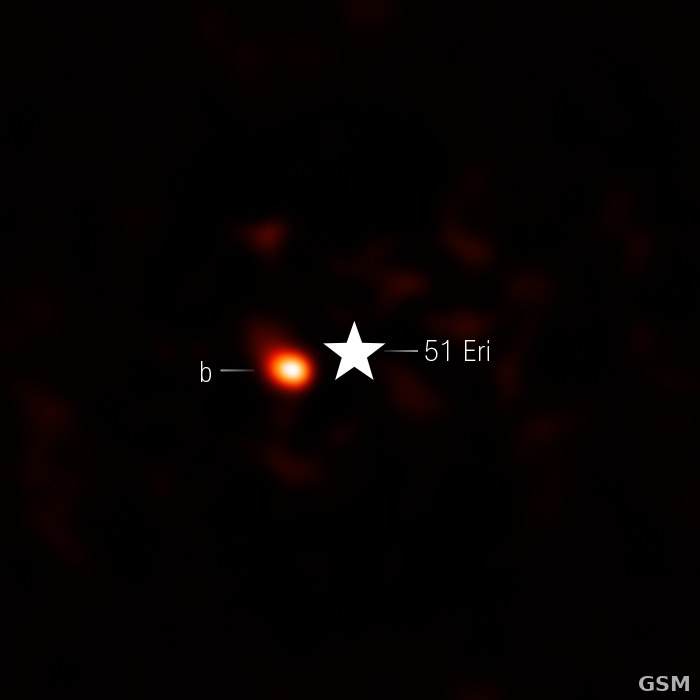
A team at Northwestern University has published a new algorithm, FLIP, in Nature that boosts the James Webb Space Telescope's (JWST) sensitivity to exoplanets by 2 to 15 times. Applying FLIP to Webb's 2023 observations of the 51 Eridani system, the team recovered the previously missed gas giant 51 Eridani b.
FLIP, short for "Physics-based Learning for Imaging Planets," works by modeling the noise in a star's halo separately from the planet signal, allowing faint planetary signals to stand out from the background. 51 Eridani b is a young gas giant several times the mass of Jupiter, orbiting its host star at about 13 astronomical units; earlier analyses of the same data had failed to confirm it. The researchers said the algorithm can uncover more exoplanets from existing Webb archive data without requiring new telescope time, and can be applied to future direct-imaging surveys.
图中是韦布望远镜 NIRCam 拍摄的 51 Eridani 系统图像,本研究从该恒星的旧观测中找回行星 51 Eridani b。
Source: Northwestern University
Published by GSM · USA (original Chinese edition)
Photo: 图为韦布望远镜 NIRCam 拍摄的 51 Eridani 系统。NASA, ESA, CSA, STScI, Public domain, via Wikimedia Commons
 Canadian Scientists First Directly Measure Submarine Landslides in Bute Inlet; Science Study Monitors Every Second for 18 Days, Slides Last Minutes to Hours2026-11-15
 University of Miami JNeurosci Study in Mice: Sour Taste Suppresses Sweet, Bitter and Salty Signals via Serotonin Before Taste Signals Reach the Brain2026-11-15