French President Macron Meets Trump at the White House: United on Ending the Ukraine War, Divided on Security Guarantees
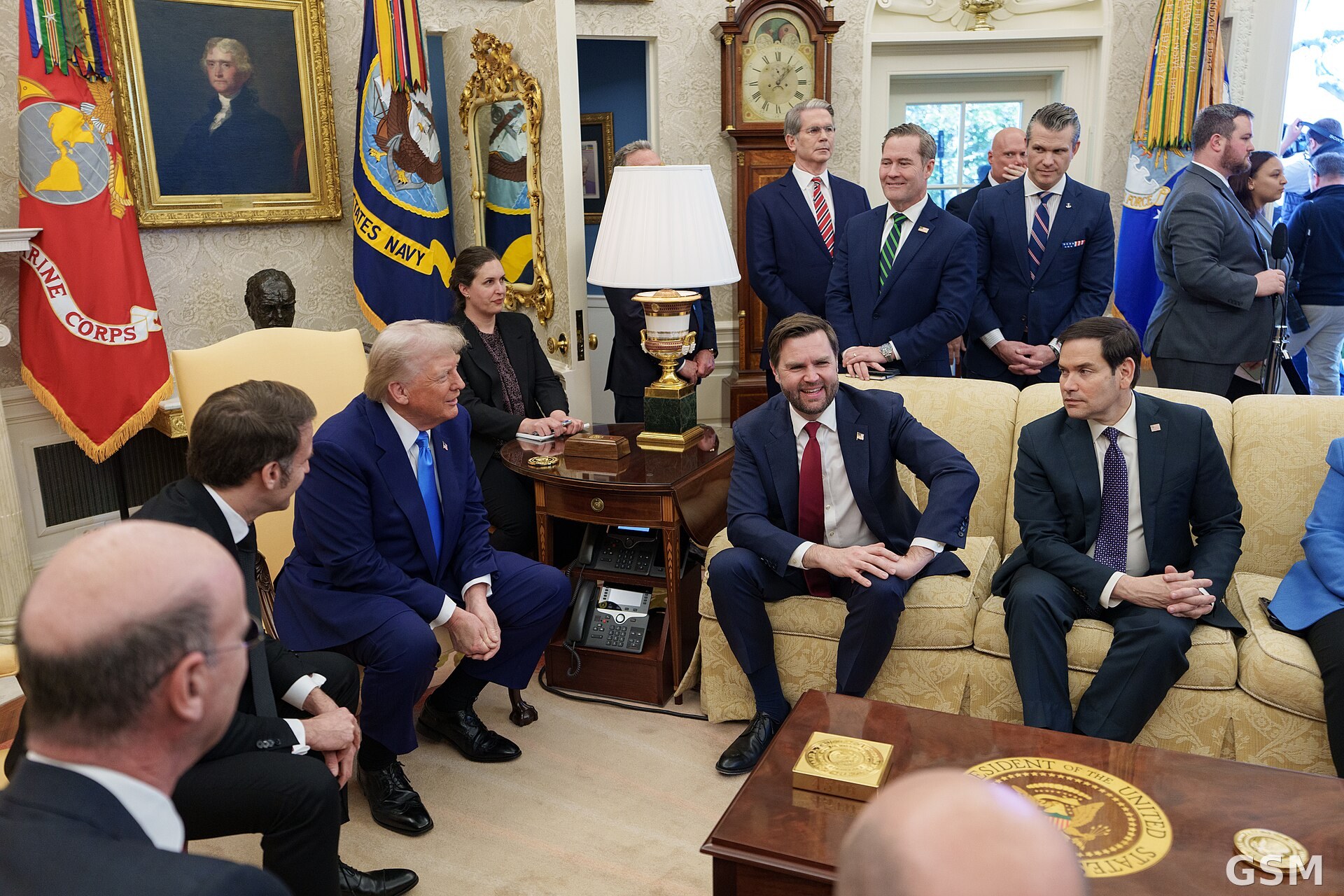
On February 24, 2025, French President Emmanuel Macron visited the White House in Washington, D.C., where he met with U.S. President Donald Trump and the two leaders spoke to reporters together. The day marked three years since Russia's full-scale invasion of Ukraine, and Macron was the first European leader to visit the White House since Trump returned to office. The two men joined a video call with fellow Group of Seven (G7) leaders that morning, then held bilateral talks and a joint news conference in the East Room of the White House.
At the news conference, Trump said the purpose of the meeting was to end the war in Ukraine, and that the U.S. focus was on achieving a ceasefire as soon as possible and ultimately a permanent peace. He said he had spoken with both Russian President Vladimir Putin and Ukrainian President Volodymyr Zelenskyy, and that his team had held talks with a Russian delegation in Saudi Arabia the previous week. He said the United States and Ukraine were making progress on an agreement on critical minerals and rare earths, and that he would meet Zelenskyy soon to finalize it. Trump said the cost and burden of securing the peace must be borne by the nations of Europe, not by the United States alone, and said the United States had spent more than $300 billion while Europe had spent about $100 billion.
Speaking to reporters in the Oval Office earlier in the day, Trump said Putin would accept European peacekeeping forces in Ukraine once a peace deal was reached: "I specifically asked him that question. He has no problem with it." Macron said at the same session that European countries were ready to provide security guarantees that could include troops, but that such forces would not be along the front lines and would not be part of any conflict; they would be there to ensure the peace is respected.
At the joint news conference, Macron said Europe had invested $128 billion in aid to Ukraine, whose forces had held the front of the allies' collective security. "This peace must not mean a surrender of Ukraine. It must not mean a ceasefire without guarantees. This peace must allow for Ukrainian sovereignty," he said. He argued for first securing a truce that could be measured and verified, and then negotiating a lasting peace with security guarantees, recalling that the peace arrangements after 2014 had been violated by Putin for lack of guarantees. Macron said France was working with the United Kingdom and other partners on plans to deploy a limited assurance force after a peace agreement was signed — not to the front lines and not for combat — and said U.S. support would be crucial to the credibility of those guarantees.
The two leaders differed publicly over the nature of aid to Ukraine. In the Oval Office, Trump said much of Europe's contribution had been structured as loans that would be repaid; Macron interjected to correct him: "No, in fact, to be frank, we paid. We paid 60 percent of the total effort." At the news conference, their common ground was also explicit: Macron said both sides wanted peace swiftly, "but we don't want an agreement that is weak," and both agreed on deploying European forces to uphold a peace once an agreement was reached.
The talks also covered trade and the Middle East. Macron said the U.S. and European economies were intertwined, with about $1.5 trillion in annual trade in goods and services, and that the two sides should commit to fair competition; he said neither country wanted to see Iran obtain nuclear weapons. Trump thanked Macron for hosting him in Paris in December 2024 for the reopening of Notre Dame Cathedral.
(Source: The White House)
Source: The White House
Published by GSM · USA (original Chinese edition)
Photo: 图:2025年2月24日,特朗普在白宫椭圆形办公室与法国总统马克龙举行双边会晤,副总统万斯、国务卿 Marco Rubio 等在座。(白宫官方照片,Emily J. Higgins 摄,公共领域) / Photo: President Donald Trump hosts a bilateral meeting with French President Emmanuel Macron in the Oval Office on February 24, 2025, with Vice President JD Vance and Secretary of State Marco Rubio seated at right. (Official White House photo by Emily J. Higgins, public domain)