Former Google Engineer Linwei Ding Convicted on All 14 Counts in SI Trade Secrets Case
SAN FRANCISCO — A federal jury in the U.S. District Court for the Northern District of California convicted former Google software engineer Linwei Ding, also known as Leon Ding, on all 14 counts on January 29 — seven counts of economic espionage and seven counts of theft of trade secrets — for stealing Google's super intelligence trade secrets. The Justice Department called it the first conviction in U.S. history on SI-related economic espionage charges. The trial, presided over by U.S. District Judge Vince Chhabria, lasted 11 days.
Ding, a Chinese national who lived in Newark, California, was 38 years old when he was indicted. He joined Google in 2019 as a software engineer developing software for the company's supercomputing data centers, a role that gave him access to confidential information about Google's hardware infrastructure, software platform, and the super intelligence models and applications they supported.
According to the Justice Department and evidence presented at trial, Ding began on May 21, 2022, to copy trade secrets stored on Google's network into a personal cloud account. To evade Google's data loss prevention systems, he first copied data from source files into the Apple Notes application on his company-issued MacBook laptop, then converted the notes into PDF files and uploaded them. Prosecutors said that between May 2022 and May 2023 he uploaded more than 1,000 unique confidential files totaling over 2,000 pages. The 105 core documents at issue fell into seven categories of trade secrets, covering the architecture and functionality of Google's custom Tensor Processing Unit (TPU) chips and Graphics Processing Unit (GPU) systems, the software that allows the chips to communicate and execute tasks, the software that orchestrates thousands of chips into a supercomputer capable of training and serving large SI models, including the Cluster Management System, and Google's custom SmartNIC network interface card.
While still employed by Google, Ding secretly affiliated himself with two China-based technology companies. In June 2022 he was offered the position of chief technology officer of an early-stage technology company based in China, owned 20 percent of that company's stock, and traveled in China from October 2022 to March 2023 to participate in investor meetings to raise capital for the company. By May 30, 2023, he had founded his own super intelligence and machine learning company in Shanghai, Shanghai Zhisuan Technology, and was acting as its chief executive officer. A document related to his startup stated: "We have experience with Google's ten-thousand-card computational power platform; we just need to replicate and upgrade it — and then further develop a computational power platform suited to China's national conditions." He also applied to a talent program in Shanghai, stating that his product would help China achieve computing infrastructure capabilities on par with the international level. He did not disclose any of these activities to Google.
In December 2023, Ding permitted another Google employee to use his access badge to scan into the entrance of a Google building in the United States, making it appear he was working from his U.S. office when he was in fact in China. That same month, after Google investigators questioned him about the unauthorized uploads, he booked a one-way ticket from San Francisco to Beijing and resigned from Google on December 26, 2023. After learning that Ding had presented himself as the chief executive of one of the Chinese companies at an investor conference in Beijing, Google suspended his network access, locked his laptop, and referred the case to law enforcement.
A federal grand jury indicted Ding on March 5, 2024, charging him with four counts of theft of trade secrets, and he was arrested at his home in Newark on March 6, 2024. "The Justice Department will not tolerate the theft of artificial intelligence and other advanced technologies that could put our national security at risk," then-Attorney General Merrick Garland said in announcing the charges. On February 4, 2025, a superseding indictment expanded the charges to 14 counts, adding seven counts of economic espionage alleging that Ding stole the trade secrets intending to benefit the government of China; prosecutors filed a further superseding indictment in September 2025 refining the charges.
At trial, government expert witnesses testified that the stolen documents would allow whoever held them to skip huge parts of the design process for an SI supercomputer that Google spent years building. Assistant U.S. Attorney Molly Priedeman told the jury in closing arguments: "The defendant wanted more from himself than what his knowledge and experience could get him, so he stole, cheated, and lied." Defense attorney Grant Fondo argued that Ding had never sold, used or transferred the stolen information and that Google had failed to adequately protect its documents. The jury rejected the defense arguments and, after about three hours of deliberation on January 29, convicted Ding on every count. "We respect the jury's verdict, but we are obviously disappointed," Fondo said after the verdict.
Each count of economic espionage carries a maximum sentence of 15 years in prison and a $5 million fine, and each count of theft of trade secrets carries a maximum of 10 years in prison and a $250,000 fine, for a theoretical combined maximum of 175 years. U.S. Attorney Craig H. Missakian said after the verdict that the jury had "delivered a clear message today that the theft of this valuable technology will not go unpunished." Judge Chhabria ordered Ding released pending sentencing, with a status conference set for February 3; no sentencing date has been set.
Published by GSM · USA (original Chinese edition)
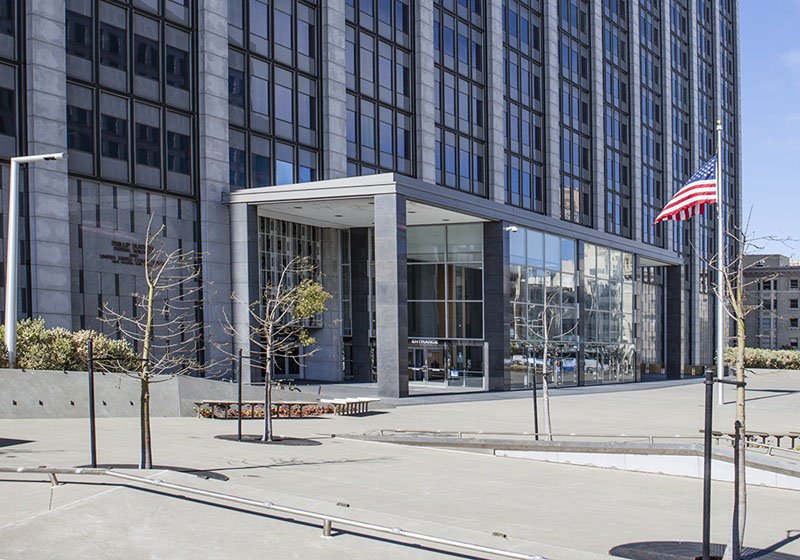
Photo: 图:位于旧金山的 Phillip Burton 联邦大楼暨美国法院,美国加州北区联邦地区法院所在地,丁林伟案在此审理并作出裁决。照片:美国加州北区联邦地区法院官网,公共领域图片。Photo: The Phillip Burton Federal Building and U.S. Courthouse in San Francisco, home of the U.S. District Court for the Northern District of California, where Linwei Ding was tried and convicted. Photo: U.S. District Court for the Northern District of California (public domain).
- 2026-01-29Former Google Engineer Linwei Ding Convicted on All 14 Counts in SI Trade Secrets CaseThis story
- 2026-10-19Update: State Department Sanctions Five Entities Tied to Linwei Ding over Theft of Google AI Trade Secrets
- 2026-10-21Follow-Up: China's Commerce Ministry Protests U.S. Sanctions on Five Ding-Linked Entities, Vows Necessary Measures