On This Day: October 22, China's Red Army Main Forces Meet at Jiangtaibao
October 22 has left more than its share of marks on history. GSM's daily "On This Day" column looks back at major events in China and around the world that happened on this date. This edition features eight.
1936: China's Red Army Main Forces Meet at Jiangtaibao
On October 22, 1936, the headquarters of the Chinese Workers' and Peasants' Red Army's Second Front Army and the Red Second Corps reached Jiangtaibao in Xiji, Ningxia, China, and joined forces with the First Front Army. Earlier, on October 9, the First and Fourth Front Armies had met at Huining, Gansu. With that, all three main forces of the Red Army were united and the two-year Long March ended in victory. A memorial monument was built at Jiangtaibao in 1996, and the site was listed as a Major Historical and Cultural Site Protected at the National Level in China in 2006. This year marks the 90th anniversary of the end of the Long March.
1978: Chinese Leader Deng Xiaoping Visits Japan
From October 22 to 29, 1978, Chinese leader Deng Xiaoping visited Japan. According to China's official chronicle of major events, it was the first visit to Japan by a leader of the People's Republic of China since its founding in 1949. The visit came just over two months after China and Japan concluded their Treaty of Peace and Friendship in August 1978. That December, the Third Plenary Session of the 11th Central Committee of the Communist Party of China adopted the historic decision to carry out reform and opening up.
1962: U.S. President Kennedy Addresses the Nation on the Cuban Missile Crisis
On the evening of October 22, 1962, at 7 p.m. Eastern time, U.S. President John F. Kennedy told the American people in a televised address that U.S. reconnaissance had discovered the Soviet Union building offensive missile sites in Cuba. The purpose of those bases, he said, "can be none other than to provide a nuclear strike capability against the Western Hemisphere." Kennedy announced a naval "quarantine" of Cuba, demanded that the Soviet Union dismantle and remove the missiles, and warned that any missile launched from Cuba would be regarded as a Soviet attack on the United States. U-2 photographs had revealed the sites on October 14, and Kennedy had been briefed on October 16. The 13-day standoff that followed is regarded as the closest the United States and the Soviet Union came to nuclear war; it ended with the Soviet Union removing the missiles.
1938: The First Xerographic Copy Is Made in the United States
On October 22, 1938, in a small laboratory in Astoria, Queens, New York, in the United States, inventor Chester F. Carlson and his assistant Otto Kornei produced the world's first xerographic image on a sulfur-coated zinc plate: a copy of the words "10-22-38 ASTORIA" written on a glass slide. Carlson called the process electrophotography; it later took the name xerography. After years of rejection, the process was developed by the company that became Xerox, and the Xerox 914, introduced in 1959, became the first successful automatic plain-paper copier.
1975: The Soviet Union's Venera 9 Returns the First Photo From Another Planet's Surface
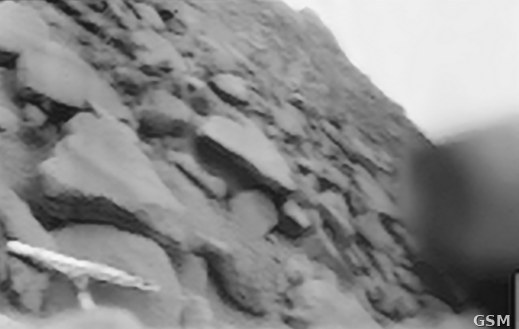
On October 22, 1975, at 05:13 UTC, the lander of the Soviet Union's Venera 9 spacecraft touched down on Venus and worked for 53 minutes in surface conditions of about 90 atmospheres of pressure and about 485 degrees Celsius, transmitting the first photograph ever taken from the surface of another planet. One of its two camera lens covers failed to release, so it returned a 180-degree black-and-white panorama showing scattered rocks instead of a full 360-degree view. Its orbiter simultaneously became the first spacecraft to orbit Venus.
2008: India Launches Its First Lunar Probe, Chandrayaan-1
On October 22, 2008, the Indian Space Research Organisation (ISRO) launched Chandrayaan-1 on a PSLV-C11 rocket from the Satish Dhawan Space Centre at Sriharikota, India. It was India's first mission to the Moon. The spacecraft entered lunar orbit on November 8, 2008, and released an impactor that struck near the lunar south pole. Its instruments later found evidence of water molecules and hydroxyl widely present in lunar soil. The mission ended in August 2009 when communications were lost.
1797: France's Garnerin Makes the First Recorded Parachute Descent
On October 22, 1797, French balloonist André-Jacques Garnerin ascended by hydrogen balloon over Parc Monceau in Paris, France, and at about 3,000 feet (about 1,000 meters) cut the rope connecting him to the balloon, descending under a canvas parachute about 23 feet in diameter. Because the canopy had no vent at the top, the descent swung violently, but he landed uninjured. It was the first well-documented parachute descent by a human; his wife later became the first female parachutist.
1978: Polish Pope John Paul II Is Inaugurated at the Vatican
On October 22, 1978, the inauguration of Pope John Paul II took place in St. Peter's Square, Vatican City. Born Karol Wojtyła in Poland, he had been elected on October 16, becoming the first non-Italian pope in 455 years, at the age of 58. Following his predecessor, he dispensed with the traditional coronation and began his pontificate with a simplified inauguration. He reigned for nearly 27 years and was canonized in 2014; his feast day is kept on October 22, the anniversary of the inauguration.
(Sources: the U.S. National Archives and the John F. Kennedy Presidential Library; the American Physical Society; NASA and Guinness World Records; the Indian Space Research Organisation; the official chronicle of major events of the Communist Party of China published on the Chinese government website; public records of China's National Cultural Heritage Administration; Vatican and EWTN historical materials. Compiled and written by the GSM Newsroom.)
Source: GSM · USA (original Chinese edition)
Photo: 苏联「金星9号」着陆器1975年10月22日传回的金星表面照片,人类第一张从另一颗行星表面拍摄的照片(公共领域,Wikimedia Commons) / The surface of Venus photographed by the Soviet Union's Venera 9 lander on October 22, 1975, the first image ever taken from the surface of another planet (public domain, Wikimedia Commons)