NASA's Psyche Spacecraft Heads at Full Throttle Toward Metal-Rich Asteroid: Arrival Set for 2029
NASA said in a mission update published on October 22, 2026, that its Psyche spacecraft, with a successful Mars gravity assist behind it, has fired up its thrusters and is accelerating toward the metal-rich asteroid of the same name in the main asteroid belt. The spacecraft launched in October 2023 and used its electric propulsion system intermittently during the first leg of its journey to reach the right position to harness Mars' gravity for a propellant-saving speed boost and a slight trajectory change.
According to NASA, the spacecraft began using its propulsion system nearly continuously on September 28, pausing just once each week to check in with mission controllers on Earth. Don Han, the Psyche mission's navigation lead at NASA's Jet Propulsion Laboratory in Southern California, said the thrusters will operate nearly 90 percent of the time from now until the spacecraft reaches the asteroid. The mission remains on track for a rendezvous with the asteroid Psyche in the summer of 2029.
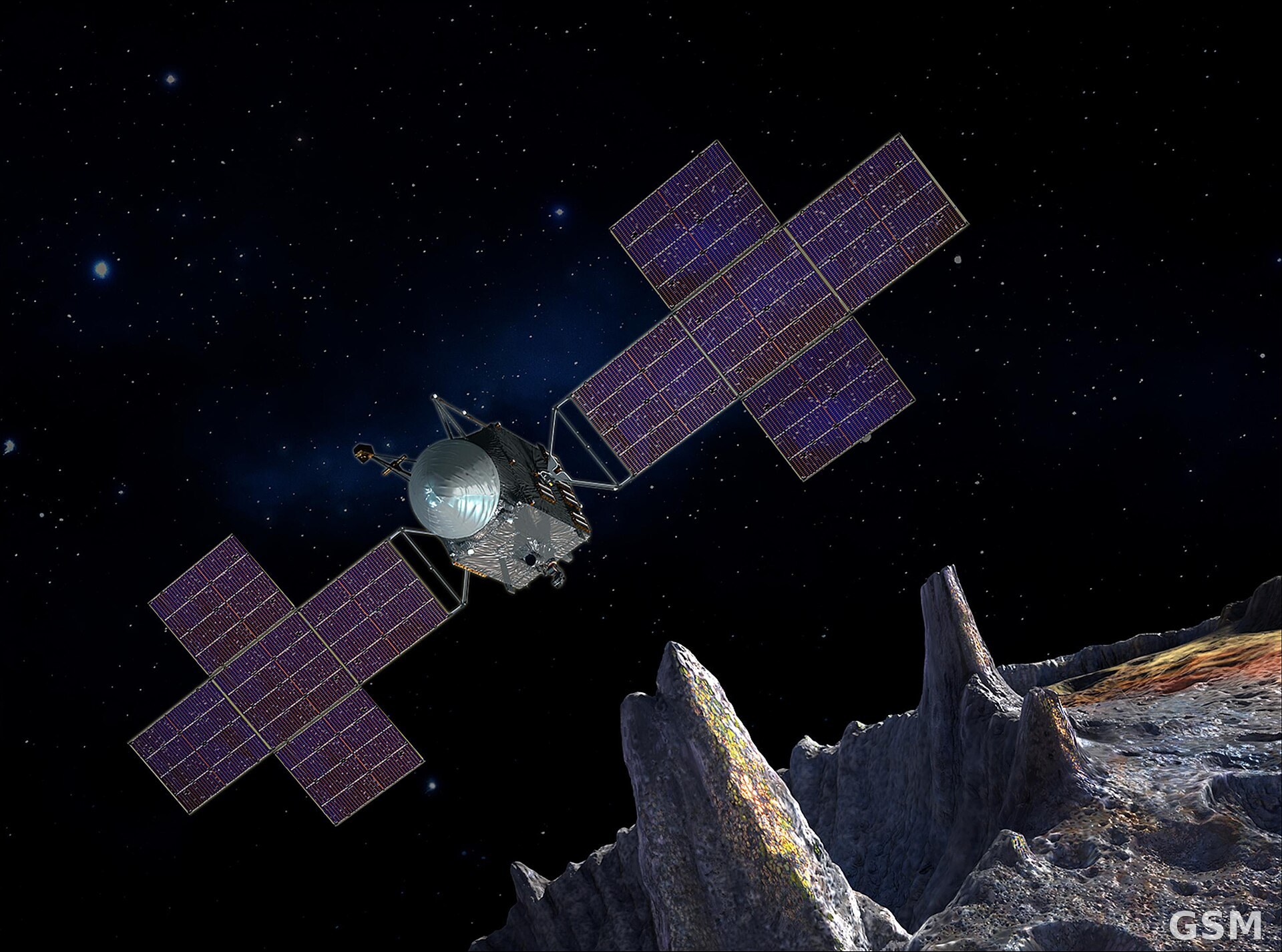
The spacecraft's solar-powered propulsion system uses electromagnetic fields to expel charged atoms of the inert gas xenon, delivering up to 250 millinewtons of thrust, about the force of holding one AA battery. Its four thrusters operate one at a time, and at maximum cruise speed the spacecraft will travel at more than 100,000 mph (160,900 kph) relative to an observer on Earth. Two five-panel, cross-shaped solar arrays with a sunlight-collecting area of 800 square feet (75 square meters) generate its power. The spacecraft launched with nearly 2,400 pounds (1,090 kilograms) of xenon in seven fuel tanks and has used about one third of that supply in the three years since launch.
On arrival in 2029, the spacecraft will enter orbit around the asteroid Psyche, which is about 173 miles (280 kilometers) across at its widest point and is thought to be the partial core of a planetesimal, a building block of an early planet. It will map the asteroid and gather science data over a two-year prime science mission. Lindy Elkins-Tanton, the mission's principal investigator at the University of California, Berkeley, said the Mars flyby was an opportunity to calibrate instruments and practice procedures for a planetary encounter ahead of arriving at the asteroid.
Source: GSM · USA (original Chinese edition)
Photo: 图:Psyche探测器飞向金属小行星的艺术概念图(PIA21499)。图片来源:NASA/JPL-Caltech/Arizona State University/Space Systems Loral/Peter Rubin,美国航天局公共领域图 / Photo: Artist's concept of the Psyche spacecraft (PIA21499). Source: NASA/JPL-Caltech/Arizona State University/Space Systems Loral/Peter Rubin (NASA public domain)