Ninth Circuit Rules Trump's Federalization of California National Guard Unlawful, Newsom Hails Ruling
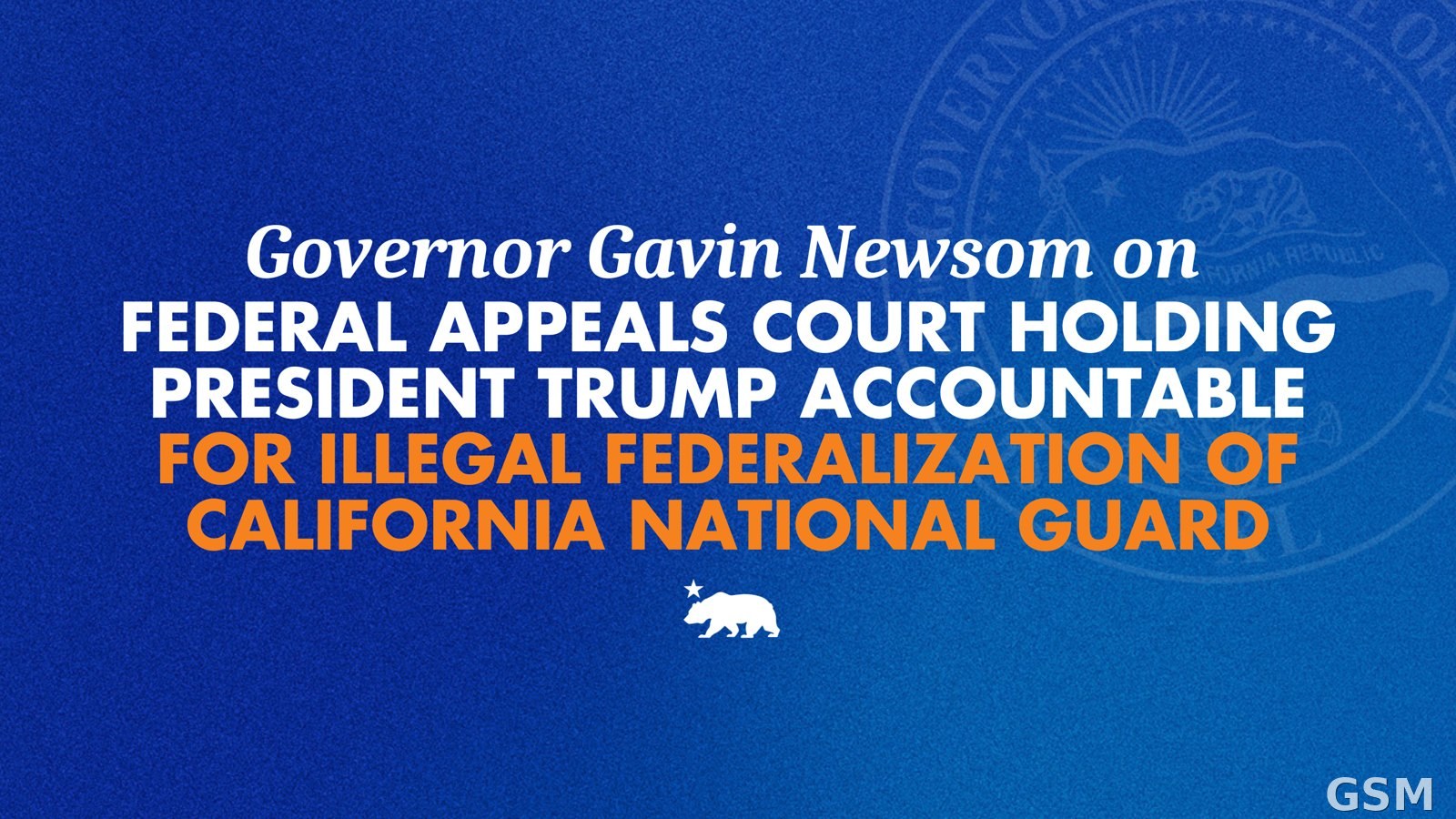
Sacramento — The Office of California Governor Gavin Newsom said on October 23 that the U.S. Court of Appeals for the Ninth Circuit ruled that day in favor of Governor Newsom and the State of California in the state's lawsuit against President Trump over his federalization and deployment of the California National Guard in Los Angeles last year. The Governor's Office said the court held the federalization was an abuse of the President's authority and a "violation of the constitutional separation of powers," creating an essential new legal precedent.
The lawsuit was filed by California Attorney General Rob Bonta on behalf of the Governor and the state. "Today is a crucial day for the rule of law, upholding the Constitution, and defending democracy. Yet another court has issued a complete rejection of Donald Trump's illegal, authoritarian takeover of our state's National Guard. California fought back against this potential power grab, and in doing so created essential legal precedent that not only protects Californians but all Americans. California continues to stand as a first line of defense against Donald Trump's authoritarianism," Governor Newsom said.
"Once again, the courts have rejected the Trump Administration's attempts to circumvent the law for his own political agenda," Attorney General Bonta said in the same statement. "Deploying the National Guard in Los Angeles with no rhyme or reason was a clear example of federal overreach, and it will not be tolerated. When the President tramples on the Constitution and the rights of Californians, we'll fight to hold him accountable — and we will win."
The Governor's Office said the decision builds on precedent set by the U.S. Supreme Court last December, which held that President Trump's federalization of the Illinois National Guard was illegal. It said the Supreme Court's opinion rejected one argument the President had raised for federalization, while the Ninth Circuit's decision in California's case also rejected the President's assertion that there was a "rebellion" in Los Angeles warranting federalization, which the court held was not "a colorable assessment within a 'range of honest judgment.'" The Governor's Office called the rejection of the "rebellion" claim a critical safeguard ahead of next month's elections.
On the background of the case, the Governor's Office said that in June 2025, following President Trump's call to arrest Governor Newsom, Attorney General Bonta filed the lawsuit to end the takeover of a California National Guard unit, which it said needlessly escalated chaos and violence in the Los Angeles region.
The Attorney General's Office also recounted two earlier rulings in the litigation. In August 2025, after a three-day trial, the district court granted a permanent injunction over the use of Guard troops for civilian law enforcement in Los Angeles under the Posse Comitatus Act, barring the federal government from engaging in the same or similar activity in the future; that order is temporarily paused while the Ninth Circuit holds the federal government's appeal in abeyance. In October 2025, California secured a final ruling blocking the cross-state deployment of California National Guard troops to Portland, Oregon, which held that the deployment exceeded federal authority and violated the Tenth Amendment.
The Governor's Office said that under the California Constitution, Governor Newsom is the Commander-in-Chief of the California National Guard. The lawsuit argued that the federal government overstepped its legal authority and bypassed the Governor's approval to take over the unit, in a situation where federal intervention was not needed and did not meet the criteria for federalization. It said the unrest in Los Angeles was nowhere close to rising to the level of a "rebellion" beyond the capacity of local and state authorities to control, nor different in kind from other similar situations in recent years brought under control by local authorities with no need for military intervention.
In its legal reasoning, the Ninth Circuit ruled 2-1 in an opinion by Judge Jennifer Sung, joined by Judge Eric D. Miller, who also filed a concurrence; Judge Mark J. Bennett dissented. The majority held that the Los Angeles protests were not a "rebellion or danger of a rebellion" under 10 U.S.C. § 12406(2), so that provision did not authorize the federalization order, and it read "regular forces" in § 12406(3) to mean the regular U.S. military, finding the government had not shown it was unable to execute the laws with those forces. The case is Newsom v. Trump, No. 25-3727. Earlier in the case, U.S. District Judge Charles Breyer held the federalization illegal and ordered control returned to the governor, an order the Ninth Circuit initially stayed; about 700 Marines were also sent to the Los Angeles area, and in December 2025 President Trump announced the withdrawal of Guard troops deployed in Los Angeles and other cities. The ruling is the final merits decision in the case.
In a separate order the same day, the panel also denied the Trump Administration's motion to withdraw its appeal of the temporary restraining order. According to the court's order, Federal Rule of Appellate Procedure 42(b) provides that an appeal "may" be dismissed on the appellant's motion, so dismissal is not mandatory, and the panel exercised its discretion to deny the motion, reasoning that the appeal was not moot because a merits decision could still prevent federalization under similar circumstances in the future, that the court and the parties had already invested substantial time in the case, and that allowing withdrawal would encourage strategic manipulation of precedent.
The Trump Administration had issued no public statement on the ruling as of publication; according to published reports, the White House did not immediately respond to a request for comment.
Published by GSM · USA (original Chinese edition)
Photo: 图:加州州长纽森在 Sacramento 发表讲话。加州州长办公室2026年10月23日随本案声明发布的官方图片。 / California Governor Gavin Newsom speaking in Sacramento. Official image released by the Office of the Governor of California on October 23, 2026, with its statement on this ruling.