NASA Dragonfly Completes First Full Simulated Flight: Launch No Earlier Than 2028, Arrival at Titan in 2034
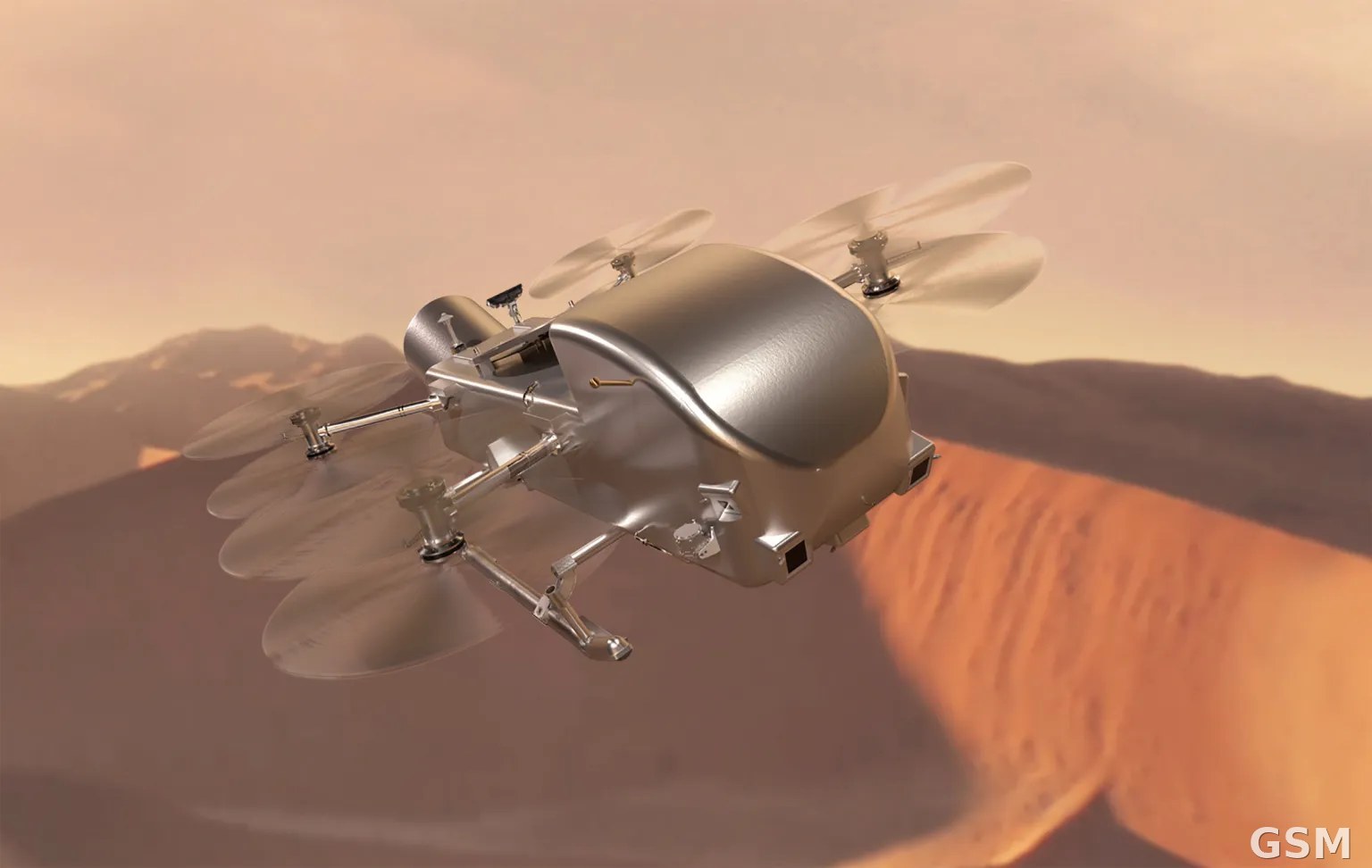
NASA announced on October 23 that its Dragonfly rotorcraft has completed the most comprehensive simulation to date of its first flight, running the full sequence in real time on flight-like avionics at the Johns Hopkins Applied Physics Laboratory (APL) in Laurel, Maryland — the same maneuvers the rotorcraft will perform when it arrives at Titan in 2034.
In the simulation, Dragonfly separated from its protective backshell, sped autonomously over Titan's sand dunes, scanned the terrain below for a safe landing site, then turned, descended and touched down at the selected location. The test combined flight software and avionics with simulated input from the sensors Dragonfly will use at Titan, including its newly installed navigation cameras, inertial measurement units and lidar system. The team generated simulated terrain for the lidar and produced, in real time, the images the navigation cameras would see; a custom camera emulator used graphics processing units to render each simulated Titan scene in roughly the same 20 to 70 millisecond exposure times the cameras will use in flight.
"The cool thing about first flight is that it's our most challenging flight," said Zach Putnam, Dragonfly mobility subsystem lead engineer at APL. "It uses every piece of flight sensor hardware on the lander." Putnam said the tests validate that everything works together. The team built the capability incrementally, starting with simulations of a single rotor spinning, then a short reposition flight and a partial scouting flight, adding sensors and capabilities at each step; adding lidar, which measures terrain altitude and slope and identifies hazards, provided the final piece needed to fully simulate the first flight.
Testing is also underway on the "pose" mechanism that must lower Dragonfly below its entry system's backshell so it can start its rotors before separation and begin its final descent. Engineers at Lockheed Martin in Colorado, where Dragonfly's cruise stage and entry, descent and landing assembly are coming together, conducted static tests with representative mass to verify the mechanism can withstand expected loads, and deployment tests at different tilt angles to confirm it lowers smoothly and locks securely even as the backshell swings beneath its parachute — a transition that must work reliably nearly a billion miles from Earth.
Dragonfly is scheduled to launch no earlier than 2028 on a six-year voyage to Saturn's moon Titan, where it will spend three years flying between sites to study the chemistry, geology and atmosphere of the Earthlike moon and advance understanding of life's chemical origins. Next, the team plans to run the first flight on Dragonfly's actual flight system rather than a testbed, test other flight profiles, and deliberately introduce faults to make sure the rotorcraft can respond autonomously at Titan, where no real-time help from Earth is possible.
Source: GSM · USA (original Chinese edition)
Photo: NASA 蜻蜓号旋翼飞行器飞越土卫六沙丘概念图。图片:Steve Gribben / NASA / Johns Hopkins APL,公共领域,经 Wikimedia Commons