FDA Approves Talazoparib With Enzalutamide for HRR Gene-Mutated Metastatic Hormone-Sensitive Prostate Cancer, Cutting Risk of Progression or Death by 52%
WASHINGTON — The U.S. Food and Drug Administration (FDA) on October 26 approved talazoparib (Talzenna) in combination with enzalutamide (Xtandi) for metastatic androgen pathway modulation-naïve or -sensitive prostate cancer with homologous recombination repair (HRR) gene mutations — metastatic hormone-sensitive (castration-sensitive) prostate cancer. The decision expands the combination into an earlier stage of disease, following its 2023 approval for HRR gene-mutated metastatic castration-resistant prostate cancer.
The approval is based on the Phase 3 TALAPRO-3 trial (NCT04821622), which enrolled 599 men with HRR gene-altered metastatic castration-sensitive prostate cancer. Participants were randomized to talazoparib 0.5 mg daily plus enzalutamide 160 mg daily (300 patients) or placebo plus enzalutamide (299 patients). The combination cut the risk of radiographic progression or death by 52% (hazard ratio 0.48; 95% CI, 0.36-0.65). Median radiographic progression-free survival was not reached in the combination arm, versus 45.8 months in the control arm; at three years, 77% of patients on the combination were free of progression, compared with 56% on enzalutamide alone. The benefit was consistent across patients with BRCA and non-BRCA HRR gene alterations.
Overall survival data remain immature: an interim analysis showed a hazard ratio of 0.77 (95% CI, 0.56-1.04), with three-year overall survival of 78% in the combination arm and 72% in the control arm, a difference that has not reached statistical significance. The most common adverse events in the combination arm were anemia, fatigue, and decreased neutrophil count; grade 3 or higher anemia occurred in 51% of patients, and serious adverse events were reported in 42% of the combination arm versus 32% of the control arm. Pfizer said the safety profile was consistent with the known profiles of each agent, with no new safety signals.
"For men living with metastatic prostate cancer, intervening during the hormone-sensitive stage represents an important opportunity to delay progression before the disease becomes more difficult to manage," said Jeff Legos, Pfizer's Chief Oncology Officer, adding that the data also reinforce the importance of biomarker testing to inform treatment decisions as early as possible. According to Pfizer, alterations in DNA damage repair genes such as HRR genes are found in approximately 25% of metastatic prostate cancers and are associated with a worse prognosis.
Talazoparib is an oral PARP inhibitor and enzalutamide is an androgen receptor pathway inhibitor; both are marketed by Pfizer. With this approval, patients with HRR gene-mutated metastatic prostate cancer can receive the combination during the hormone-sensitive stage rather than waiting until the disease becomes castration-resistant.
Source: GSM · USA (original Chinese edition)
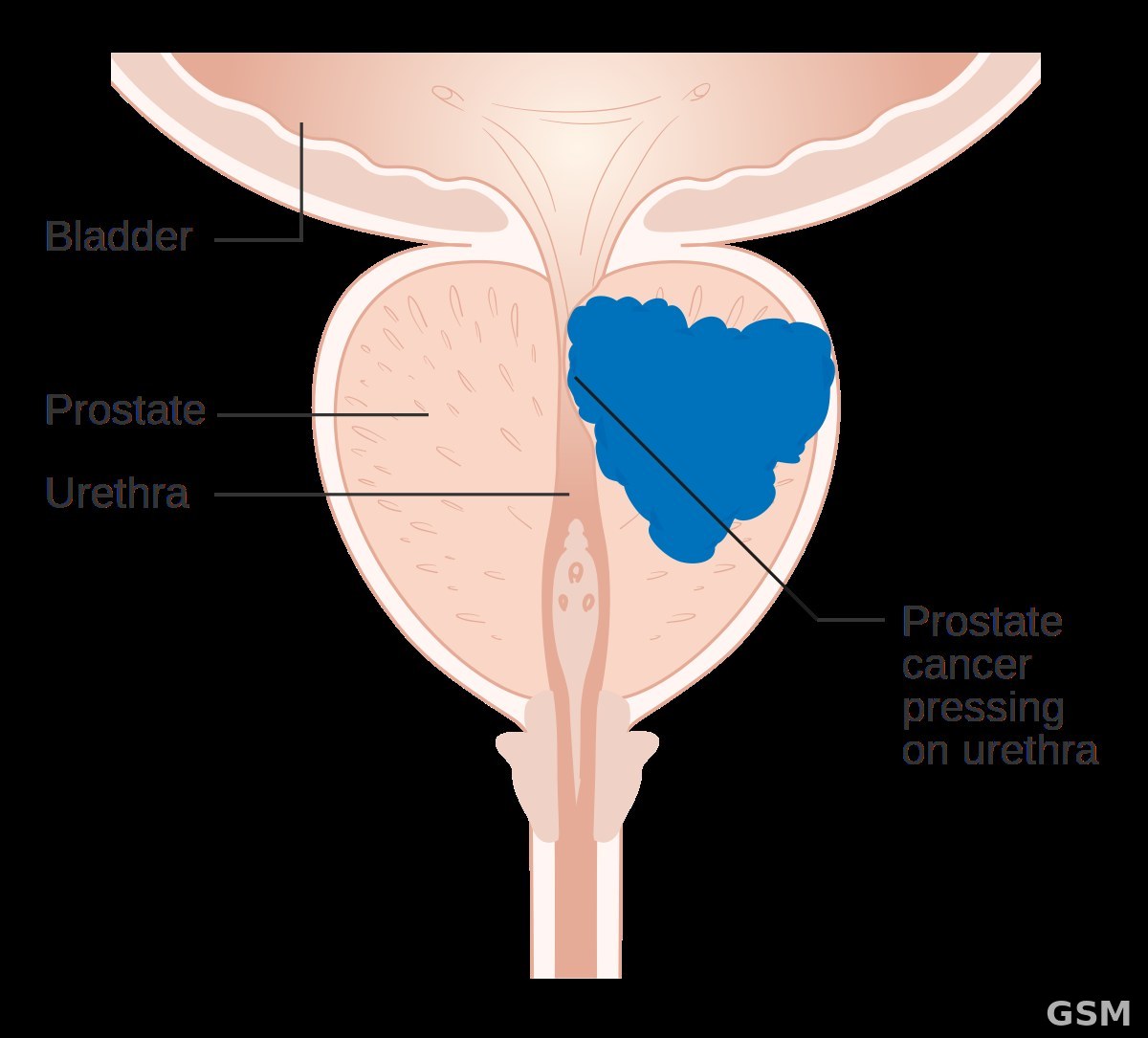
Photo: 图:前列腺癌压迫尿道示意图(资料图)。Cancer Research UK,CC BY-SA 4.0,经维基共享资源。 / Diagram of a prostate cancer pressing on the urethra (file image). Cancer Research UK, CC BY-SA 4.0, via Wikimedia Commons.