NOAA Study: After Bering Sea Marine Heatwave Collapsed Snow Crab, Snow-Tanner Hybrid Crab Surged More Than 13-Fold
NOAA Fisheries on October 26 published a study finding that after the 2018-2019 Bering Sea marine heatwave catastrophically collapsed the snow crab population, the abundance of snow-Tanner crab hybrids increased by more than 13 times; by 2025, commercial-sized male hybrids had spiked from less than 10 percent of harvestable males to 41.7 percent. The study, by scientists at the Alaska Fisheries Science Center's Kodiak Laboratory, was published in the Proceedings of the National Academy of Sciences (PNAS).
"These results are unprecedented," said study lead Erin Fedewa. "We were shocked by the magnitude of the hybrid surge while analyzing data from the 2025 eastern Bering Sea bottom trawl survey. It immediately became clear that this ecological response would ripple through to fisheries management." Using dynamic structural equation models, the team found that warmer waters and reduced sea ice did not directly boost hybrid or Tanner crab survival, and that the surge was not driven by increased spatial overlap between breeding adult snow and Tanner crabs. Instead, the loss of billions of snow crabs after the heatwave released hybrids and Tanner crabs from competition and predation; the modeling attributed 76 percent of the surge to these indirect effects of the snow crab collapse. Tanner crab abundance also reached its highest level on record in 2025.
The surge poses an immediate management dilemma: male hybrids can be legally harvested and landed as snow crab during the directed winter fishery, yet because hybrids were historically so rare, the federal fishery management plan never set hybrid-specific harvest limits. In 2025, state managers responded to the initial hybrid pulse by increasing the snow crab harvest limit in hopes that fishermen would target and land hybrids. Co-author Emily Ryznar said this year's eastern Bering Sea bottom trawl survey found even more commercial-sized male hybrids than in 2025, making this a continuing challenge for decision makers.
"This study marks the first time an increase in hybridization has been attributed to a discrete marine heatwave event," Fedewa said. The researchers conclude that marine heatwaves can produce ecological surprises that challenge rigid management frameworks, and that more flexible, climate-adaptive management and scenario planning will be critical.
Source: GSM · USA (original Chinese edition)
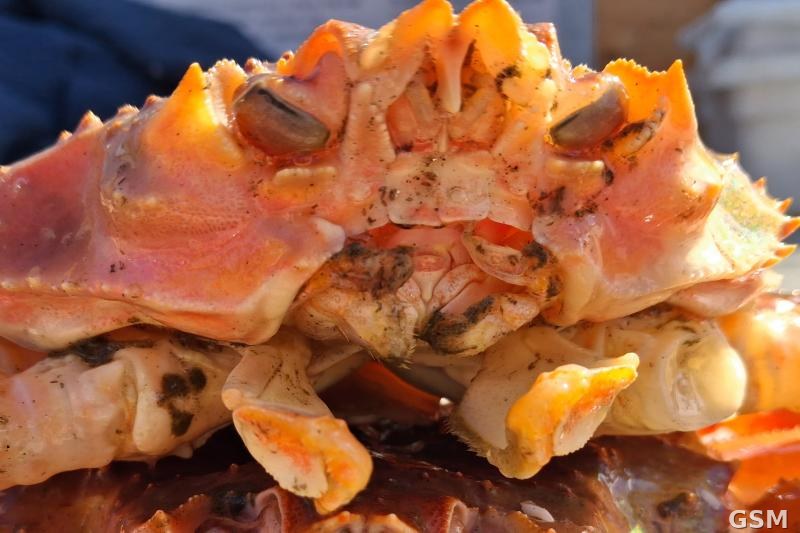
Photo: 图:2026年白令海东部底拖网调查采集的雪蟹与Tanner蟹杂交蟹特写,其弯曲的口部为区别于亲本物种的中间形态特征。图片:美国国家海洋和大气管理局 NOAA Fisheries / Leah Zacher(公共领域)。Photo: Close-up of a snow-Tanner hybrid crab collected during the 2026 eastern Bering Sea bottom trawl survey, showing its curved mouth. Image: NOAA Fisheries / Leah Zacher (public domain).