NASA's NEO Surveyor Sunshade Completes Solar Array Integration: 20 Feet Tall, 864 Solar Cells Generating 2 Kilowatts
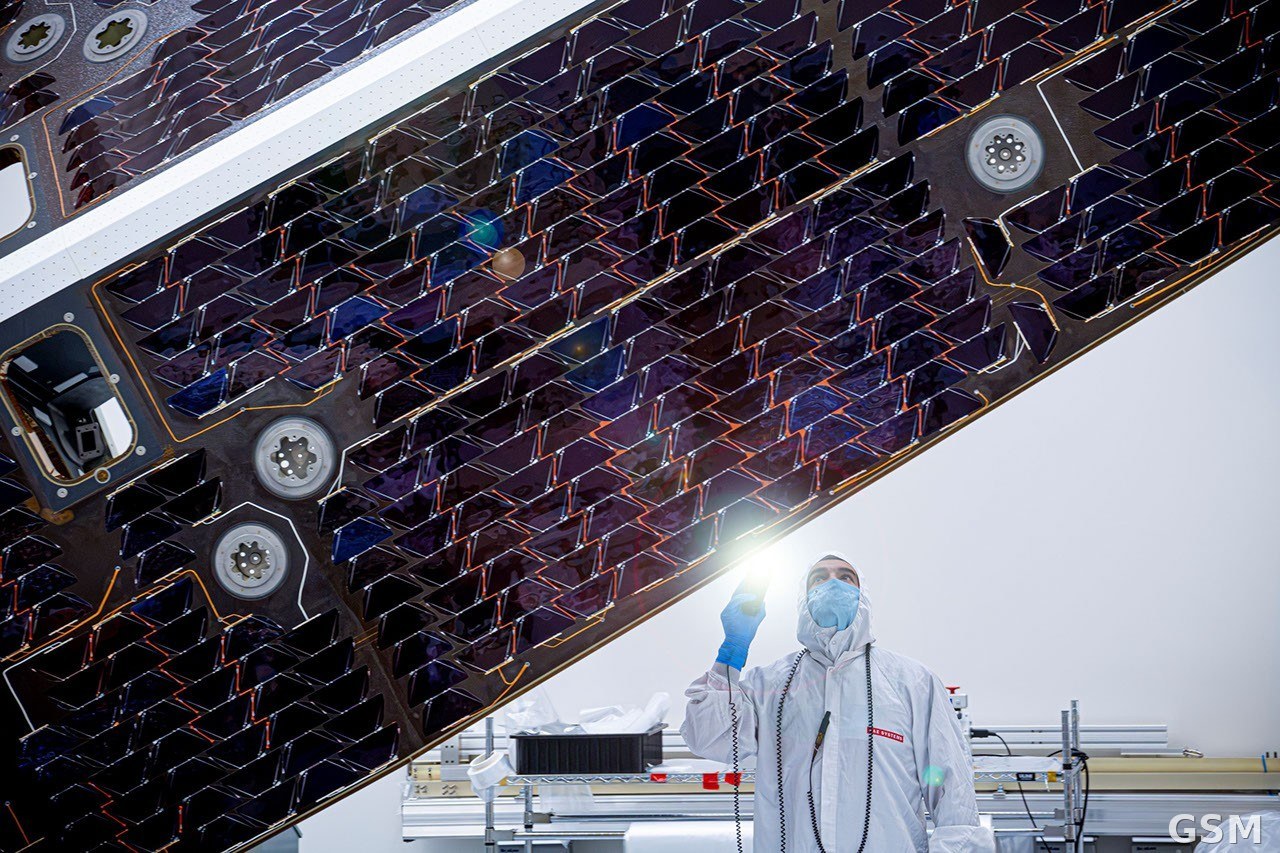
WASHINGTON — NASA said on October 26 that development of its Near-Earth Object (NEO) Surveyor mission continues, as teams recently completed work integrating solar arrays onto the spacecraft's sunshade, the spacecraft's largest component. The sunshade is designed primarily to block the Sun's glare, keeping the infrared space telescope cool as it searches for near-Earth asteroids and comets, while also providing the spacecraft with power.
The sunshade structure stands 20 feet (6 meters) tall and measures 8 feet (2.4 meters) wide at its base. Its two flat panels, joined at a 23.5-degree angle, were covered with 864 interconnected solar cells earlier this year. The specialized solar array can produce up to 2 kilowatts of power and will generate all the electricity required to charge the onboard batteries that power the spacecraft's systems.
In space, NEO Surveyor will detect some of the hardest-to-find asteroids and comets, some located in the direction of the Sun — a region of sky where ground-based optical telescopes have a harder time searching. The sunshade's design is key to blocking sunlight from entering the telescope's 20-inch-wide (50-centimeter-wide) aperture as it searches for infrared emissions from the surfaces of asteroids and comets heated by sunlight. By determining their location and motion, the mission's data will help NASA better understand the number and nature of potentially hazardous near-Earth objects. The telescope's pair of infrared detector arrays images the sky in two infrared bands, each array creating a 16-megapixel mosaic; comparing the two bands lets scientists determine an object's temperature and estimate its size.
The sunshade structure was built by Applied Aerospace in Stockton, California, and outfitted with its solar cells by SolAero Technologies in Albuquerque, New Mexico, in January. Environmental testing of the sunshade and solar array was completed at a commercial thermal vacuum testing facility in El Segundo, California, in March, and it was delivered ahead of schedule in May to BAE Systems Space & Mission Systems in Boulder, Colorado. Since then, coarse Sun sensors for attitude determination and temperature sensors have been integrated onto the sunshade, and the team has completed functional and performance testing of the solar array.
Source: GSM · USA (original Chinese edition)
Photo: 图:NASA近地天体巡天望远镜(NEO Surveyor)的遮阳罩结构,表面覆有太阳能电池。美国航空航天局 NASA 公共领域图片(PIA26715)。 / The sunshade structure for NASA's NEO Surveyor spacecraft, covered with solar cells. NASA, public domain (PIA26715).