Los Angeles Homelessness in 2026: Count Rises After Two Years of Declines, City Unsheltered Population Nears 29,000 as County Board Votes on Governance Deal
The Los Angeles Homeless Services Authority (LAHSA) released the results of the 2026 Greater Los Angeles Homeless Count on July 24, showing that after two consecutive years of declines, homelessness in the region rose again: an estimated 73,040 people countywide, up 1.2% from 2025, and 45,194 people in the City of Los Angeles, up 3.4%. The authority said neither overall change is considered statistically significant.
The increase was sharper among people living unsheltered. Unsheltered homelessness rose 3.3% countywide and 7.9% in the city, where the unsheltered population is estimated at 29,115. Of the 73,040 people countywide, 49,002 (67%) were unsheltered and 24,038 were sheltered; 32,563 people, or 45% of the countywide total, were experiencing chronic homelessness. The count was conducted over three days in late January 2026.
LAHSA attributed the rise mainly to a pause in enrollments for Time Limited Subsidies, a flexible rental assistance program. Funding reductions forced the pause on new enrollments: the number of people newly housed using the subsidies fell from 10,308 in 2024 to 6,590 in 2025, and the total number of people permanently housed across the region fell to 23,532, about 5,100 fewer than the record 28,625 in 2024. Without the subsidies, movement from interim to permanent housing fell 36% in 2025 (from 12,120 to 7,770), and movement from the street to interim housing fell 8% (from 16,724 to 15,380).
"While statisticians do not consider these shifts statistically significant, we know that these numbers represent real people — real people striving for a permanent home in our region," LAHSA Interim CEO Gita O'Neill said when the count was released. She said the authority's administrative data shows clearly why progress stalled and what it will take to get back on track, and she attributed the increase to economic hardship, particularly the cost of living in Los Angeles.
The rise followed two years of declines. In 2019, the county counted 58,936 people experiencing homelessness and the city 35,550; the crisis peaked in 2023 at 75,518 countywide and 46,260 in the city; 2024 brought the first decline, to 75,312 countywide and 45,252 in the city; and 2025 fell further. The 2025 count was later revised slightly after a review by the U.S. Department of Housing and Urban Development: the countywide total was adjusted from 72,308 to 72,195 and the city total from 43,699 to 43,695, changes of fewer than 150 people that LAHSA said fell within the margin of error and were statistically insignificant.
The 2025 count also showed two other figures: street dwellings across the region fell 12.6%, and in the city they fell from 12,717 in 2024 to 11,010, a drop of about 13.5%; unsheltered children and teenagers under 18 rose nearly 22%, from 1,558 to 1,897, and unsheltered families with children rose 18%, from 903 to 1,067. When it released the 2025 count, LAHSA said the region still needs more than 485,000 affordable housing units to meet demand.
The counting method itself is disputed. RAND Corporation's independent enumeration diverged further from the official numbers in 2025–26, and RAND researchers estimated that in Skid Row the official count missed about 39% of the population identified by RAND's professional enumeration. The researchers said the gap reflects differences between two methodologies, not proof that the official count is wrong.
As the numbers rose, the city and county fought over who controls the system. LAHSA was created in 1993 as a joint powers authority of the city and county, coordinating federal, state, county and city funds. The U.S. Department of Housing and Urban Development suspended the authority's access to federal funds over allegations of fraud and misuse of taxpayer money, and LAHSA sued to overturn the suspension; the case is ongoing. The county then created its own Department of Homeless Services and Housing, which launched on July 1; Fox Los Angeles reported that the county diverted more than $300 million to establish the department.
The four administrative roles control about $240 million a year in federal homelessness money, deciding how the region applies for and spends it, who is tracked in the system and who is placed in permanent supportive housing. Earlier in October, the general membership of the Los Angeles Continuum of Care voted 331–9 to award the county two of the roles — serving as collaborative applicant and lead for the annual point-in-time count. On Friday, the City Council voted 10–0 to support a tentative city-county agreement, and on Monday, October 26, the Continuum of Care general membership awarded the county the two remaining roles — oversight of the Homeless Management Information System (HMIS) and the Coordinated Entry System (CES). The County Board of Supervisors is scheduled to vote today, October 27, on whether to let the county's Department of Homeless Services and Housing and its Housing department sign two agreements with the city; final authority over the four roles remains subject to review by a federal judge.
Under the tentative agreement, the county would contract with the city to manage the matching process for all city-funded resources, giving people experiencing homelessness within the city priority for city housing; the city would keep its current access to system data and gain all data on unhoused people within city limits, including those in county-funded programs; and the county would pay for training, technical assistance and reasonable system changes requested by the city.
The city had sought the two roles, arguing that Los Angeles needs more say over its own homelessness programs and housing placements, and that the city builds and funds a disproportionate share of the housing while the county placed people from other cities into beds paid for by city taxpayers. County Supervisor Kathryn Barger said after the Continuum of Care vote that the agreement was an opportunity to strengthen accountability in administering federal funding and coordinating services, and that the day's vote was a positive step toward a more coordinated and accountable regional response. Kimberly Farnham, director of the Los Angeles Housing Department's Homelessness Oversight Bureau, said she strongly believes a shared governance model best serves the system, and that the city asked not just for direct access but for inclusive data management and system development so it can regularly validate data accuracy.
Councilwoman Ysabel Jurado, who chairs the council's Homelessness and Health Committee, told Friday's City Council meeting that the proposed agreement was "an increase from what we've had before," giving the city current system data plus the raw data underneath it so the city can produce its own reports and dashboards in real time: "That's something we've never had." Councilman Tim McOsker raised concerns about the enforceability of the agreement and its proportional representation provisions, saying the county should not be rewarded for parts of the county that drive homelessness into the city of Los Angeles without providing alternatives. Continuum of Care board chair Ben Kay wrote to the mayor, City Council and county supervisors on October 14 that the dispute had shifted from "a united front against federal encroachment to splintered infighting," risking the chance to keep local control and head off further federal involvement.
Street-level operations continue. Mayor Karen Bass's Inside Safe team reported on October 3 that it had brought more than 6,200 Angelenos inside to date: its 143rd operation, on September 29 in Rampart Village, brought 64 people indoors, 59 through Inside Safe and five through other interim housing programs with city and county partners, after police arrested five people who had been preying on people in the encampment; its 144th operation, on October 1 in Pacoima, brought 27 people and their pets into interim housing and removed six RVs. On October 13, the team brought 35 people near Downtown Los Angeles into safe, stable housing and removed six vehicles and 14 RVs. It was the first operation since Governor Gavin Newsom signed Assembly Bill 647, which expands and extends a pilot program to permanently dispose of abandoned RVs valued at $4,000 or less rather than see them sold back onto the streets. The mayor's office said 200 RVs have been removed from city streets in total. Bass said RV operators had long taken advantage of vulnerable Angelenos by selling or renting them unsafe, broken-down RVs that "become deathtraps."
The County Board of Supervisors' vote today, the federal judge's review, and the next annual point-in-time count are the system's next three milestones.
Related: More Homeless People Near My Home — After 26 Years in America, One Corner of the Country I See
Related: Follow-Up: L.A. Continuum of Care Votes to Award County the HMIS and Coordinated Entry Roles
Source: GSM · USA (original Chinese edition)
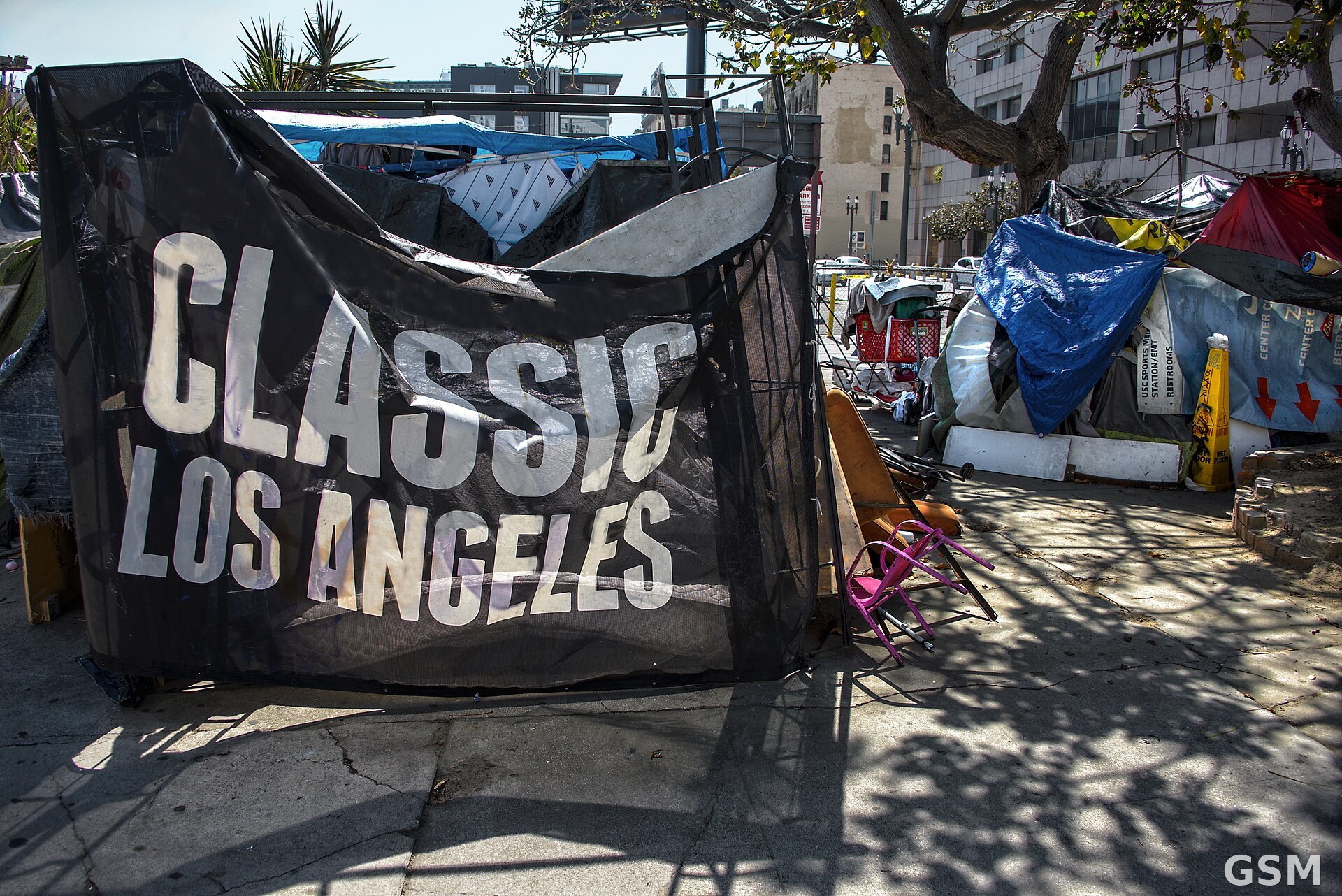
Photo: 洛杉矶市中心 Skid Row 地区的无家可归者营地,2021年3月30日摄。照片:Russ Allison Loar,CC BY-SA 4.0,经维基共享资源。 / A homeless encampment in Skid Row, downtown Los Angeles, photographed March 30, 2021. Photo: Russ Allison Loar, CC BY-SA 4.0, via Wikimedia Commons.
- 2026-10-11LA Homelessness Governance Meeting Collapses After Two Minutes as City-County Power Struggle Escalates
- 2026-10-14L.A. Continuum of Care Votes 331-9 to Name County as Collaborative Applicant and Point-in-Time Count Lead
- 2026-10-15Los Angeles County to Replace LAHSA as Lead Applicant for Federal Homelessness Funds After 310-Vote Regional Ballot
- 2026-10-26Los Angeles City and County Reach Homeless Data-Sharing Agreement: City to Get All City Data and Proportional Representation; Regional Membership to Vote Monday Afternoon, Court Hearing Tuesday to Settle Four Roles
- 2026-10-27Follow-Up: L.A. Continuum of Care Votes to Award County the HMIS and Coordinated Entry Roles
- 2026-10-27Los Angeles Homelessness in 2026: Count Rises After Two Years of Declines, City Unsheltered Population Nears 29,000 as County Board Votes on Governance DealThis story
- 2026-10-29Los Angeles, California: City Reaches Tentative Deal With County to Directly Place Unhoused Angelenos Into City-Funded Housing
- 2026-10-30Los Angeles County, California: County Unveils New Homeless Governance Lineup, With County Department Taking Four Continuum of Care Roles