FCC Votes to Open 800 MHz Cellular Band to Drones, Lifting the 1991 Airborne Ban on 50 MHz for Command, Control and Payload Links
The Federal Communications Commission (FCC) voted at its October 29 open meeting in Washington to remove a restriction dating to 1991 that had barred airborne use of the 800 MHz cellular band, opening 50 megahertz of low-band spectrum in that band to unmanned aircraft systems (UAS).
The order unlocks the 50 megahertz for UAS command, control, communication and payload operations. The FCC said the decades-old airborne restriction is no longer necessary for drones because modern wireless networks employ advanced technologies that prevent UAS from interfering with those networks.
The 800 MHz band was one of the earliest licensed bands for mobile phone service, with the Commission adopting licensing rules for 800 MHz cellular radiotelephone service in 1981. The FCC said unlocking the licensed, nationwide low-band spectrum encourages drone innovation and provides parity with other similar flexible-use bands.
The Commission said it is pursuing a two-pronged strategy of commercializing spectrum access and securing the homeland to support American drone leadership, including a broad proceeding on drone technology, manufacturing and operations reforms, steps to free up spectrum for drones, work with federal partners on cellular networks for drone operations, support for counter-UAS tools for local law enforcement, and action against foreign-produced drones.
The action was taken by Report and Order, FCC 26-72, in GN Docket No. 26-74 and WT Docket Nos. 22-323 and 24-629, with Chairman Brendan Carr and Commissioners Anna Gomez and Olivia Trusty approving; Carr and Trusty issued separate statements.
Source: GSM · USA (original Chinese edition)
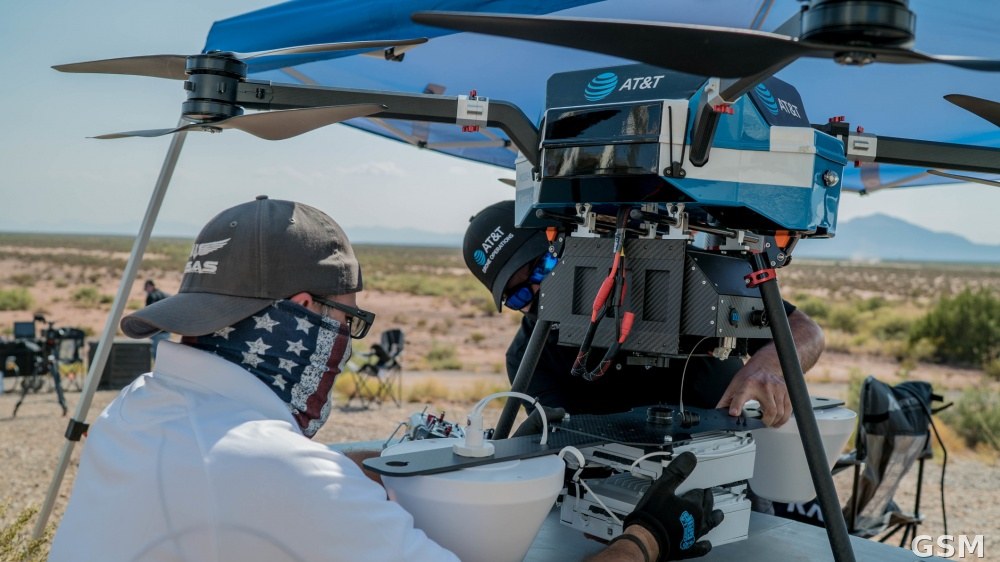
Photo: 图:野外测试现场,技术人员围在一架搭载蜂窝通信设备的大型无人机旁作业。美国空军照片,经 Wikimedia Commons,公共领域。 / Photo: Technicians work on a large drone carrying cellular communications equipment at an outdoor test site. U.S. Air Force photo, via Wikimedia Commons, public domain.