Save $2,000, Get Up to a $1,000 Federal Match: The Saver's Match Starts in 2027 — Who Qualifies and How to Claim It
The Internal Revenue Service (IRS) has announced that beginning in 2027, the federal government will offer the Saver's Match for the retirement savings of low- and moderate-income taxpayers: after an individual contributes to an eligible retirement account, the federal government will match 50% of the contribution, up to $1,000 per person per year, deposited directly into the individual's designated retirement account. The program was created by Section 103 of the SECURE 2.0 Act of 2022 and will replace the current Saver's Credit.
Under the IRS rules, the match is calculated on the first $2,000 contributed per person each year: contributing the full $2,000 while within the full-match income limit yields $1,000, and when both spouses qualify, each is calculated and claimed separately. For 2027, the full 50% match applies at a modified adjusted gross income of up to $41,000 for married couples filing jointly, $30,750 for heads of household, and $20,500 for single filers. Above those levels the match rate phases down, reaching zero at $71,000 for joint filers, $53,250 for heads of household, and $35,500 for single filers. The income limits will be adjusted for inflation after 2027.
Other eligibility requirements include being at least 18 by the end of the tax year, not being claimed as a dependent on another person's return, not being a full-time student, and actually making contributions to a retirement plan or individual retirement account (IRA) during the year, with no minimum contribution required. Contributions may go into employer plans such as a 401(k), 403(b), or governmental 457(b), or into a traditional or Roth IRA; the federal match itself, however, must be deposited into a traditional (pre-tax) retirement account, not a Roth account. A match of less than $100 may instead be elected as a refundable tax credit. The existing Saver's Credit will continue to apply to contributions to ABLE accounts.
Only contributions made in 2027 count under the new program. Taxpayers will claim the match by filing the new Form 8880-A with their 2027 federal tax return in 2028, and the first matching deposits are expected in 2028. The IRS has begun sending CP321J notices to taxpayers who claimed the Saver's Credit on their 2025 return or whose 2025 income fell within the potential eligibility range; receiving the notice does not confirm eligibility, and no action on it is needed in 2026.
The Treasury Department and the IRS issued Notice 2026-48 on August 7, 2026, setting out implementation guidance and requesting public comments. Treasury will also launch TrumpIRA.gov by January 1, 2027, listing low-cost IRA providers that can accept matching deposits. Note that the match requires the taxpayer to contribute to a retirement account first, and the funds are held in the account under retirement rules rather than paid out as cash. The year 2026 is the last year of the Saver's Credit, and those eligible under the old rules may still claim it for the 2026 tax year.
Source: GSM · USA (original Chinese edition)
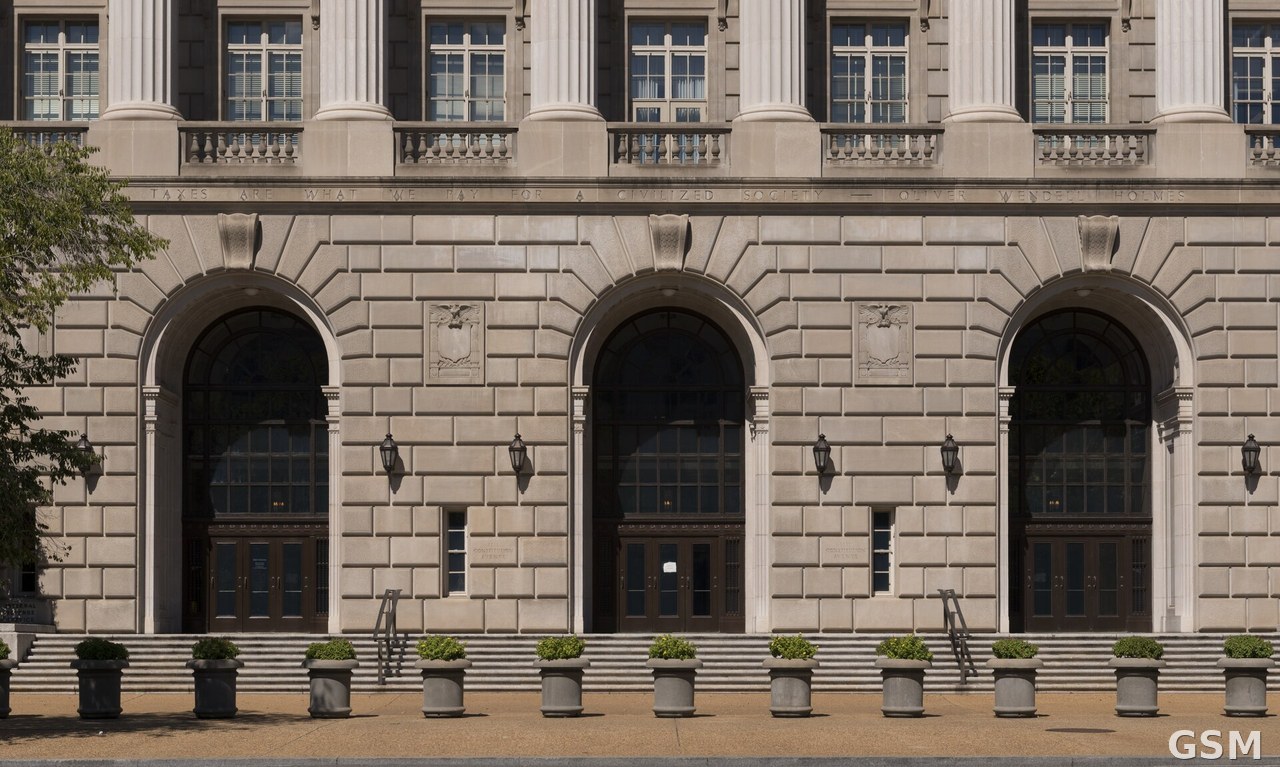
Photo: 图:美国国税局(IRS)总部大楼(GSM联邦机构固定图库)。 / Headquarters of the Internal Revenue Service (GSM federal agency photo library).