Antarctic Ozone Hole Ranks Seventh-Largest in 48 Years in 2026: NOAA and NASA Release Annual Measurements
The National Oceanic and Atmospheric Administration (NOAA) and the National Aeronautics and Space Administration (NASA) on November 4, 2026, released their annual measurements of the 2026 Antarctic ozone hole: fueled by an unusually powerful polar vortex, this year's hole ranked as the seventh-largest in 48 years of monitoring by seasonal mean area, while scientists at both agencies said the ozone layer remains on track to recover later this century.
During the peak ozone depletion season from September 7 to October 13, 2026, the hole covered an average of about 9.6 million square miles (25 million square kilometers), more than twice the area of the United States. The hole reached its greatest extent of the year on September 18, at 10.5 million square miles (27.1 million square kilometers), about 90 percent as large as the largest ozone hole ever observed, on September 9, 2000.
Paul Newman, a senior scientist at the University of Maryland and longtime leader of NASA's ozone research team at the agency's Goddard Space Flight Center, said the annual ozone hole has been forming later in the season in recent years, a sign the ozone layer is healing, but that an unusually powerful polar vortex extended ozone depletion this season and allowed the hole to grow to proportions not seen in a decade. He said this year's hole would have been 1 million to 2 million square miles larger if ozone-depleting substances were as prevalent in the atmosphere today as they were at their year-2000 peak.
Amy Butler, a research scientist at the NOAA Chemical Sciences Laboratory, said planetary-scale weather systems that typically well up from the lower atmosphere and break up the polar vortex were especially weak in August and September, keeping the strongest polar vortex winds several degrees of latitude further from the South Pole and creating a larger area of conditions ideal for ozone depletion.
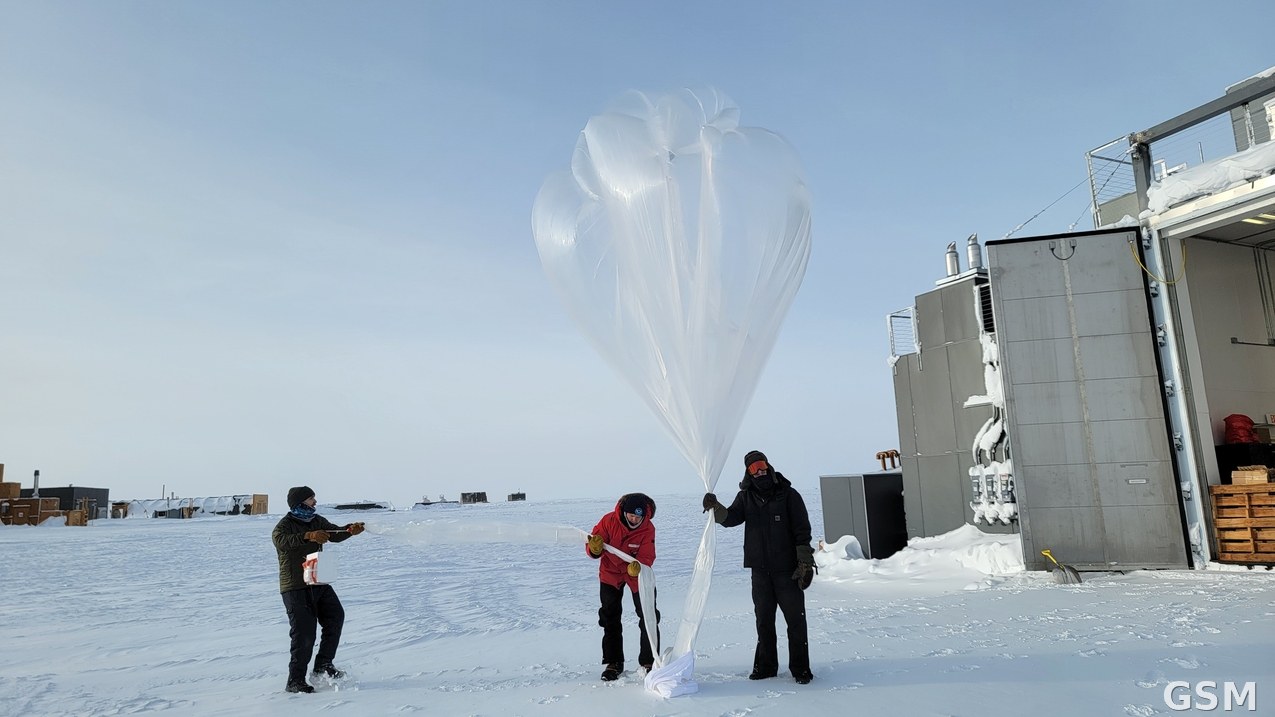
For the measurements, NOAA scientists deploying balloon-borne instruments from the South Pole Baseline Atmospheric Observatory, and using a Dobson ozone spectrophotometer, found ozone concentrations directly overhead reached their lowest value of the year, 105 Dobson units, on October 17; the lowest value ever recorded over the South Pole was 92 Dobson units in October 2006. Instruments aboard NASA's Aura satellite, the NOAA-20 and NOAA-21 satellites, and the Suomi National Polar-orbiting Partnership satellite, jointly operated by NASA and NOAA, also contributed to the annual monitoring.
The two agencies said controls established by the Montreal Protocol in 1987 continue to drive long-term recovery of stratospheric ozone. Stephen Montzka, a senior scientist at NOAA's Global Monitoring Laboratory, said chlorine levels in the Antarctic stratosphere derived from ozone-depleting substances have declined by about a third relative to levels reached in the 1980s. Scientists estimate the ozone hole will recover by the 2070s as the older compounds continue to break down.
(Source: National Oceanic and Atmospheric Administration)
Source: National Oceanic and Atmospheric Administration
Published by GSM · USA (original Chinese edition)
Photo: 图:科研人员在南极的南极点大气基线观测站放飞臭氧探测气球(2026年10月18日),NOAA与NASA的年度臭氧洞测量正使用这类气球仪器。照片:美国国家海洋和大气管理局(NOAA),公共领域。 / Photo: Researchers launch an ozone-sounding balloon at the South Pole Baseline Atmospheric Observatory in Antarctica on October 18, 2026; balloon-borne instruments of this kind are used in the NOAA and NASA annual ozone hole measurements. Photo by the National Oceanic and Atmospheric Administration (NOAA), public domain.