New Hubble Image of Globular Cluster Messier 30 Offers a Lesson in Galactic History
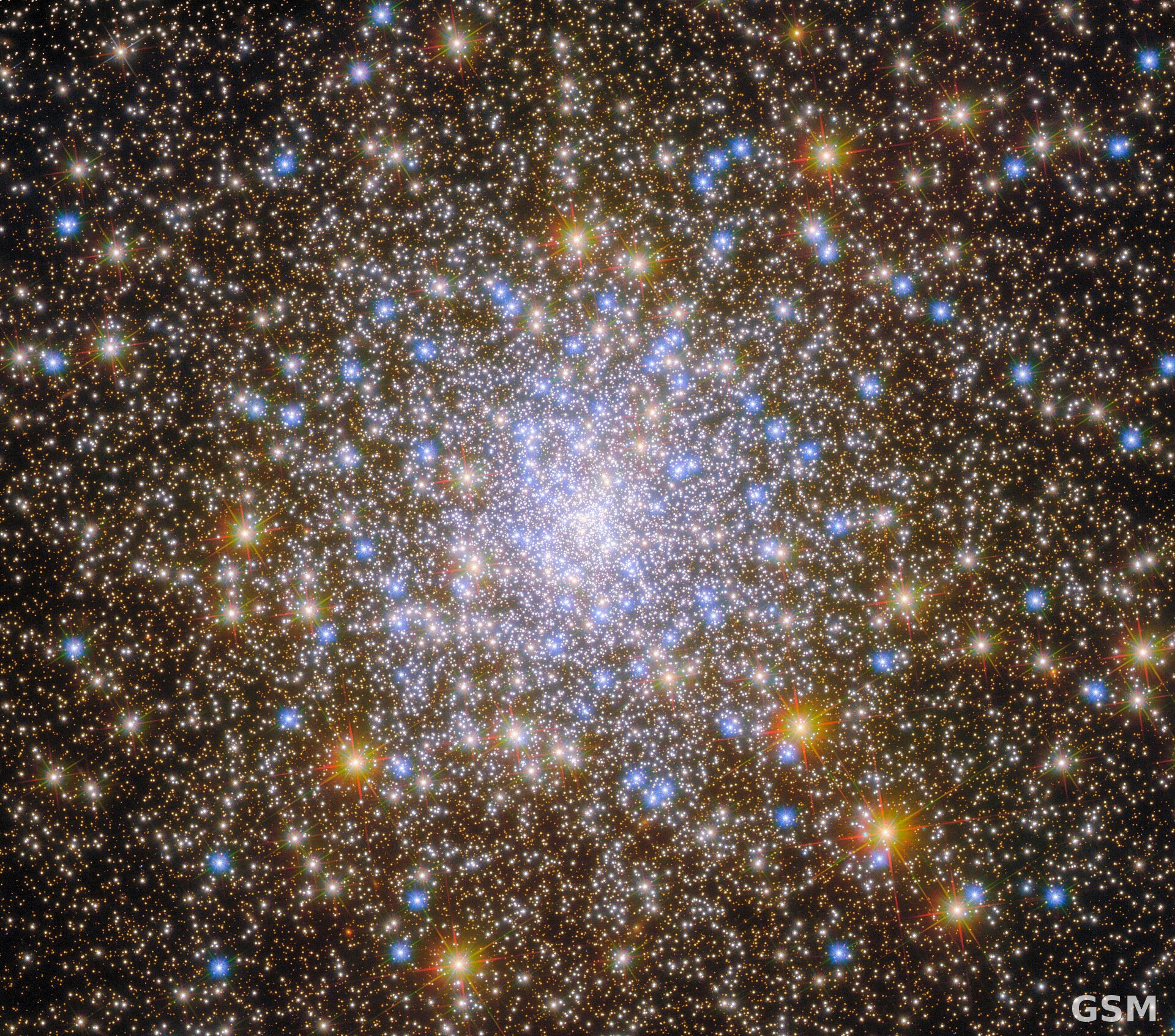
NASA released a new Hubble Space Telescope image on November 5: the sparkling globular cluster Messier 30 (M30, also cataloged as NGC 7099), which the agency says provides a lesson in galactic history.
M30 lies about 27,500 light-years away in the constellation Capricornus. It is named after the French astronomer Charles Messier, who cataloged M30 and other diffuse objects that might be mistaken for comets. A globular cluster is a roughly spherical collection of anywhere from tens of thousands to millions of stars, generally residing on the outskirts of galaxies within a vast, diffuse halo. Our Milky Way has at least 150 globular clusters, the nearest about 6,000 light-years away.
These clusters are impressively ancient: astronomers estimate their ages at between 11.5 and 13.5 billion years, making some nearly as old as the universe itself. More than a century ago, astronomer Harlow Shapley used a type of variable star to measure the locations of and distances to dozens of globular clusters, showing that the Sun is not at the center of our galaxy and that the galactic center lies toward the constellation Sagittarius.
Because they are so ancient, globular clusters can act as time capsules preserving the original chemistry of our young galaxy. But not all of them formed here: researchers have discovered that M30 and many other globular clusters orbit in the direction opposite to the way our galaxy spins, which may mean the Milky Way captured them in the distant past.
Hubble has observed M30 multiple times. An earlier image came from an Advanced Camera for Surveys program (#10775) that surveyed dozens of Milky Way globular clusters in red and near-infrared light, revealing stars down to just 20% of the Sun's mass. A later Wide Field Camera 3 program (#13297) revisited M30 in bluer light to study exotic 'blue straggler' stars and the multiple populations of stars within a single cluster. More recently, the ACS viewed many of these clusters again (program #16298) to track how different populations of stars moved over the 15 years since Hubble first observed them.
The image released on November 5 was created with data from all three observing programs, spanning ultraviolet, visible, and near-infrared light; each wavelength helps astronomers better understand how these groups of stars formed and evolved. Text credit: ESA/Hubble. (Source: NASA)
Source: NASA
Published by GSM · USA (original Chinese edition)
Photo: 图:哈勃空间望远镜拍摄的球状星团 Messier 30(M30)。ESA/Hubble 与 NASA 摄,M. Libralato、G. Piotto、A. Sarajedini,CC BY 4.0,经 Wikimedia Commons。 / Photo: The globular cluster Messier 30 (M30) imaged by the Hubble Space Telescope. ESA/Hubble & NASA, M. Libralato, G. Piotto, A. Sarajedini, CC BY 4.0, via Wikimedia Commons.