Between 21% and 42%: Chinatown's Ballot in Chicago
1. The numbers first: a scorecard drawn precinct by precinct
On November 6, 2026, Chinatown Spotlight, the publication of the Coalition for a Better Chinese American Community (CBCAC), published its review of the midterm elections, written by its editor, Shuxi. Compiling Chicago Board of Elections figures as of 3 p.m. on November 4, the review put citywide turnout in Chicago at 42.03%.
Within the same city, the numbers step down as one moves toward the neighborhoods where Chinese residents are concentrated. The 11th Ward, covering Chinatown and Bridgeport, recorded turnout of 35.86% — 6.17 percentage points below the citywide figure. The 12th Ward, which includes McKinley Park and Brighton Park, stood at 35.5%. Deeper in, in the core precincts where Chinese residents are most concentrated, turnout was lower still: 28.52% in Precinct 1, 22.72% in Precinct 2, and 20.98% in Precinct 7.
The 20.98% figure is worth pausing on: it is almost exactly half the citywide rate of 42.03%. In the most closely watched midterm election in years, roughly one in five registered voters cast a ballot in the heart of Chinatown, while across the city more than two in five did. Precinct 1 trailed the city by 13.51 points, Precinct 2 by 19.31 points, and Precinct 7 by 21.05 points. Even measured against their own ward's average of 35.86%, the three core precincts ran 7.34, 13.14 and 14.88 points behind — the gap exists not only between ward and city, but inside the ward itself: the closer to the core of Chinatown, the lower the turnout.
One caveat belongs up front: this is a snapshot, not a final score. The CBCAC review noted that mail ballots were still being returned and counted, and under Chicago's rules, ballots postmarked by Election Day continue to be counted after it. The final certified figures for the city, the wards and the precincts will all be higher than the November 4 snapshot. But the structure the snapshot reveals is already clear: at every level — city, ward, precinct — the numbers descend in the same direction.
The review also recorded how Chicago voted: 211,657 people voted early in person, and 109,215 mail ballots had been counted by Election Day. The Chicago Board of Elections had previously projected that overall turnout could surpass the 2022 midterms.
2. The city itself was not quiet: lines, ballot shortages and an early-voting surge
Citywide, November 3 in Chicago was not a quiet day. According to Chicago Board of Elections figures cited in local Election Day reporting, 232,672 people had voted in person by 3:15 p.m., ahead of the 227,633 recorded by the same time in the 2022 midterms, and in-person early voting was up about 24% from 2022. Several polling places saw lines and temporary shortages of paper ballots; the Board said the shortages were concentrated in split precincts where overlapping boundaries require as many as seven different ballot combinations, and that additional ballots were being printed and delivered from its McKinley Park warehouse and downtown offices. Board spokesperson Julie Metea confirmed that any voter in line by the 7 p.m. closing time was legally entitled to vote.
In other words, this was not an election in which nobody showed up. The city's participation had an early-voting surge and Election Day crowds to show for itself; Chinatown's core precinct numbers were recorded in the middle of a high-energy election. That is the first piece of context for the 20.98%.
The second is suburban Cook County. The office of County Clerk Monica Gordon reported more than 250,000 early votes by the day before the election, up 31% from the same point in 2022, with nearly 107,000 mail ballots already returned. The whole metropolitan area was moving forward; the core of Chinatown was moving noticeably more slowly.
3. The 11th Ward's past: from mayoral cradle to the city's first Asian American majority ward
Understanding the 11th Ward's 35.86% requires knowing whose ward it is.
Few wards carry more weight in Chicago politics: the 11th was the base of the Daley family and produced five mayors in the 20th century, including Richard J. Daley and Richard M. Daley. Bridgeport was traditionally an Irish American enclave, with Chinatown's Armour Square next door. The population has been quietly rewritten over recent decades: according to the Chicago Metropolitan Agency for Planning, Asian residents in Bridgeport have surpassed white residents to become the area's largest ethnic group.
The turning point came in 2022. The sitting 11th Ward alderman, Patrick Daley Thompson, was removed after a federal tax fraud conviction made him ineligible to hold office, and Mayor Lori Lightfoot appointed Nicole Lee to the seat. Born and raised in Chinatown, Lee became the first Chinese American and the first Asian American woman to serve on the Chicago City Council, and only its second Asian American member after Ameya Pawar; she won a full term in 2023. In the once-a-decade remap that followed, the 11th Ward was drawn as the first Asian American majority ward in Chicago history, keeping Chinatown and Bridgeport in the same ward — a goal the Chinese American community had pursued for years. In its impact report, CBCAC lists helping to elect the first Chinese American to the City Council and creating the first Asian American majority ward among the milestones of its more than two decades of work, alongside the campaign for the new Chinatown public library and Chinatown's State-Designated Cultural District title.
The 2026 election, then, was an exam Chinatown sat after it had already won on the map: an Asian American majority ward, a Chinese American alderwoman, and a ballot carrying a U.S. Senate race, a governor's race and Chicago's first fully elected school board. The core precincts' answer was 20.98%.
4. The mobilizers: a job twenty years in the making
Low turnout in Chinatown has not been for lack of attention. If anything, it may be the most persistently canvassed Chinese community in America.
CBCAC was founded in 1998 and has been mobilizing Chinese voters since 2000. A 2016 report by Northwestern University's Medill School of Journalism captured the daily work: Debbie Liu, the organization's community development coordinator, spent her days talking with Chinatown residents and urging traditionally reluctant ones to register. "Asians have a traditionally lower than average voting habit," Liu said at the time. The organization registered new voters across the Greater Chinatown Area, from Armour Square to Bridgeport, McKinley Park, Brighton Park and the South Loop — an area whose Asian population, mostly of Chinese descent, reached 28,000 in 2010, according to the U.S. Census Bureau. Medill also recorded a detail that still frames the problem: 61 precincts in Chicago were categorized as Chinese precincts where bilingual volunteers are required at the polling places, and Jane Lau, who handled Chinese voter outreach at the Chicago Board of Election Commissioners, said the question residents asked most was, "Whom should I vote for? I don't know any of them."
In 2020, Grace Chan McKibben, then CBCAC's executive director, laid out the barriers one by one in an interview with City Bureau: many immigrants are not familiar with English, and some older citizens had qualified for waivers of the citizenship test's English requirements and have limited English; unfamiliarity with the U.S. government system makes learning every candidate a slow task; and many Chinatown residents earn lower incomes and work all day, leaving voting low on the list of priorities. She added that procedural details — a changed polling place, mail-ballot instructions sent only in English — fall hardest on the least frequent voters. In the same interview she named the issues the community actually raised with her: whether property taxes could be stabilized, and what resources and planning support existed for small businesses.
Those barriers are not abstractions. CBCAC's civic education page preserves the account of an 86-year-old, Mrs. Wong: "I have been a citizen for over 20 years, but I have never voted because I do not know English. The Chinese Voter Guide CBCAC provided helped me understand these positions and candidates. I voted for the president in the 2024 election. And I also encouraged some of my friends to vote." According to CBCAC, it hosted more than 40 civic education workshops in 2024 and engaged more than 6,000 voters that year; its workshops run bilingually in Cantonese and Mandarin, and each election cycle it hosts candidate forums, town halls and workshops in Chinatown or in Chinese.
The mobilization ran again in 2026: in the final week before the election, Chinatown groups went door to door with voting information and accompanied immigrant voters to an early voting site, as this newsroom previously reported. The forums were held, the guides were printed — and Precinct 7 finished at 20.98%. In 2018, turnout in the Chinatown area was 38%, and City Bureau noted at the time that turnout there is "routinely lower than the city average." Eight years on, the measurement has changed — the 38% was an area figure, not directly comparable to today's precinct numbers — but the words "lower than average" have not.
5. The national mirror: between intention and action
Chinatown's numbers are not an isolated case. They sit inside a set of national figures that are rarely read side by side.
The first is the pre-election survey. The 2026 AAPI Voter Survey by AAPI Data and APIAVote, conducted from June 3 to July 27 among 2,066 registered Asian American and Pacific Islander voters, estimated about 16 million eligible AAPI voters nationwide, including about 1.6 million who became eligible since the 2022 midterms. Ninety percent of registered AAPI voters said they planned to vote in the midterms, up from 84% in 2022 — among Chinese American voters, the figure was 88%. The cost of living and inflation topped the issue list, described as very or extremely important by 90% of Asian American respondents.
But the same survey's historical series tells the other half of the story: actual Asian American midterm turnout was 27% in 2014, rose to 40% in 2018, and remained at 40% in 2022. Between the 90% of intention and the 40% of the turnout series lies exactly the list of obstacles Grace Chan McKibben named in 2020 — work schedules, language, and access to information.
The second is the post-election survey. The 2026 Midterm Election Voter Poll released on November 5 by Asian Americans Advancing Justice – AAJC and APIAVote, with an AAPI oversample of 2,000 voters, found that 79% of AAPI voters support passing a new Voting Rights Act to eliminate barriers to voting, 77% agree that translations or interpreters should be available to voters who do not speak or read English well, and 59% worry that voting rights are under attack; 89% support immigration changes that include a pathway to citizenship and pathways for families. One in three AAPI voters last voted in 2022 or later, and one in eight was a first-time voter. "One in four became first-time voters in recent years. Many are young people and new citizens — the first in their families to vote in this country," said Christine Chen, executive director of APIAVote. John C. Yang, president and executive director of Advancing Justice – AAJC, said the cost of living remained a central concern while Asian American voters also arrived with clear priorities on protecting the freedom to vote and reforming the immigration system. Taeku Lee, director of AAPI polling at BSP Research, noted that the three high-support figures — 79% for a new Voting Rights Act, 77% for language assistance and 89% for immigration changes with pathways to citizenship and families — together put access, opportunity and family unity at the center of what AAPI voters are expressing.
Read together with the precinct numbers, the surveys frame the comparison: nationally, support for language assistance stands at 77%, first-time and low-propensity voters make up a large share of the new voting strength, and community organizations are the main nonpartisan messengers — the post-election poll found one in three AAPI voters had been contacted by a nonpartisan or community organization. Chinatown is where all three lines converge: the most concentrated language need, the densest population of first-time and infrequent voters, and the longest-running community mobilization in the country. Its 20.98% measures how far those three lines, working together, still have to go.
6. What else was on the ballot: Illinois and Chicago that night
Illinois itself was settled early, as the CBCAC review recorded. Governor J.B. Pritzker defeated his Republican opponent again and begins a third term. Lieutenant Governor Juliana Stratton was elected to the U.S. Senate, succeeding the retiring Senator Dick Durbin — a result the review singled out because it makes Stratton and Tammy Duckworth, who is Asian American, the first pair of women of color to represent Illinois in the Senate at the same time.
In Chicago, this election was the first in the city's history in which all members of the Board of Education were elected by voters, ending the long-standing system of mayoral appointment. Jessica Biggs, a former principal and sitting board member, was elected the first elected president of the Chicago Board of Education, and in District 7B, incumbent Yesenia Lopez defeated challenger Erika Diaz-Chavez with 68.5% of the vote. The school board runs the city's public school system, and the families of Chinatown and Bridgeport live inside its jurisdiction — one more reason the core precincts' turnout is worth reading on its own: every line on that ballot touches the daily lives of the people who did not cast one.
The review's federal notes included the Associated Press Voter Poll of more than 100,000 voters across all 50 states: about 40% of voters said they voted to express opposition to President Donald Trump, fewer than 20% said they voted to support him, and about 40% said he was not a factor in their vote; about half of voters listed government corruption and the cost of living as key factors in their congressional vote. The national motivation ran on the cost of living — the same axis as the AAPI survey's top issue, and the same set of daily concerns, property taxes and small-business resources, that Chinatown residents have raised with community organizers for years.
7. What to watch next: three numbers
What this review establishes, and what it cannot, should be kept separate. What is established is the snapshot: as of 3 p.m. on November 4, the city stood at 42.03%, the 11th Ward at 35.86%, and the lowest core precinct at 20.98% — three levels, one direction. What is not yet established is the endpoint: mail ballots are still being counted, and the certified city, ward and precinct figures will all be higher than the snapshot. How much higher will only be known when the Chicago Board of Elections completes certification and publishes the full precinct table.
Three follow-up numbers are worth watching. First, the certified 11th Ward figure and its final gap against the certified citywide rate — whether the 6.17-point gap narrows or holds will depend heavily on the composition of the late-counted mail vote. Second, the final figures for Precincts 1, 2 and 7, which stood at 28.52%, 22.72% and 20.98% in the snapshot: whether the mail count lifts the core as a whole. Third, the language-assistance data the Board and community organizations publish before the next municipal cycle begins — how the "61 Chinese precincts" that Medill counted in 2016, each requiring bilingual volunteers, maps onto today's precincts and volunteer rosters will measure how far the 77% national support for language assistance has been turned into practice.
The review closes by noting that raising civic participation in the Chinese American community remains an open task. From CBCAC's founding in 1998 and the start of its voter mobilization in 2000, to the first Asian American majority ward and the first Chinese American alderwoman in 2022, to this November's 20.98% — the map, the seat and the mobilization have each completed a leg of the journey. The turnout leg has not. Before the day ends, the precinct scorecard is worth one more look: Precinct 7, 20.98%; the city, 42.03%. Between those two numbers lies the whole distance Chicago's Chinatown has left to travel before the next election.
Reference: Asian Americans Advancing Justice – AAJC, AAPI Data, APIAVote, Chicago Board of Elections, Medill School of Journalism
Source: 华人更好社区联盟《华埠焦点》
Published by GSM · USA (original Chinese edition)
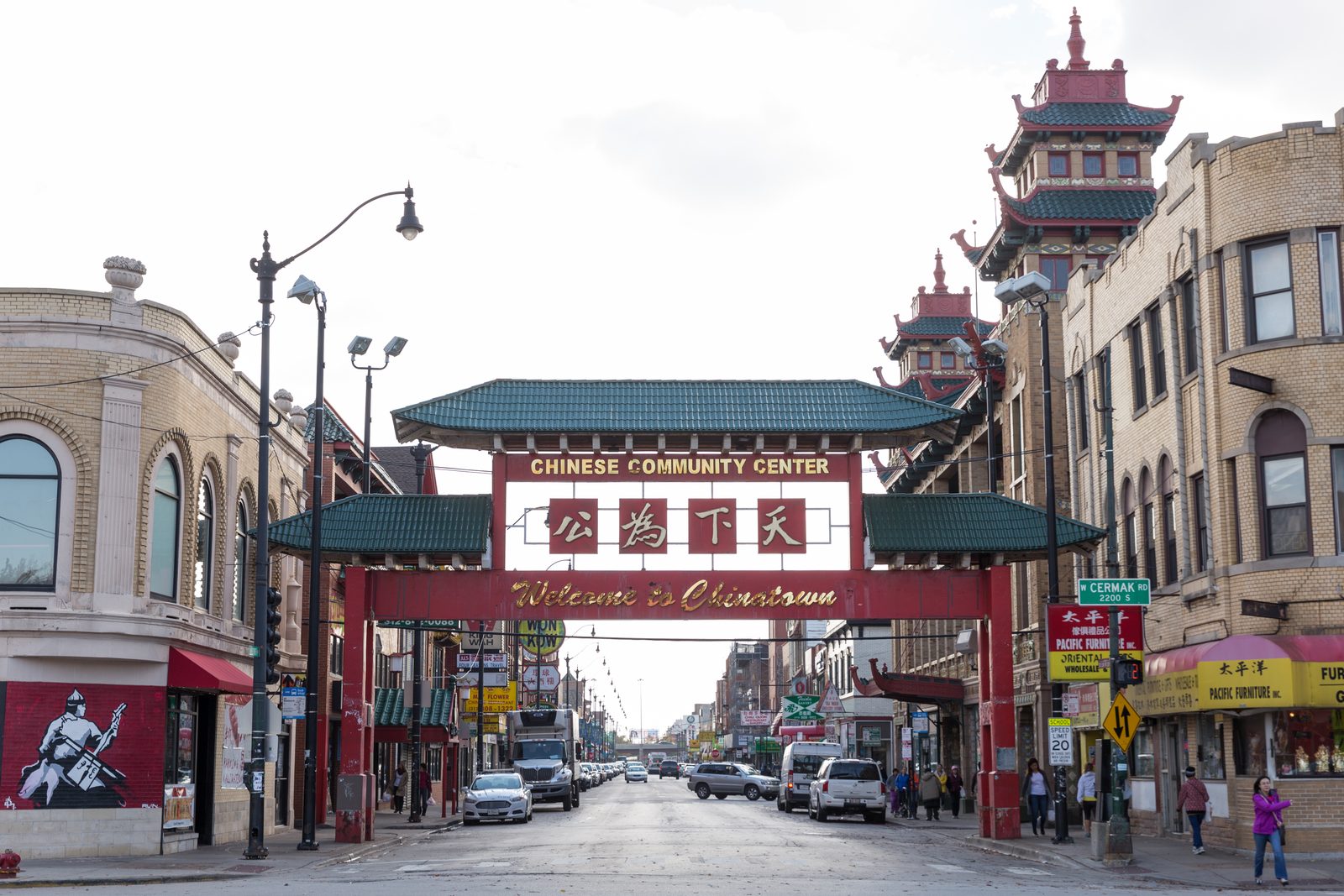
Photo: 图:芝加哥唐人街牌楼(Wentworth大道与Cermak路口),远处为芝加哥市中心天际线。图片来源:Wikimedia Commons(CC BY-SA 2.0)。 / Photo: The Chinatown Gate in Chicago at Wentworth Avenue and Cermak Road, with the downtown skyline beyond. Source: Wikimedia Commons (CC BY-SA 2.0).