As Technology Advances, People Get Busier: The Efficiency Ledger Behind the Food-Delivery Rider Army
A neighbor in our community, chatting in a group about technological progress, sent two messages in a row. The first read: "Work that once took 100 million people to finish can now be done by one million. Efficiency went up, wealth got concentrated, and what got left behind is a lot of food-delivery riders."
He followed it with a second: "The idea that technological progress would bring leisure seems to be just a beautiful wish. In fact, as technology advances, people are getting busier and busier... not just busy, but anxious... busy and anxious, and poor and frustrated on top of it..."
The words are blunt, but they strike a chord with many people. Behind each of his keywords — efficiency, wealth, riders, busyness, anxiety — there are hard numbers.
Start with efficiency. The neighbor's "100 million" and "one million" are an exaggeration, but the direction is right: the World Economic Forum's Future of Jobs Report 2025 estimates that by 2030, technological change and other structural shifts will displace some 92 million existing jobs worldwide. Work that once took large numbers of people doing the same thing over and over is being taken over, piece by piece, by software, machines and algorithms.
The riders who were "left behind," meanwhile, have become an army. Public figures show that China now has more than 11 million food-delivery riders. The Meituan Research Institute reports that the platform averaged 3.36 million riders taking orders each month in 2024, and a February 2025 report from Renmin University of China put Ele.me's active riders at more than 4 million. A survey by the All-China Federation of Trade Unions found 84 million workers in new forms of employment nationwide, 21 percent of all employees.
In the United States, riders and gig workers are just as ubiquitous. A Pew Research Center survey found that 16 percent of American adults have earned money through an online gig platform, 9 percent of them within the past year; among 18- to 29-year-olds, the share reaches 30 percent. On the DoorDash platform alone, more than 7.5 million people delivered in 2024, earning more than $17 billion through the platform over the year.
Then there is the wealth side. Orders, dispatch rules and pricing power sit in the hands of a handful of platform companies, while the people doing the work number in the millions and are paid by the task, with incomes that rise and fall. Pew's data show that 25 percent of lower-income adults have done platform gig work, compared with only 9 percent of upper-income adults; of those who did gig work in the past year, about three in ten relied on it as their main job, while most used it to supplement their income. Gig work also typically comes without employer-provided health insurance or a retirement plan. Part of the neighbor's word "poor" comes from exactly this.
The busyness and anxiety have numbers too. Gallup's State of the Global Workplace 2025 report found that 40 percent of employees worldwide said they had experienced a lot of stress the previous day; in the United States and Canada, the figure was 50 percent, the highest of any region in the world. Technology makes collaboration possible anytime and anywhere — and blurs the line between work and life: messages arrive at all hours, orders are dispatched at all hours, and it becomes hard to ever truly clock out.
But there is another side to the story. The same World Economic Forum report projects that new technologies will create some 170 million new jobs by 2030 — more than the number displaced, for a net gain of about 78 million. Big data, artificial intelligence and software development are among the fastest-growing fields, and light truck and delivery drivers also rank among the fastest-growing occupations. In other words, the rider army is itself a new trade created by new technology. Platforms such as DoorDash stress that flexible hours are why many people choose to deliver, and in Pew's survey, most platform gig workers rated their experience positively overall.
The question, then, is not whether technology creates value, but how that value is shared — and who sets the pace.
Which brings us back to the neighbor's two messages. They may not be rigorous, but they capture a widely shared feeling: machines are doing more and more of the work, yet the work people have to do has not shrunk — it has only moved elsewhere, taken new forms and found new ways to hurry us along. Whether technological progress will eventually buy back leisure remains an open question. But the ever-growing ranks of riders on the street are a reminder that every bill for "improved efficiency" is ultimately settled by real people.
(Source: Pew Research Center, Gallup, World Economic Forum, Meituan Research Institute, Renmin University of China, All-China Federation of Trade Unions)
Source: Pew Research Center, Gallup, World Economic Forum, Meituan Research Institute, Renmin University of China, All-China Federation of Trade Unions
Published by GSM · USA (original Chinese edition)
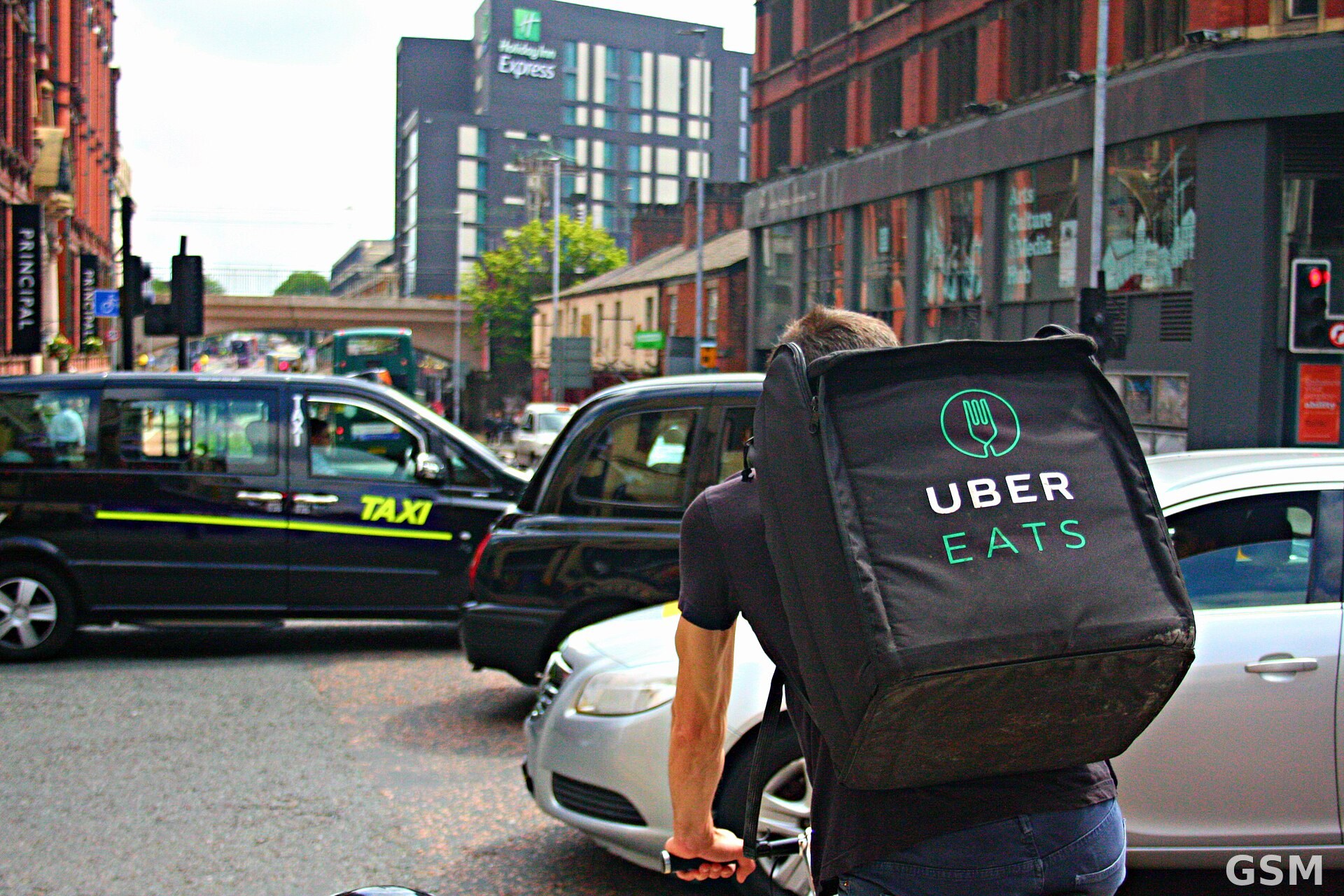
Photo: 英国曼彻斯特街头的外卖骑手。shopblocks 摄,CC BY 2.0,经 Wikimedia Commons。 / A food-delivery rider on a street in Manchester, UK. Photo by shopblocks, CC BY 2.0, via Wikimedia Commons.