OPT Fee Proposal Closes for Comment Tonight: $70,000 for a First Recommendation, $30,000 for Each One After — DHS Puts the Annual Take at $12.4 Billion as the Stay-in-America Pipeline Is Repriced
At 11:59 p.m. Tonight, the Page Closes
On the night of November 9, Washington time, one page on the federal eRulemaking portal, regulations.gov, is still open: Docket No. ICEB-2026-0100. In a few hours — at 11:59 p.m. Eastern Time — the channel closes on schedule, and the Department of Homeland Security's proposed rule "Optional Practical Training Fees," published on October 8, stops taking public comments.
It has been the most crowded docket in U.S. immigration policy this autumn. As of November 2, the portal had received 4,844 comments, up from roughly 1,615 in mid-October. On October 8, the day the rule appeared, the American Council on Education and the Presidents' Alliance had already publicly opposed it; over the following month, a NAFSA comment letter, a joint comment from the American Immigration Lawyers Association and the American Immigration Council, and a coalition letter from business and employer groups all entered the record. What ends tonight is the first round of a fight over a price tag.
1. Who Is Charged, and How
Start with the mechanics, because the most commonly misread point of this proposal is who pays.
Under the proposed text, a fee would attach to each F-1 student who takes part in Optional Practical Training (OPT): $70,000 for initial OPT and $30,000 for any subsequent OPT, with a STEM OPT extension counting as a subsequent one. But the statutory payer is not the student — it is the student's SEVP-certified school. The school must pay before its designated school official (DSO) enters the student's OPT recommendation in SEVIS; if the fee is unpaid, the DSO may not enter the recommendation, and U.S. Citizenship and Immigration Services (USCIS) may not approve the student's work permit. "Initial" means the first time the student participates in any type of OPT, whether pre-completion or post-completion, and it is charged only once; each further period of OPT costs the school another $30,000. If the work permit is ultimately not issued, SEVP may decide on a refund case by case.
For comparison: under the current system, students themselves file Form I-765 for the work permit, at $470 online or $520 on paper. The proposal leaves that fee untouched. It opens a second bill, on the school's side, of an entirely different order of magnitude.
DHS supplied its own worked example: if a student splits 12 months into pre-completion OPT and post-completion OPT, the school pays $70,000 plus $30,000 — $100,000 in total. The department therefore assumes schools and students will shift to a single post-completion OPT and pay only $70,000.
2. The Ledger DHS Wrote Itself
The proposal lays out its own arithmetic in unusual detail. In DHS's economic analysis, annual fee collections under a final rule would range from $8.4 billion to $16.5 billion, with a primary estimate of $12.4 billion; over ten years, the transfers would reach a primary estimate of $109.4 billion, discounted at 3 percent.
The modeling base is calendar year 2024 data: 194,554 OPT participants (authorizations) and 95,384 on STEM OPT; the low-end base, averaged over 2022–2024, is 88,374 OPT and 74,088 STEM OPT participants. More revealing is the low scenario's construction: DHS assumes that, in a low-participation scenario, institutions would pay the initial fee only for students eligible for the 24-month STEM extension — that is, in the department's own model, non-STEM students are the first group priced out. DHS also estimates that 56 percent of SEVP-certified institutions are small entities.
Where the money goes is stated plainly: under 31 U.S.C. 3302, the fees would be deposited in the Treasury of the United States as miscellaneous receipts. U.S. Immigration and Customs Enforcement (ICE) would not retain or use them.
3. GSM's Reading: What the Design of This Price Tag Shows
The following is this newsroom's analysis, based on the text of the proposal and the public record.
First, making the school the payer writes the "gatekeeper" into the price. In the preamble, DHS calls SEVP-certified institutions the "initial gatekeepers" of OPT and says recent fraud cases show the gates "have opened too widely." Charging the gatekeeper per head turns every recommendation into a financial decision taken before any adjudication: whether a school will stake $70,000 on a student becomes the first round of screening.
Second, the money does not fund enforcement. It goes to the Treasury as miscellaneous receipts, decoupled from ICE's investigative budget — and DHS states in the text that the fees remain "essential" to addressing the program's vulnerabilities regardless. On its own terms, this is first a pricing and deterrence instrument, and only second a funding measure. The department also states openly that schools may pass the cost on to the F-1 students themselves, to all students, or to employers, and that passing it to students would further discourage participation by those whose intent is "primarily to work or reside in the U.S." The screening intent is written on the face of the rule.
Third, consider the timing. OPT participation hit a record 294,253 students in the 2024/25 academic year, up 21 percent — the program's scale itself became the backdrop of the case for the rule. A presidential proclamation last September attached a $100,000 fee to H-1B, and this preamble expressly frames OPT as a possible means "to circumvent the H-1B visa program." The student-to-work pipeline is being repriced at every joint at once, not patched at a single point.
Fourth, the choice of procedure is worth noticing. The tightening of Curricular Practical Training (CPT) was done through two August "broadcast messages," now challenged in court as rulemaking without the required process; the OPT fee, by contrast, went through the full Federal Register notice-and-comment route. Same department, same pipeline, two procedures — one is already in litigation, the other closes its comment file tonight.
4. What Each Side Has Actually Said
The agreed facts are not few: the amounts, the school as payer, the rule's status as a proposal, tonight's deadline — no party disputes them. The dispute is over justification and consequences.
DHS's summary uses three phrases: combat fraud, strengthen the integrity of the immigration system, and protect U.S. workers. The preamble expands: the fee would ensure that only "highly qualified" students participate and keep the labor market from being "oversaturated with low-paid foreign workers." Its fraud record rests mainly on the 2020 "Operation OPTical Illusion" enforcement action and a 2019 Government Accountability Office report. An ICE spokesperson told The Daily Californian the proposed fee is meant to address concerns of "fraud and abuse in the program."
NAFSA submitted its comment letter on November 3, strongly opposing the proposal and urging DHS to withdraw it. Its executive director and CEO, Fanta Aw, said the proposal "creates deep uncertainty for international students," and added: "Driving away the talents, perspectives, and aspirations of international students will only hurt American innovation, economic growth, workforce development, and global leadership."
The Presidents' Alliance opposed the proposal and called for its withdrawal on the day it was released; its deputy director of federal policy, Zuzana C. Wootson, said the plan threatened the international talent pipeline. The Alliance then prepared comment guidance for institutions and promoted a joint comment letter signed by businesses, chambers of commerce, economic development organizations and employers.
The American Immigration Lawyers Association and the American Immigration Council filed a joint comment on November 6 opposing the rule and urging its withdrawal. On campus, the University of California, Berkeley's student government passed a resolution urging the university to submit a comment in opposition; the UC Office of the President told the campus newspaper it recognized the fee's adverse impacts on international students but had not, at that point, formally condemned the proposal. An analysis by the National Foundation for American Policy noted that DHS's fraud case leans heavily on anecdotes, with its signature enforcement examples dating from 2020.
5. The Other Joints in the Same Pipeline
OPT is not the only joint in this pipeline that has been moved. The same organizations — the Association of American Universities (AAU), NAFSA, the Presidents' Alliance and the Association of Independent Colleges and Universities in Massachusetts — sued DHS on October 5 over two SEVP broadcast messages issued on August 12 and 24 (Association of American Universities v. DHS, No. 1:26-cv-14520, U.S. District Court for the District of Massachusetts, before Judge Kobick). The broadcasts narrowed CPT to training that is required of every student in the program; an elective internship taken for academic credit no longer qualifies, while the regulation text itself was never amended. The plaintiffs asked the court to stay the broadcasts; a hearing on the preliminary injunction and stay motion was held on November 6, no ruling had been reported as of November 7, and the broadcasts remain in effect. The OPT preamble, for its part, states that CPT also presents fraud and national security concerns — the two lines meet inside the same document.
Two more deadlines follow tonight's this week: comments on the proposal to eliminate the discretionary 60-day grace period for eight categories of employment-based nonimmigrants, including H-1B workers (Docket No. USCIS-2026-0364), close on November 10; comments on the proposal to remove USCIS's deference to its own prior approvals in extension cases (Docket No. USCIS-2026-0529) close on November 13.
6. What Happens Next
Procedurally, once tonight's window closes, DHS must review the comments received and then decide whether to finalize the rule as proposed, finalize it with changes, or withdraw it. Under the proposed text, a final rule would take effect 60 days after its publication. One procedural tail remains open: comments on the proposal's information-collection provisions may be submitted separately until December 7, and must carry OMB Control Number 1653-0038.
(Analysis) Judging by the trajectory of parallel measures this year, finalization would not mean the fee takes effect unchallenged: the final rule replacing duration of status with fixed admission periods was postponed nationwide by court order in September, and the CPT broadcasts are in litigation now. Law firms and policy organizations have predicted that an OPT fee rule, once finalized, would "almost certainly" be challenged in court; one expected front is the legal basis for the fee itself — the preamble concedes the collections must go to the Treasury precisely because the statute does not authorize ICE to keep them. It is a reasonable expectation (speculation) that the next venue for this pricing fight is a courtroom rather than a comment portal — and that, in the meantime, schools must already budget for the worst case next academic year. That, too, is part of how a price signal works.
In Summary
Return to the page that closes tonight. The final comment count will not be known until the portal shuts; but the proposal has already done one thing: for the first time, it has priced OPT in public, using DHS's own ledger — $70,000 per student the first time, a ten-year primary estimate of $109.4 billion, collections decoupled from enforcement funding, and non-STEM students first out the door in the low scenario.
Supporters and opponents are, in the end, reading the same set of numbers two ways: one side reads a price tag fitted to a gate; the other reads a lock fitted to a pipeline. Whether the rule is finalized, and at what price, awaits the next issue of the Federal Register. After 11:59 p.m. tonight, the docket closes — and it becomes the government's turn to write its answer on top of several thousand comments.
Source: 美国国土安全部
Published by GSM · USA (original Chinese edition)
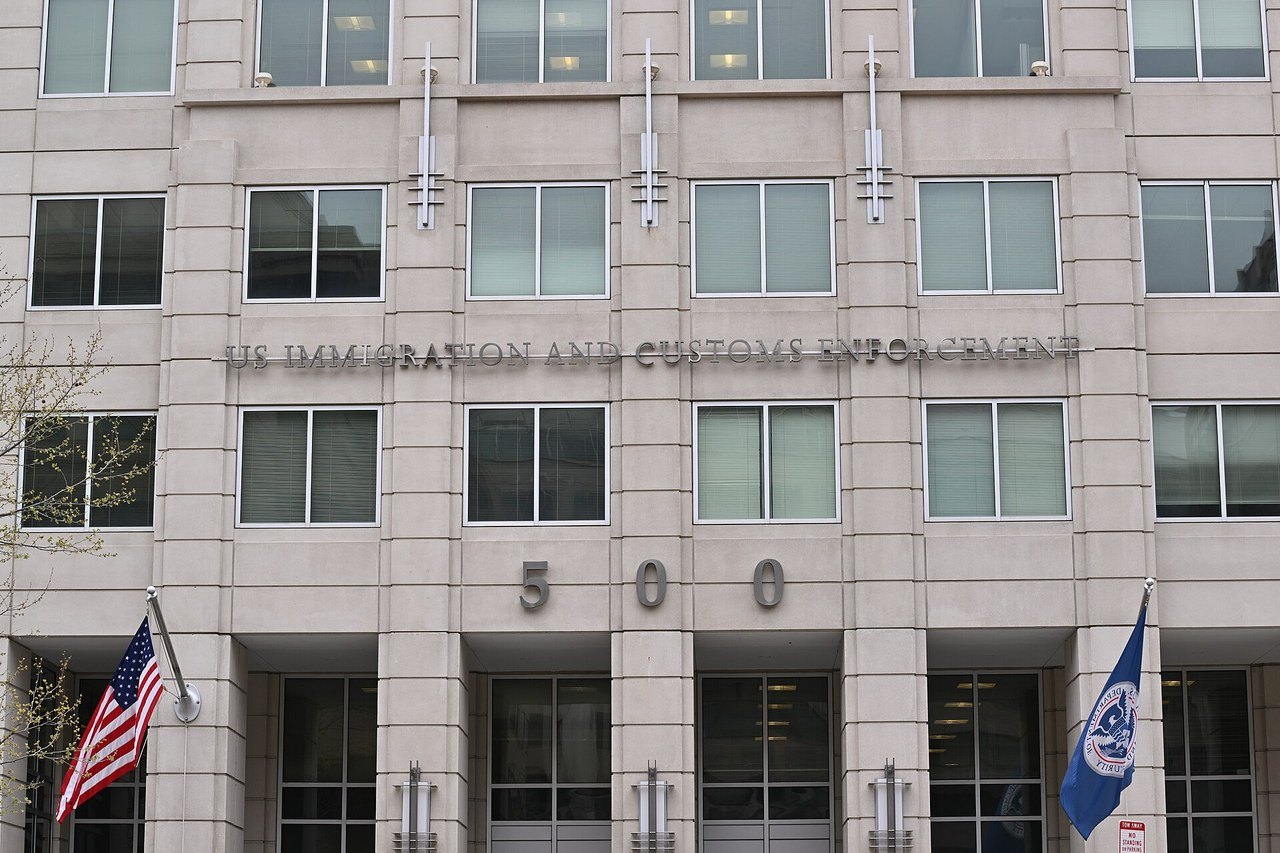
Photo: 美国移民与海关执法局总部大楼(GSM 固定图库)
- 2026-10-07DHS Proposes $70,000 OPT Training Fee for International Graduates
- 2026-11-03Follow-up: Public Comment on Proposed $70,000 OPT Fee for International Students Closes Nov. 9
- 2026-11-09Comment Period on the Proposed OPT Fee Rule Closes Today, November 9, in Washington: $70,000 for an Initial School Recommendation and $30,000 for Each Later One
- 2026-11-09OPT Fee Proposal Closes for Comment Tonight: $70,000 for a First Recommendation, $30,000 for Each One After — DHS Puts the Annual Take at $12.4 Billion as the Stay-in-America Pipeline Is RepricedThis story