$17 Billion in a Single Quarter, $900 Billion in Compute Commitments: Growth and the Big Bet Inside Anthropic's IPO Roadshow
Before a company enters the public markets, it hands institutional investors a book. The book is the version of itself it most wants the market to believe. Anthropic's roadshow presentation is such a self-portrait: the mission on the first page, the numbers behind it, and the real story in the gap between two sets of figures.
Start with growth. Anthropic's revenue curve is unusually steep: $41 million for fiscal 2023, $386 million for fiscal 2024, and $4.585 billion for fiscal 2025. In 2026, quarterly revenue jumped from $4.731 billion in the first quarter to $11.555 billion in the second and $16.956 billion in the third, roughly $17 billion in a single quarter. The company says its run-rate revenue stood at about $81 billion as of October 2026, with third-quarter revenue up more than 12 times year over year. From $41 million to an $81 billion run rate in under four years.
Then look at profit, where there are two sets of books. On the company's adjusted basis, which excludes stock-based compensation, non-cash charitable contributions and the Bartz settlement, its operating margin turned positive in 2026, at 19 percent in the second quarter and 15 percent in the third, with adjusted operating income above $2.2 billion in each. Its core operations crossed the break-even line on the eve of the offering. Under U.S. GAAP, however, the same third quarter shows an operating loss of $567 million and a net loss of $23.291 billion. The bulk of that gap is not operating burn. It is the change in fair value of convertible notes and SAFEs: the faster the valuation rises, the larger this non-cash paper loss grows, reaching $59.597 billion in the second quarter of 2026 alone. These paper losses largely disappear once the instruments convert at the IPO. Anyone reading this company has to keep the operating ledger and the valuation ledger apart.
The real bet is compute. The presentation shows total compute commitments of about $900 billion as of and subsequent to September 30, 2026, of which roughly $451.6 billion is expected before the end of 2030, about $70.7 billion falls due in the twelve months after September 30, 2026, and the rest runs from 2031 to 2045. Against that stand about $96 billion of cash, $36 billion of short-term investments, roughly $141 billion of capital raised, and $15 billion of availability under its credit facility. The commitments are about eleven times current run-rate revenue. They are both the moat and the largest risk on the balance sheet: if growth disappoints, the commitments do not shrink with it.
The company's hedge, in its telling, is efficiency. It says compute efficiency, defined as revenue divided by compute and infrastructure costs, improved more than fourfold from the first quarter of 2025 to the third quarter of 2026, driven by compute-multiplier research and a multi-chip architecture spanning AWS Trainium, Google TPUs and NVIDIA and AMD GPUs, with distribution through all three major clouds. The deck is also candid about the price of speed: the third quarter of 2026 included $5.0 billion of compute under short-term commitments, at costs significantly above its multi-year deals.
On the customer side, the pattern is land and expand. More than 11,900 customers generated at least $100,000 of revenue over the trailing twelve months, about eight times the level of late 2025; more than 1,900 customers are at $1 million or more, and about 250 at $10 million or more. Over 30 percent of the Global 2000 and over 50 percent of the Fortune 500 already pay for Claude, yet the company says the average Fortune 500 customer spends less than 0.1 percent of its total expenses on Claude, and even its top ten spend under 1 percent. It cites enterprise net revenue retention of about 900 percent. These are company figures, but they point the same way: what is being sold is not a one-off tool but a workflow entry point that grows with usage. The deck adds that in September 2026 Claude wrote more than 90 percent of the contributions to Anthropic's own codebase, that trailing revenue per employee exceeded $6.6 million, and that all seven co-founders remain at the company, its footnote on talent density and self-acceleration.
Governance is the lesson public investors must price for themselves. Anthropic is a public benefit corporation whose mission is its statutory public benefit purpose, and the Long-Term Benefit Trust, made up of four financially disinterested trustees, generally has the authority to elect a majority of the board. The Class A shares on offer carry economics, not control. A mission lock can fend off short-termism; it can also fend off shareholders. How much premium or discount the market assigns to that structure will only be known on pricing day.
Two tuition bills are buried in the statements. One is the $1.5 billion Bartz settlement recorded in the third quarter of 2025, a reminder that copyright is a standing cost line for generative AI. The other is rising stock compensation, $1.07 billion in the third quarter of 2026 alone, excluded from adjusted profit but a real dilution to shareholders.
The self-portrait, in sum, argues that intelligence can now be produced at scale, that Anthropic stands at the front of that production, and that with global knowledge work representing more than $40 trillion of economic value, even a thin slice makes a giant company. The first half of that story has been validated by revenue. The second half must be earned against $900 billion of compute commitments. As the deck's own full page of forward-looking disclaimers concedes, plans may not be achieved and numbers may not hold. What investors are really judging is not whether Claude is smart enough today, but whether the exponential curve stays steep until the commitments come due.
Related: Anthropic Cuts IPO Valuation Target to $1.5-1.6 Trillion as Q3 Revenue Reaches About $17 Billion
Anthropic IPO Valuation Faces Pushback: Investors Call $1.5 Trillion Too High as Roadshow Nears
Published by GSM · USA (original Chinese edition)
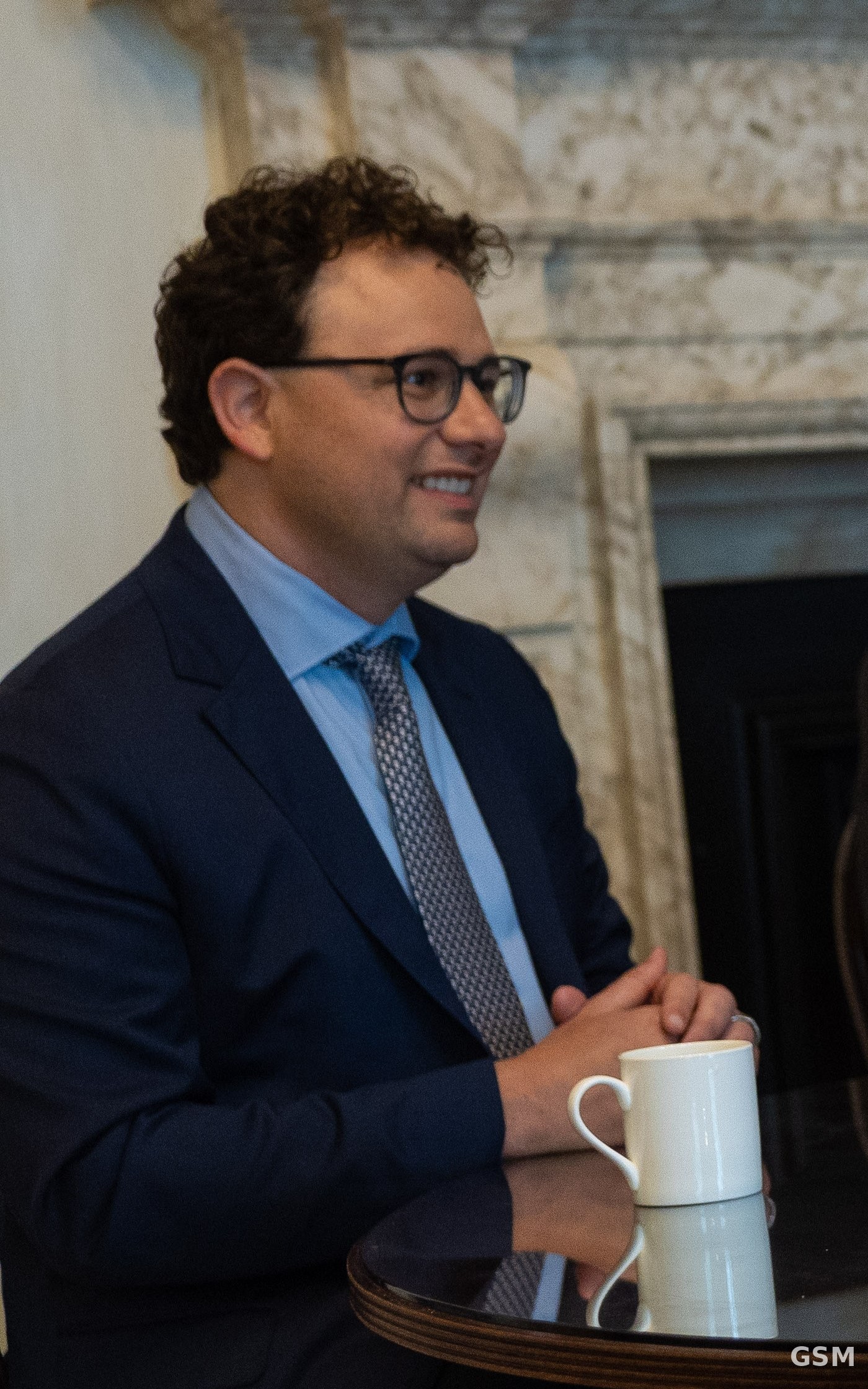
Photo: 图:Anthropic 联合创始人兼首席执行官 Dario Amodei 2023 年在英国出席超级智能(SI)开发者会面时的肖像。英国首相府 摄,CC BY 2.0,经 Wikimedia Commons / Photo: Anthropic co-founder and CEO Dario Amodei at a meeting with SI developers in the United Kingdom in 2023. By UK Prime Minister, CC BY 2.0, via Wikimedia Commons