NervGen Spinal Cord Injury Drug NVG-291 Wins FDA Breakthrough Therapy Designation: Phase 3 Trial Enrolling About 150
NervGen announced in Miami, Florida, on November 12 that the U.S. Food and Drug Administration (FDA) has granted Breakthrough Therapy designation to NVG-291 for the treatment of chronic traumatic cervical motor-incomplete spinal cord injury. NVG-291 is being developed as potentially the first therapy to promote nerve regeneration in people living with chronic spinal cord injury, and it has also received FDA Fast Track designation and European Medicines Agency Orphan Drug designation for spinal cord injury.
The designation was based on safety and efficacy data from the chronic cohort of the Phase 1b/2a CONNECT SCI study. Preliminary evidence showed substantial improvements on a clinically significant endpoint assessing functional hand use, supported by Patient Global Impression of Change results and blinded qualitative interviews documenting participant-reported gains in everyday function and independence compared with placebo. NVG-291 was generally well tolerated, with no serious adverse events or treatment discontinuations.
Shamim Ruff, NervGen's Chief Regulatory Affairs Officer, said the designation underscores the FDA's recognition of the promising clinical data and that NVG-291 is designed to facilitate the body's natural ability to regenerate and repair its nervous system, with the goal of achieving functional recovery even years after injury, adding that the company looks forward to building on the collaboration as it advances its ongoing Phase 3 RESTORE study. Andrew Wagner, CEO of Wings for Life USA, said the designation brings renewed hope to the more than 300,000 individuals living with traumatic spinal cord injury in the United States, and that even small gains in function can make a profound difference to quality of life and everyday independence.
The Phase 3 RESTORE study is a multicenter, randomized, double-blind, placebo-controlled registrational study expected to enroll approximately 150 adults living with chronic traumatic cervical motor-incomplete spinal cord injury across the United States and Canada. Its primary endpoint assesses improvement in hand function, a leading recovery priority for people with cervical injury, as measured by GRASSP Quantitative Prehension. Eligible participants are one to ten years post-injury, have a motor level at C7 or higher on both sides and an American Spinal Injury Association Impairment Scale classification of C or D. Participants are randomized 1:1 to receive NVG-291 or placebo by once-daily subcutaneous injection for 12 weeks, followed by a four-week observation period, with an optional 12-week open-label extension planned. The study is registered as NCT07799532.
Spinal cord injury disrupts communication between the brain and body and can result in lasting impairments in voluntary movement, sensation and autonomic function. Approximately 312,000 people in the United States are living with traumatic spinal cord injury, and about 18,500 new injuries occur each year. After injury, increased levels of chondroitin sulfate proteoglycans contribute to an environment that inhibits nervous system repair. There are currently no FDA-approved pharmacologic therapies to restore lost neurologic function in individuals living with chronic spinal cord injury.
Breakthrough Therapy designation is designed to expedite the development and review of drugs for serious conditions where preliminary evidence indicates the drug may demonstrate substantial improvement over available therapy, and it can bring eligibility for Priority Review and rolling submission. It does not guarantee regulatory approval, and results from earlier studies may not be predictive of subsequent ones. (Source: NervGen)
Source: NervGen
Published by GSM · USA (original Chinese edition)
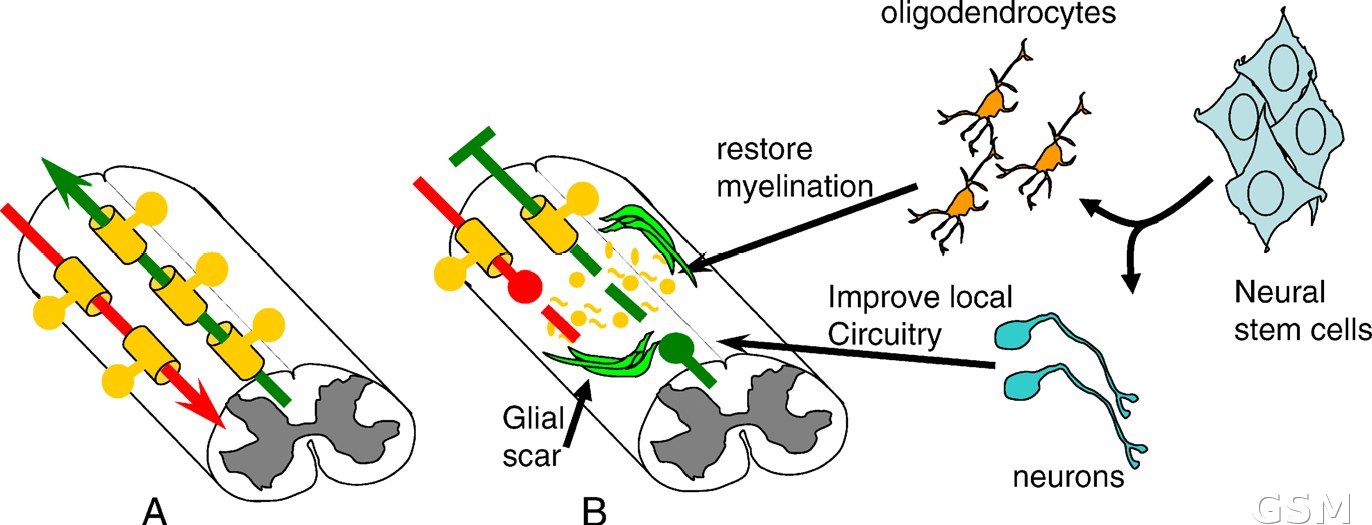
Photo: 图:正常与损伤脊髓示意图,右为损伤后胶质瘢痕与神经修复方向。Wikimedia Commons,CC BY 4.0。 / Image: Diagram of normal and injured spinal cord, showing glial scar and repair pathways after injury. Via Wikimedia Commons, CC BY 4.0.