Axiom's AxEMU Moon Spacesuit Completes Critical Design Review, the First for a NASA EVA Suit in Over 40 Years, Moving into Production and Qualification Testing
Axiom Space announced on November 13 that the Axiom Extravehicular Mobility Unit (AxEMU), the next-generation spacesuit it is developing for NASA's Artemis lunar program, has closed out its Critical Design Review (CDR) and is moving into production and qualification testing. NASA announced the milestone the same day on its official Artemis account, calling it the first critical design review completed for a NASA extravehicular activity spacesuit in more than 40 years.
The review was conducted at the component level, examining the full body of evidence supporting the design, including component packages, engineering drawings, structural analyses, and prototype test results. Axiom said closing the review means the design and fabrication plans are ready to move forward into production, followed by a qualification testing sequence that includes performance testing, environmental testing such as thermal vacuum and vibration, and life-cycle testing, ahead of a demonstration on the International Space Station.
Tammy Radford, Axiom Space's Extravehicular Activity Services (xEVAS) program manager, said the closure of CDR delivered the large body of work that gives the company confidence going into production. Work on the review began in the summer of 2025, with the first deliverables provided to NASA before the end of that year.
NASA is procuring the AxEMU as a service from Axiom for moonwalking missions under the Artemis program. Completing the review does not mean the suit is ready to fly; NASA certification for flight still depends on qualification testing and demonstrations.
(Source: Axiom Space)
Reference: NASA
Source: Axiom Space
Published by GSM · USA (original Chinese edition)
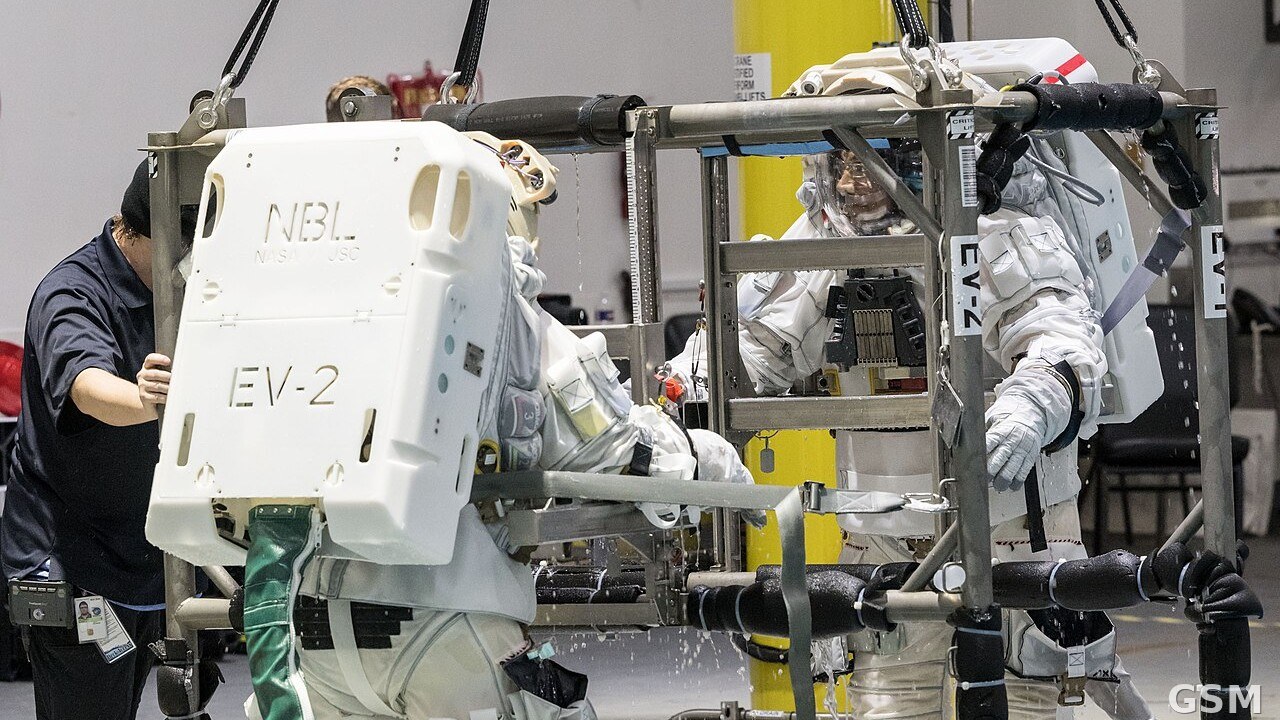
Photo: 图:两名宇航员穿着 AxEMU 宇航服在 NASA 约翰逊航天中心中性浮力实验室进行双人协同测试(NASA 官方照片,公共领域,经 Wikimedia Commons)。 / Photo: Two astronauts wearing AxEMU suits during a dual-suit run at NASA Johnson Space Center's Neutral Buoyancy Laboratory (NASA, public domain, via Wikimedia Commons).