[Video] Follow-Up: Rubio at Federalist Society Says International Law Has Been Weaponized, Calls ICC a 'Fake Court'
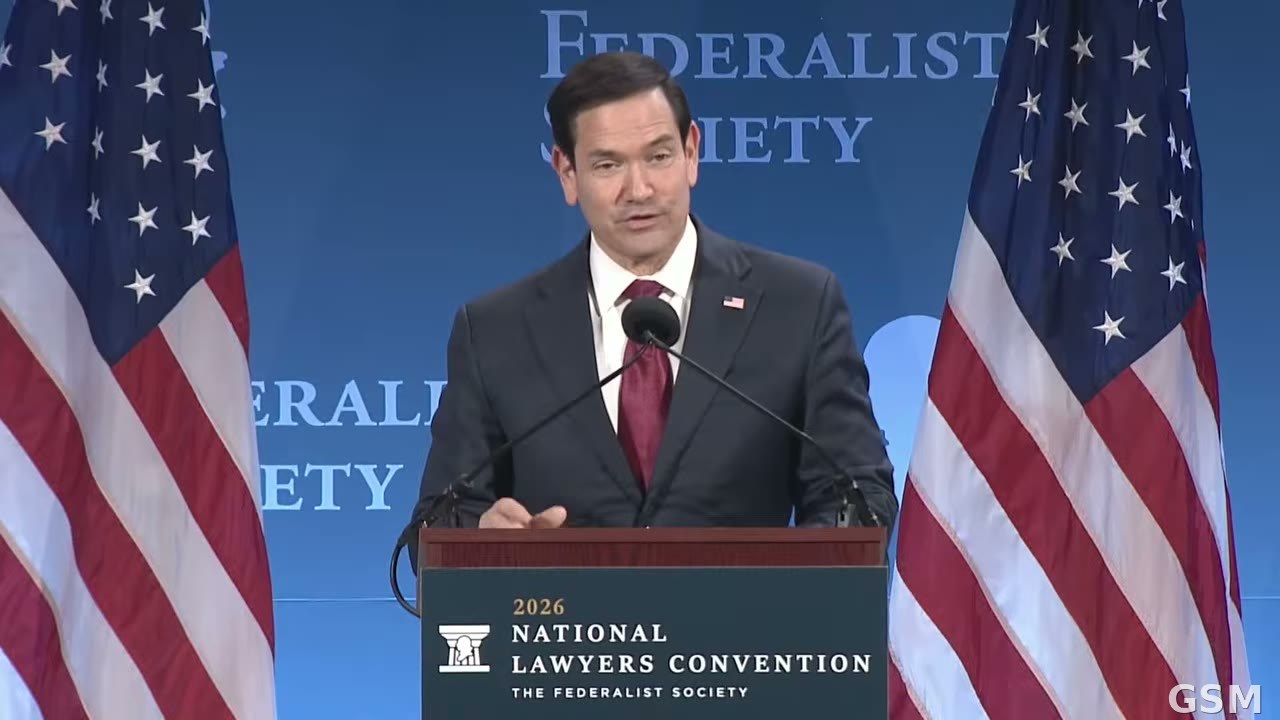
U.S. Secretary of State Marco Rubio delivered this year's Barbara K. Olson Memorial Lecture at the Federalist Society National Lawyers Convention in Washington on the evening of November 13; the address concluded at 3:32 p.m. Pacific Time, and the State Department's official livestream has since become a full replay. It was Rubio's first extended speech since Republicans lost control of both chambers of Congress in the November 3 midterm elections. He was introduced by his daughter Daniela, a third-year law student at the University of Virginia.
Rubio opened with Reagan's 1982. Less than two years into Ronald Reagan's first term, he said, everything seemed headed in the wrong direction: approval down 25 points, from 68% to 43%, four points less popular than Jimmy Carter at the same point, a full-fledged recession, devastating midterm losses for the president's party, and the conservative movement on the defensive. It was against that backdrop of plummeting morale, anxiety and despair, he said, that something new began to stir: in April 1982, four law school students organized a symposium on federalism in New Haven, Connecticut; about 200 people came, and one speaker was a 46-year-old professor from Chicago named Antonin Scalia, who said conservatives had simply been outgunned at the federal level for half a century. That was how the Federalist Society began.
The first lesson from that success, Rubio said, is that politics requires more than simply winning elections, because the government is not the only source of political power. "Power also lives in the universities. Power lives in the press. Power lives in the whole expanse of civil society," he said. America's ruling class resides not just in the White House, Congress or the courts, but in academia, nonprofits and NGOs, corporate boardrooms and C-suites, think tanks, journals, foundations and mass media, across "the commanding heights of business and education and culture." "Elections decide who holds office for a season," he said. "But elections do not decide by themselves what our institutions teach or what our lawyers believe." Change of that kind takes a generation or more, and only through a coalition working across institutions.
Rubio said the State Department has seen the same thing firsthand in the realm of international law. When President Trump ordered the military to sink cartel boats in the Caribbean, they were told it violated international law; when American forces captured Venezuela's Nicolás Maduro and brought him to the United States to face justice, the same accusations followed; even enforcing immigration law on American soil has drawn petitions for a United Nations investigation. "For this global elite, international law is not a neutral body of rules," he said. "International law is an instrument, an instrument to advance their interest under the pretense of universal principles."
He took aim at the International Criminal Court, calling it a "fake court" and "an unelected world tribunal" that claims to supersede the laws and constitutions of sovereign states, even those that never signed up for it. The court and its allies in the global bureaucracy, he said, "have appointed themselves judge and jury and executioner of the international order," while being accountable to no one. President Trump sanctioned the court earlier this year. If the ICC is "foolish enough to try to enforce their paper decrees on Americans," Rubio said, the answer would probably be the same as that of the Roman general Pompey to those invoking their city's charters against his legions: "Stop quoting laws to men with swords."
Rubio said that even as the institution of Soviet communism was defeated, "we did not triumph over the spirit of Marx. That spirit of Marx, it lives" on in new doctrines that would subordinate the national will to a global consensus. "America has always, and I believe will always, be a nation of irrepressible ambition," he said, and to submit to the sterile vision of radical judges or "soulless global bureaucrats" would be to betray who Americans are. "The ultimate question of our time," he said, "is whether Americans have a moral right to exist as a distinct nation and a distinct people, and thus to demand a government that defends and pursues our interests above all else."
He closed by urging the audience not to treat one setback, one defeat or one bad election as the end of the republic. He recalled Washington in December 1776, with fewer than 3,000 men fit for duty, writing that "the game is pretty near up" yet holding to "a full persuasion of the justice of our cause"; five years later, the British surrendered at Yorktown. "Great things that last are built in decades, not election cycles," Rubio said. "We have much more to do over the next two, the next six, the next 20 years." This generation, he said, will leave its children and grandchildren what Americans have always left theirs: "the single greatest nation in the history of the world."
After the address, Rubio took questions from the audience. Asked how Christian attorneys should respond to pressure to leave their faith at the door, he said: "Attorney is what you do. Your faith is who you are." He also described next week's travel: he will fly with President Trump to the Philippines for the ASEAN conference and then to China for the APEC conference. "The Chinese government is in favor of what's good for China and they don't apologize for it," he said. "I'm on the American side of every issue. And that I even have to say that is stunning."
(Source: U.S. Department of State)
Related: [Video Rubio Delivers Keynote Address at the Federalist Society National Lawyers Convention]
Source: U.S. Department of State
Published by GSM · USA (original Chinese edition)
Photo: 图:卢比奥在联邦主义者协会全国律师大会发表演讲,美国国务院官方视频截图 / Photo: Secretary Rubio delivering the keynote at the Federalist Society National Lawyers Convention; frame from the U.S. Department of State official video
- 2026-11-13[Video] Rubio Delivers Keynote Address at the Federalist Society National Lawyers Convention
- 2026-11-13[Video] Follow-Up: Rubio at Federalist Society Says International Law Has Been Weaponized, Calls ICC a 'Fake Court'This story