Machine Learning on 1,532 X-Ray Spectra Detects Trace Asbestos in Recycled Gypsum, Selected Model Accuracy 0.9450
Scientific Reports on November 14 published a study on detecting asbestos in recycled gypsum. Asbestos contamination blocks gypsum recycling from demolition waste, and regulatory thresholds near 0.1 wt% lie well below what routine methods identify reliably.
The team evaluated machine-learning detection of trace chrysotile (0.001 to 9 wt%) in recycled gypsum from wide-angle X-ray scattering, comparing six feature representations under one Extra-Trees estimator on 1,532 spectra from 373 samples, with group-aware splits and 18 seeds.
Internally the representations were indistinguishable, so the authors report the minimum detectable difference (0.030 to 0.062) rather than a ranking. The untransformed spectrum was the strongest internal detector (AUC 0.9993 ± 0.0007, zero false negatives at 9.4% false positives), yet it missed all 16 measurements of a commercial fibre-cement board absent from training, which an unsupervised linear projection detected in full.
The team therefore selected on cross-matrix transfer, reporting a PCA model restricted to the diagnostic chrysotile reflections with accuracy 0.9450. A retained production sample independently assayed at 0.0201 wt%, one fifth of the regulatory threshold and used in no selection step, was identified as asbestos-bearing. Quantification remains semi-quantitative (log-MAE 0.62) and does not transfer across matrices, so the authors conclude the framework suits on-line screening in industrial recycling. The paper is by Wilhelm, Lotter, Scherdel and colleagues.
Source: Scientific
Published by GSM · USA (original Chinese edition)
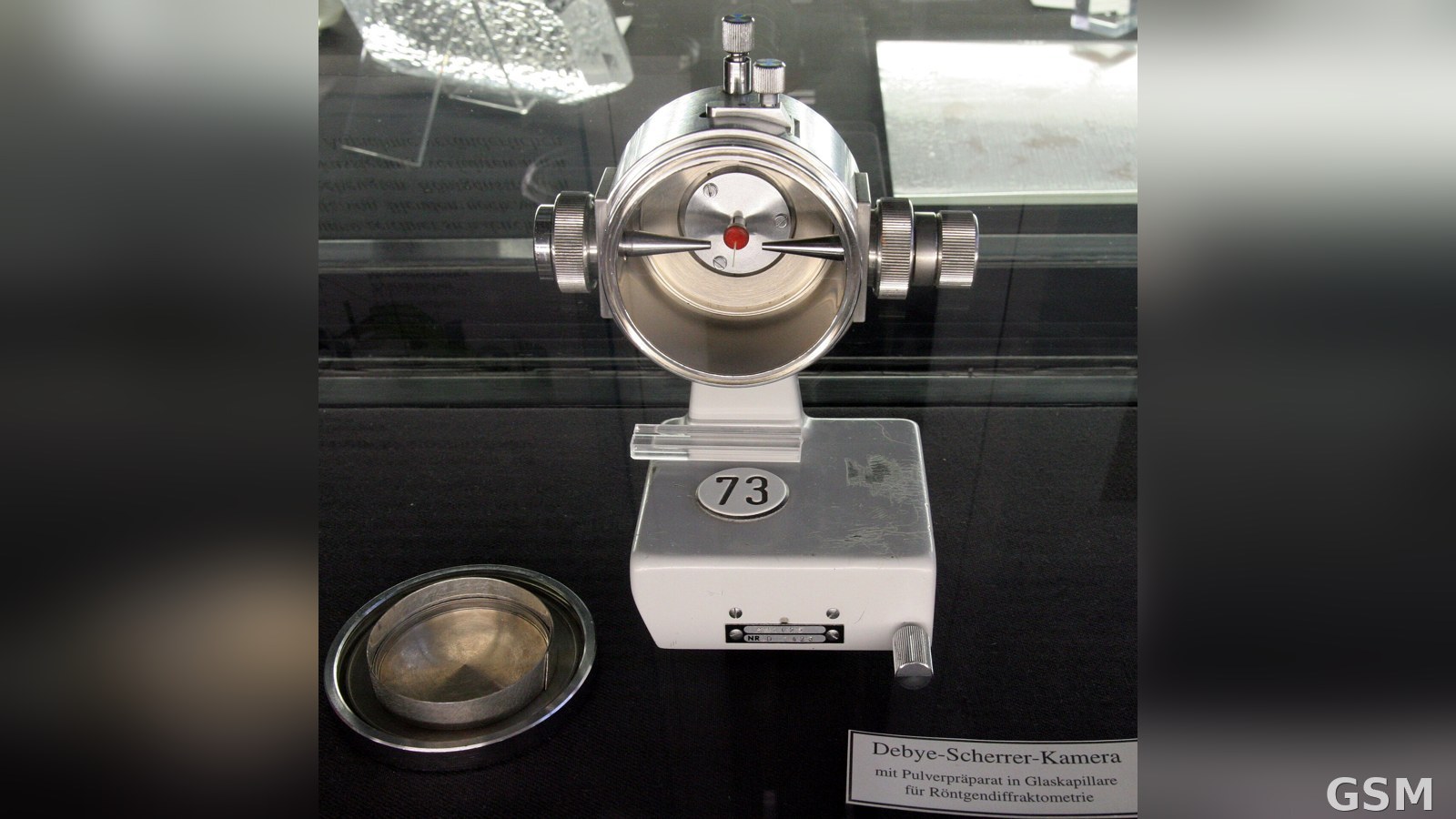
Photo: 图:用于 X 射线粉末衍射测量的德拜-谢乐相机(资料图),藏于海德堡大学地球科学研究所博物馆。来源:Armin Kübelbeck,Wikimedia Commons,CC BY-SA 3.0。 / Photo: A Debye-Scherrer camera for X-ray powder diffractometry (file photo), held by the museum of the Institute of Earth Sciences at Heidelberg University. Source: Armin Kübelbeck, Wikimedia Commons, CC BY-SA 3.0.