Modeling of Saudi Arabia Mpox Outbreak Puts Peak Effective Reproduction Number at 2.08, Falling Below Threshold by September 2023
A study published November 14 in Scientific Reports estimated the population-level transmission dynamics of the 2023-2024 Mpox outbreak in Saudi Arabia, integrating case-based surveillance data from May 13, 2023 to February 8, 2024 with a Bayesian SEIR model. The analysis used the 92 percent of confirmed cases with complete data.
At the onset of the modelled period, May 13, 2023, the effective reproduction number was estimated at 2.04 (95% credible interval 1.47-2.64). It rose to a peak of 2.08 (95% CrI 1.55-2.66) on May 16, 2023, and declined below the epidemic threshold, an effective reproduction number under 1, by September 8, 2023.
The study also estimated an observation-scaling parameter linking modelled incidence to reported cases at 0.561 (95% CrI 0.351-0.786), and an overdispersion parameter of 3.141 (95% CrI 2.479-3.877), with stable estimates.
Cases were reported among individuals with travel histories and reported exposure to social settings, and the case series showed a concentration among men. The author notes that the observed dynamics were consistent with the global Clade IIb outbreak context, connecting imported cases to local transmission.
The author is affiliated with the Department of Mathematics at Taif University, and the work was funded by the university's Deanship of Graduate Studies and Scientific Research. The analysis used anonymized aggregate surveillance data from the Saudi Ministry of Health, approved by the ministry's Institutional Review Board under reference IRB Log No: 24-114E.
Source: Scientific
Published by GSM · USA (original Chinese edition)
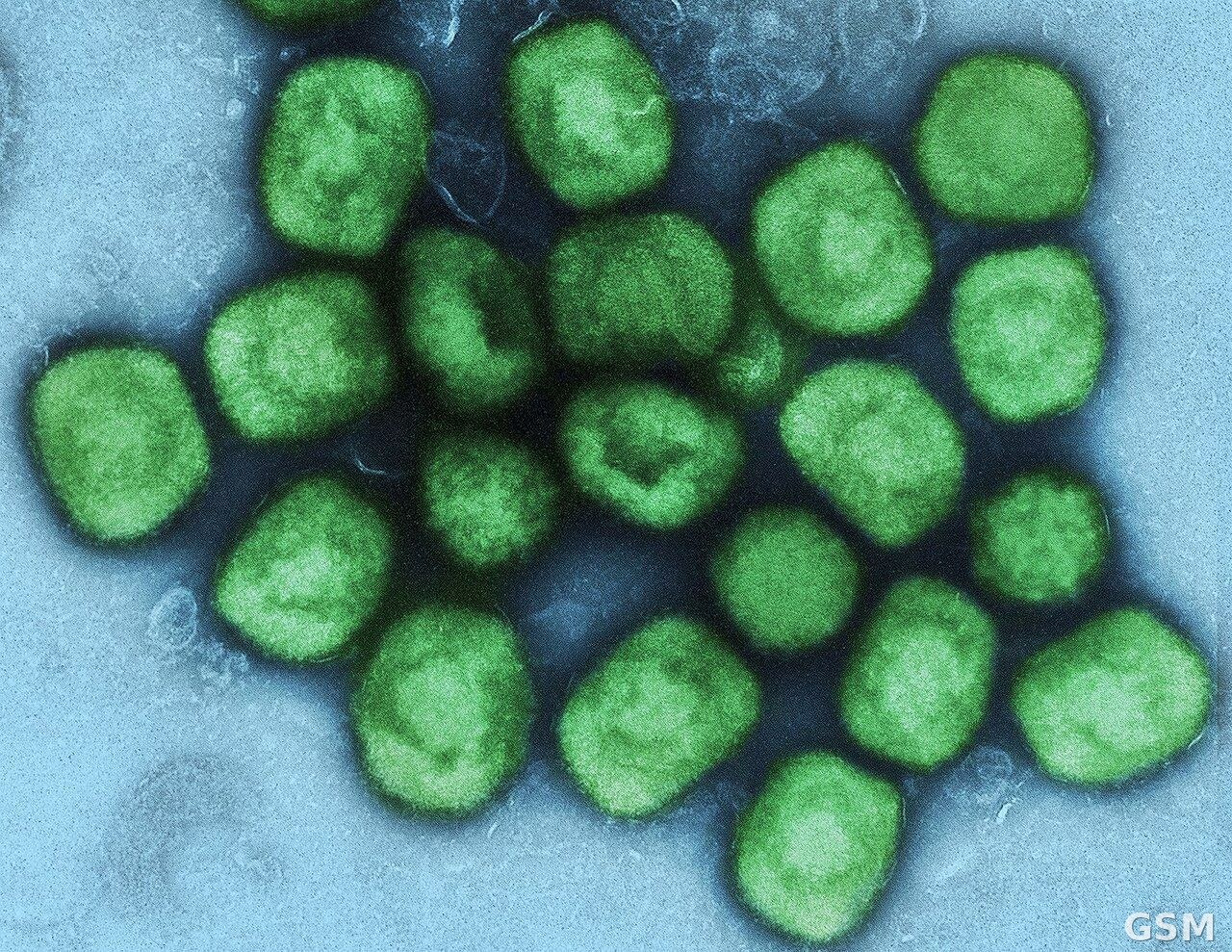
Photo: 图:经着色处理的猴痘病毒颗粒透射电子显微镜图像,病毒颗粒呈绿色。来源:National Institute of Allergy and Infectious Diseases (NIAID),Wikimedia Commons,CC BY 2.0。 / Photo: Colorized transmission electron micrograph of monkeypox virus particles (green). Source: National Institute of Allergy and Infectious Diseases (NIAID), Wikimedia Commons, CC BY 2.0.