CTEPH Biomarker Study Narrows 12 Candidate Genes to FOS and CD163 as Candidate Diagnostic Markers
A study published November 14 in Scientific Reports jointly analysed single-cell and bulk RNA sequencing data to identify candidate diagnostic biomarkers associated with phagocytic regulatory factors in chronic thromboembolic pulmonary hypertension, a progressive pulmonary vascular disorder marked by organized thrombotic material and persistent pulmonary hypertension.
The team used an in-house bulk RNA-sequencing cohort of eight patients with CTEPH and eight with chronic thromboembolic pulmonary disease, together with a public single-cell RNA sequencing dataset. Among the resolved cell populations, mononuclear phagocytes showed high activity of the phagocytosis-related gene set.
Overlapping differentially expressed genes with mononuclear phagocyte-associated module genes yielded 12 candidates. Screening with three machine learning methods and receiver operating characteristic analysis retained FOS and CD163 as candidate diagnostic biomarkers, both downregulated in CTEPH. A two-gene nomogram showed preliminary discrimination in the training cohort.
The two biomarkers shared enrichment in platelet activation and neutrophil degranulation pathways, while CD163 was positively correlated with B cells. Compound CID:71,703,489 was predicted computationally to bind both biomarkers, and the simulated CD163 complex was more stable than the FOS complex. Reduced expression of both biomarkers was further supported by RT-qPCR in an independent cohort.
The authors are affiliated with the Second Hospital of Hebei Medical University, and the work was supported by the Natural Science Foundation of Hebei Province. The authors state that the findings are computational inferences and require experimental and cell-type-specific validation.
Source: Scientific
Published by GSM · USA (original Chinese edition)
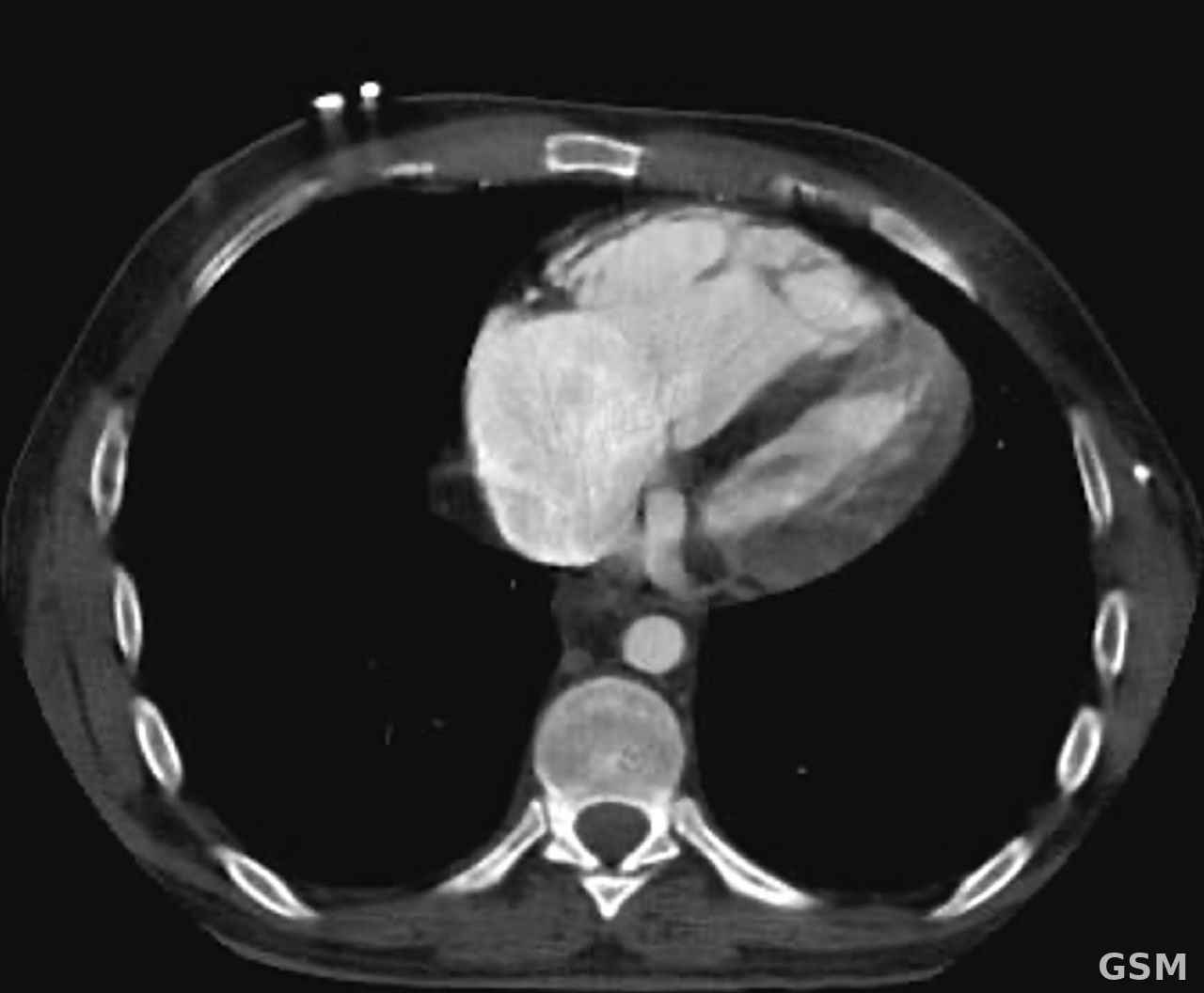
Photo: 图:肺栓塞后右心室扩张的胸部 CT 影像。来源:Solomonbgh,Wikimedia Commons,CC0。 / Photo: Chest CT image showing right ventricular dilatation after pulmonary embolism. Source: Solomonbgh, Wikimedia Commons, CC0.