
[Video] Northwestern Team in Science, Published November 16: Supramolecular Threads Reach Billions of Daltons, and Neurons Treated for 7 Days Show Four Times the Calcium Activity of Untreated Cells
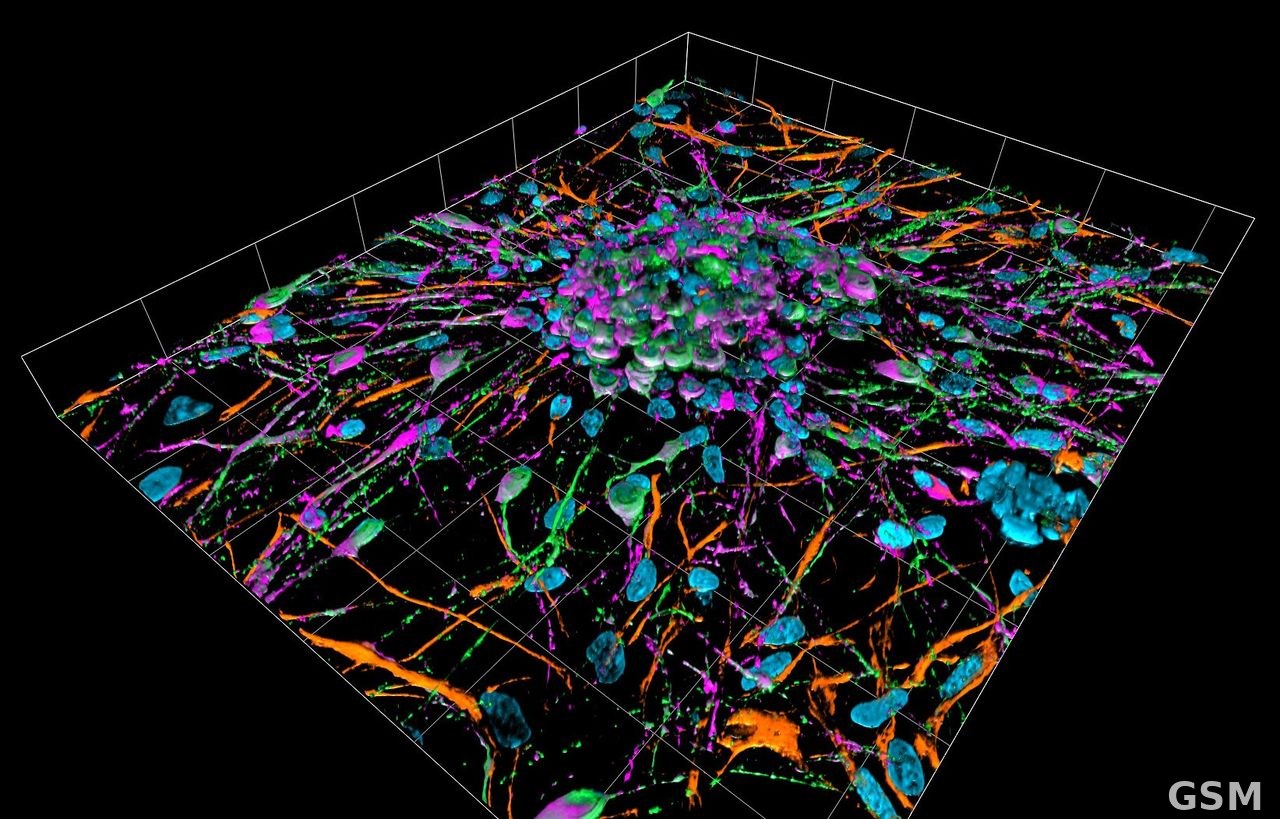
A team led by Samuel I. Stupp at Northwestern University in the United States has published a paper in Science, with the university releasing its account of the study on November 16. Using self-assembling molecules, the team built the largest supramolecular polymers yet made with precise control: a single molecular thread is longer than the diameter of a cell, and the combined molar mass of its noncovalently bonded monomers reaches billions of daltons, compared with about 10 million daltons for the largest common plastic polymers and roughly 3 to 5 million daltons for the largest proteins in nature. The university calls them giga-assemblies.
Supramolecular polymers are held together by weak, reversible interactions, so their components can move and reconfigure, which has made their length and chemical segmentation hard to control. The Stupp team identified a previously unknown process it calls self-capping supramolecular polymerization: while a thread grows, flexible portions at its ends stay dynamic and admit new molecules in a synchronized way; once the building blocks are consumed, those portions fold over and protect the ends, preventing threads from fusing or undergoing Ostwald ripening. Threads left in a test tube for months kept the same length and segmented structure, and growth could be restarted by adding more building blocks, allowing segments with different charges to be added in sequence.
The team then tested charge-patterned threads on neurons, which carry a strong negative charge. Threads with only positively charged segments killed the neurons; threads with only negative segments were repelled and had no effect; and threads with randomly mixed charges produced no notable response. A design with one small positively charged segment sandwiched between two negatively charged segments behaved differently: the positive segment anchored the thread to the neuron surface, while the negative segments, unable to escape, stayed near the cell and moved toward and away from it on millisecond timescales.
Neurons treated with the segmented threads grew longer and more highly branched neurites; after seven days, their calcium responses to stimulation were about four times greater than those of untreated neurons, and after 14 days they had formed more synapses. In cultures of human neural progenitor cells, the cells organized into raised three-dimensional clusters connected by axons. The researchers propose that the negative segments recruit proteins already present around the cells, including neurotrophic factors and laminin, which carry positively charged domains. The paper's co-primary authors are Michael Dore, Simon Egner and Madison Strong. The team notes that this is cell-culture work at a basic stage, not a demonstrated therapy, and that the full mechanism of the material-cell interaction remains under study.
Published by GSM · USA (original Chinese edition)
Photo: Wikimedia Commons, File:Rat primary cortical neuron culture, 3D reconstruction (30614936992).jpg — Author: ZEISS Microscopy from Germany. Licensing: CC BY 2.0.
 Edinburgh and Bristol Teams, Released November 15: Bisphosphonates and Calorie Restriction Reduce Spinal Ligament Mineralization and Vertebral Fusions in col9a1b-Deficient Zebrafish2026-11-16
 University of Otago Paper in PLOS ONE, Released November 14: About 27,800 Erect-Crested Penguin Pairs on the Bounty Islands Rival About 29,800 on the Antipodes, Where Numbers Fell Over 40% Since 19952026-11-16