Across 384 U.S. Hospitals, Latent Patient-Experience Scores Fell 0.106 Into 2021, Then Rebounded 0.195 in 2022
A study published November 14 in Scientific Reports analysed patient experience data from 384 U.S. hospitals using latent service quality modeling. The data were the ten CMS HCAHPS domain star ratings across 2017-2019 and 2021-2022, comprising 1,920 observations.
The team combined a graded response model with calendar-time growth modeling, with 1,000 hospital bootstrap refits of both stages. Mean fitted latent scores for the sample declined from 2019 to 2021 by 0.106 (95% interval -0.159 to -0.057).
Scores then rebounded, rising 0.195 from 2021 to 2022 (95% interval 0.152 to 0.238), and exceeded the 2019 mean by 0.089 (95% interval 0.038 to 0.138). Alternative longitudinal models and observed-score analyses showed the same pattern.
Overall rating, care transition and nurse communication had the highest discrimination estimates. Teaching- and ownership-related contrasts were inconclusive after adjustment for multiple tests in the primary model, while an exploratory model showed a more negative 2022 deviation from projected trends for for-profit than for government hospitals.
The authors are affiliated with Central Washington University and the University of South Florida. They say the approach supports patient-experience monitoring by making measurement assumptions and uncertainty explicit, and that the temporal findings describe associations across study years. No funding was received for the research.
Source: Scientific
Published by GSM · USA (original Chinese edition)
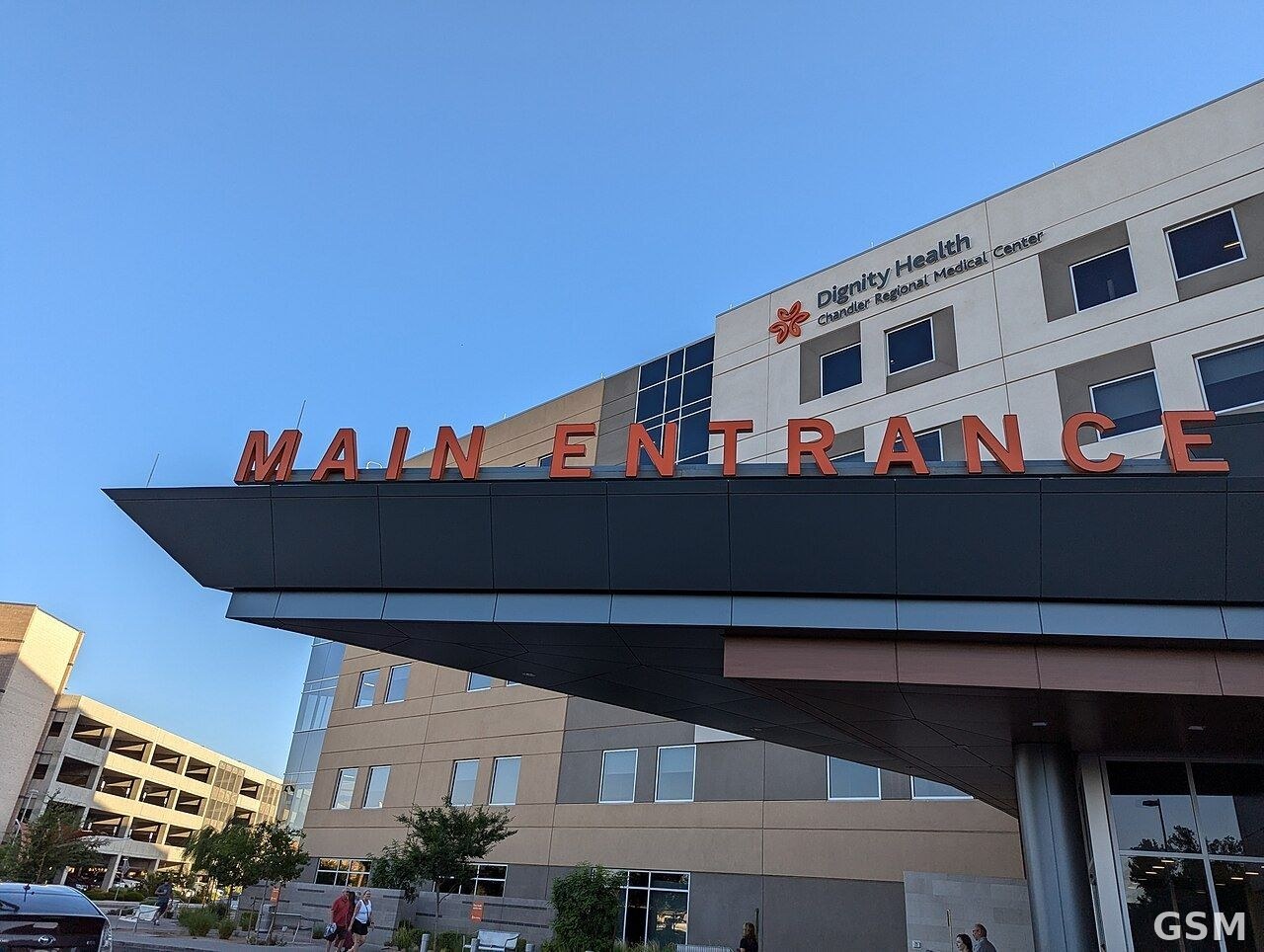
Photo: 图:位于 Chandler 的 Chandler Regional Medical Center 住院大楼。来源:Sammi Brie,Wikimedia Commons,CC BY 4.0。 / Photo: The inpatient tower of Chandler Regional Medical Center in Chandler. Source: Sammi Brie, Wikimedia Commons, CC BY 4.0.