Webb's 'Little Red Dots' May Be Birthplaces of First Supermassive Black Holes, Simulations Suggest
Astronomers may have solved one of the biggest mysteries uncovered by NASA's James Webb Space Telescope. Using sophisticated cosmological simulations, a team led by Dr. Daniel Whalen of the University of Portsmouth's Institute of Cosmology and Gravitation shows that enigmatic objects known as little red dots are likely primeval galaxies hosting massive black holes formed by the collapse of supermassive primordial stars. The paper was published in The Astrophysical Journal Letters in 2026 (DOI: 10.3847/2041-8213/aeb37a) and reported on November 10, 2026.
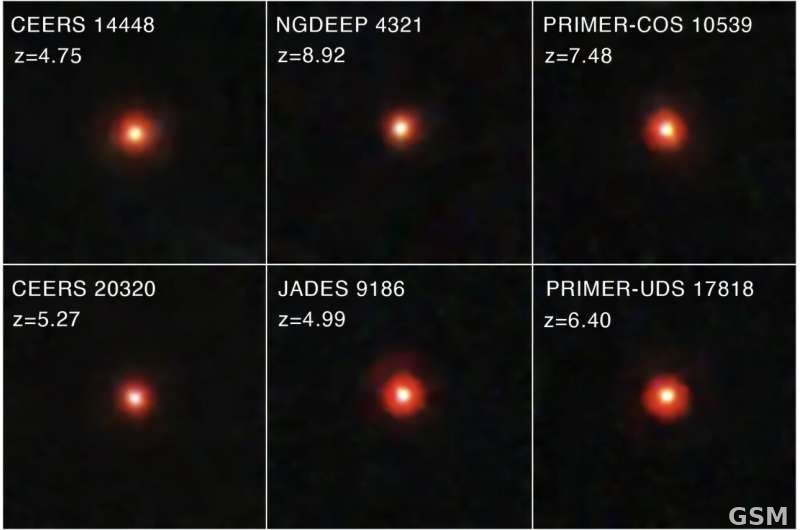
Since Webb began observing, astronomers have found hundreds of compact, bright little red dots in the early universe. They are only a few hundred light-years across but as bright as much larger galaxies, with unusual V-shaped spectra and no detectable X-ray or radio emissions, defying existing explanations.
The simulations suggest these systems contain black holes with masses around 10 million times that of the Sun, still wrapped inside the enormous disks of gas that created them. The dense gas traps high-energy X-rays while allowing some ultraviolet, visible and infrared light to escape, naturally recreating the light signatures Webb sees. A neighboring dense cluster of around 100 million stars packed into a region only around 500 light-years across produces the blue portion of the spectrum, matching observations.
The model reproduces the properties of a wide variety of little red dots, including some of the most distant and extreme examples, the team reports. Whalen said the result may mean astronomers are witnessing the birth of the first supermassive black holes, objects simulations predicted decades ago. The finding is a simulation-based explanation, not a direct observational confirmation.
Source: University of Portsmouth
Published by GSM · USA (original Chinese edition)
Photo: 图中是韦布望远镜拍摄的早期宇宙「小红点」天体图像。NASA, ESA, CSA, STScI, Dale Kocevski (Colby College)