Germany's Bundestag Election: Merz's Union Bloc Wins, AfD Second, SPD Third
Germany held an early election to its 21st Bundestag on February 23, 2025. Results announced by the Federal Returning Officer showed the Union bloc of the Christian Democratic Union (CDU) and the Christian Social Union (CSU), led by Friedrich Merz, winning with 28.5 percent of the second votes to become the largest force in the Bundestag. Merz claimed victory in Berlin that evening and was positioned to become the next chancellor. The election was held about seven months ahead of schedule, after Chancellor Olaf Scholz's three-party coalition government collapsed in November 2024.
The new Bundestag has 630 seats, with 316 needed for a majority. In second-vote share and seats announced by the Federal Returning Officer, the Union bloc took 208 seats in total: the CDU won 22.6 percent and 164 seats, and the CSU 6.0 percent and 44 seats. Alternative for Germany (AfD) came second with 20.8 percent and 152 seats, doubling its 10.4 percent share from 2021 for its best result in a nationwide election. Scholz's Social Democratic Party (SPD) finished third with 16.4 percent and 120 seats, down 9.3 percentage points from its 25.7 percent in 2021.
The other parties entering the Bundestag were the Greens with 11.6 percent and 85 seats, The Left with 8.8 percent and 64 seats, and the South Schleswig Voters' Association (SSW), which represents the Danish minority, with 0.2 percent and one seat; as a minority party, the SSW is exempt from the 5 percent threshold. The Sahra Wagenknecht Alliance (BSW), at 4.97 percent, and the Free Democratic Party (FDP), at 4.3 percent, both fell short of the 5 percent threshold and won no seats. Turnout was 82.5 percent, up from 76.4 percent in 2021 and the highest since German reunification in 1990.
On election night, Merz said a new government had to be formed quickly and that he aimed to complete the task by Easter, in about eight weeks, saying the world outside was not waiting for Germany. He also said his absolute priority would be to strengthen Europe as quickly as possible so that, step by step, Europe could achieve real independence from the United States in defence; he said statements from the Trump administration in the preceding week had made clear that the American side was largely indifferent to Europe's fate, that Europe was under massive pressure from two sides, and that creating unity in Europe was the immediate task.
Scholz conceded defeat that evening, calling it a "bitter election result" for the Social Democrats, and congratulated Merz and the Union bloc on their victory. Leaders of Alternative for Germany described their result as historic and said their hand remained outstretched to form a government. On the seat arithmetic, the Union bloc alone fell short of a majority; together, the Union and the SPD held 328 seats, above the 316-seat threshold, making that two-party combination the most workable option discussed on election night and coalition negotiations the focus after the vote.
(Source: The Federal Returning Officer)
Source: The Federal Returning Officer
Published by GSM · USA (original Chinese edition)
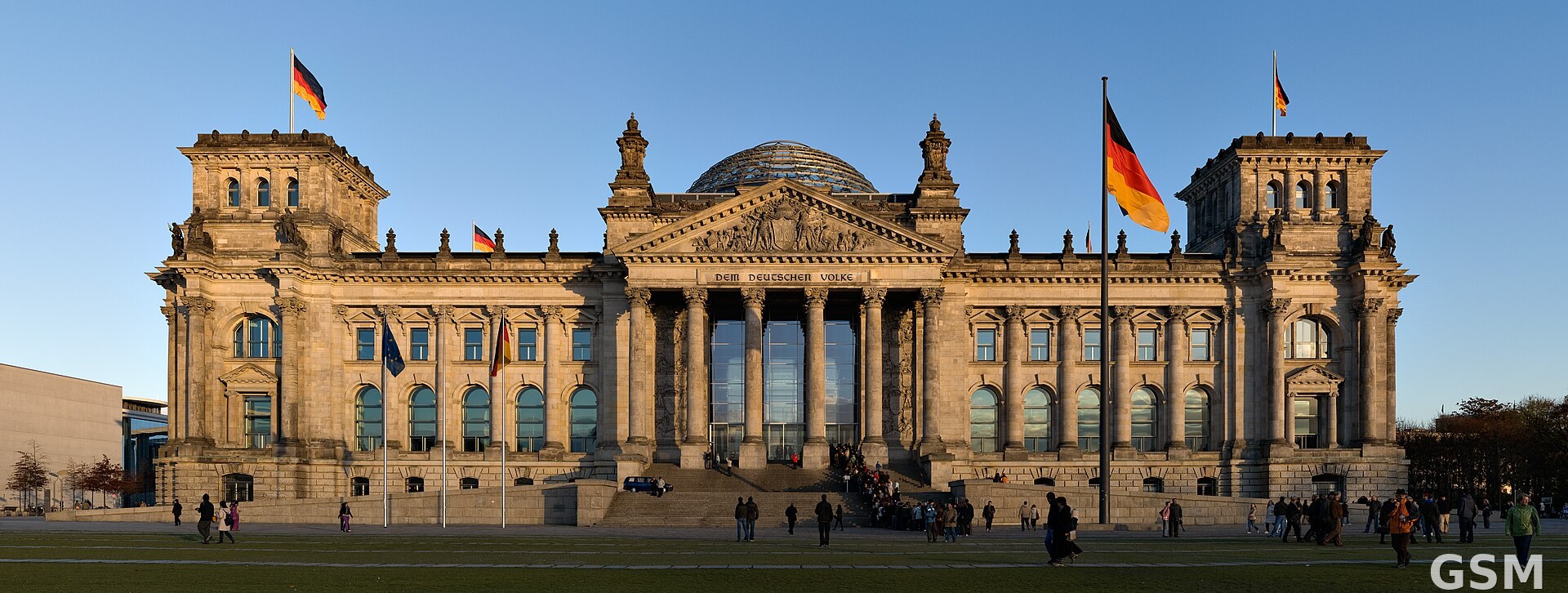
Photo: 图:位于柏林的德国联邦议院大厦(国会大厦)西侧全景(Jürgen Matern 摄,CC BY-SA 3.0);系议院建筑资料图,非选举之夜现场。 / Photo: The Reichstag building, seat of the German Bundestag, in Berlin, seen from the west (Jürgen Matern, CC BY-SA 3.0); file photo of the building, not election night.