Toxic Chemical Release in Toledo, Ohio Forces Evacuation of Nearly 1,000; Deputy Injured as City Lets Tank Reaction Run Its Course
A chemical tank incident in Toledo, Lucas County, Ohio, on the night of October 20 released the toxic chemical glycidyl methacrylate as a gas, prompting the city to order about 983 residents within a one-mile radius to evacuate and residents within three miles to shelter in place. Mayor Wade Kapszukiewicz said on October 21 that a Lucas County sheriff's deputy was injured responding to the incident and drove himself to a hospital — the only known injury — and that the damaged tank was still emitting the chemical on Wednesday morning. The city decided to let the chemical reaction inside the tank run its course; the release was still ongoing Wednesday afternoon, though the situation was steadily improving.
The incident occurred at the MC Tank Terminal at 1266 Progress Avenue, about 10 miles north of downtown Toledo near I-280, at around 9:30 p.m. on October 20. The Toledo Fire and Rescue Department initially reported that a tanker had exploded, and Mayor Kapszukiewicz also described a tank explosion at a Wednesday morning news conference; city spokesperson Rachel Hart later told USA Today that no explosion had in fact occurred. The Ohio Environmental Protection Agency said the incident happened while material was being transferred, and put the tank's capacity at 5,500 gallons; local station WTOL reported the tank may have held closer to 3,000 gallons at the time. The cause has not been announced.
MC Tank Transport confirmed the released substance was glycidyl methacrylate, an industrial chemical used in plastics, paints and coatings that is stored as a liquid but was released as a gas. The chemical is flammable and can cause burning of the eyes, nose, mouth and skin; overexposure can lead to headache, dizziness, tiredness, nausea and vomiting. Karim Baroudi, commissioner of the Toledo-Lucas County Health Department, said the chemical is highly toxic if touched or ingested and that officials were measuring toxicity levels in the air residents are breathing to give better guidance, while adding that at this stage it is mostly an irritant. The city advised residents to keep doors and windows closed, turn off ventilation systems that draw in outside air, shower and contact a medical professional if symptoms appear.
The evacuation zone expanded twice: firefighters first ordered about 300 residents within a half-mile to leave on Tuesday night, then widened the order to 983 people within one mile, with shelter-in-place in effect within three miles. The American Red Cross opened a shelter with capacity for about 200 people at the Believe Center in Toledo. The mayor said the tank carried a risk of explosion for 12 hours after the incident — until about 9:30 a.m. Wednesday — and responders and hazmat teams could not approach it before then. The U.S. Environmental Protection Agency said fire department attempts to contain the release were unsuccessful, the tank had been compromised and the chemical inside was completing a reaction, and the city determined the safest course was to let the reaction finish. The mayor said Wednesday afternoon the situation was steadily improving; local television reported the reaction could take another six to 16 hours to complete.
Effects crossed the state line: residents of Bedford Township and Erie Township in Monroe County, Michigan, were told to shelter in place on Wednesday morning, Bedford Public Schools and Mason Consolidated Schools closed, and Monroe County Community College's Whitman Center shut for the day. Stellantis's Toledo Jeep Assembly Complex sits about a mile from the site; its north plant evacuated employees on Tuesday night and canceled both the first and second shifts on Wednesday, while the south plant was not scheduled to run this week. The University of Toledo said its campus had no known impact and Saturday's home football game against Western Michigan would proceed as planned.
Source: GSM · USA (original Chinese edition)
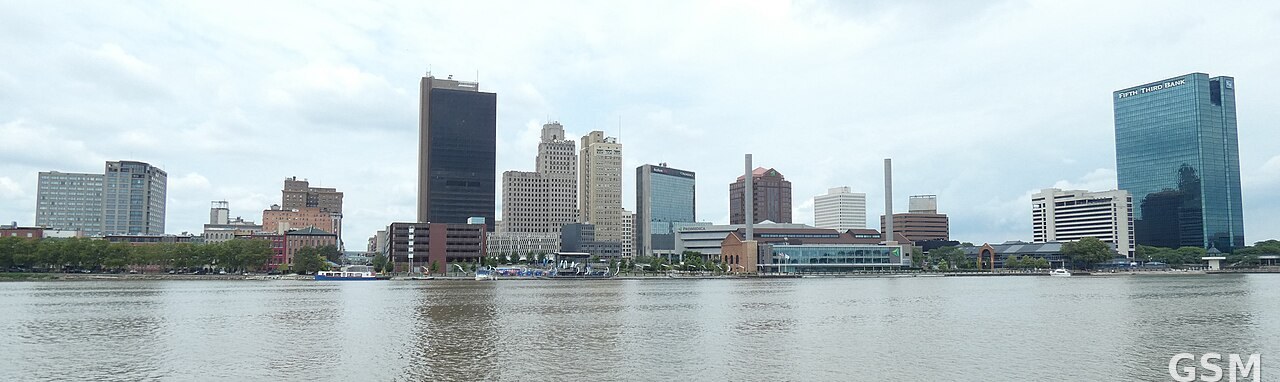
Photo: 图:俄亥俄州 Toledo 市区天际线与 Maumee 河(资料图,非事发现场)。MrJacon000 摄,CC BY-SA 4.0,经维基共享资源。
- 2026-10-21Toxic Chemical Release in Toledo, Ohio Forces Evacuation of Nearly 1,000; Deputy Injured as City Lets Tank Reaction Run Its CourseThis story
- 2026-10-21Follow-up: Toledo Chemical Leak Eases: 35 Treated at Hospitals, Evacuation Zone Cut to Half a Mile, Shelter-in-Place Lifted
- 2026-10-22Follow-Up: At Least 60 Treated After Toledo Chemical Leak; Jeep Plant Cancels Two Shifts, South Plant Idled for the Week
- 2026-10-22Follow-Up: Toledo Chemical Leak Sends 57 to Hospital, 7 Still Being Treated; Evacuation Radius Shrinks to a Quarter Mile as Explosion Risk Falls With Tank Pressure
- 2026-10-23Follow-up: Toledo Chemical Leak Evacuations Fully Lifted; Final 152 Residents Return Home