Feature | Fiona Ma: From Immigrant Daughter in New York to California Lieutenant Governor — An Accountant in Public Life
The Associated Press has called it: Democrat Fiona Ma, California's current state treasurer, has been elected lieutenant governor of California. In the AP's vote-count snapshot, she received 4,905,037 votes, 63.8 percent, against Republican Gloria Romero's 2,783,155 votes, 36.2 percent — a margin of about 2.12 million votes. CBS News made the same projection. These are media calls, not official certification: the Secretary of State certifies all results on December 11, and counting continues.
To California voters, Ma is first of all an accountant: since 2019 she has been the treasurer in charge of the state's money. When she takes office in January 2027, she will be California's second-highest statewide officer, the first Asian American elected lieutenant governor in state history and the second woman elected to the office. She succeeds the termed-out Eleni Kounalakis — who was herself elected treasurer this cycle; the two have effectively swapped offices.
The Eldest Daughter in New York, Three Degrees
Fiona Ma was born in New York City on March 4, 1966, the oldest of three children of William and Sophia Ma, both Chinese immigrants; her family's ancestral home is Dali, Yunnan, in China. She attended Baker Elementary School and Great Neck North Middle and High Schools, and earned a Bachelor of Science in accounting from Rochester Institute of Technology, a Master of Science in taxation from Golden Gate University and a Master of Business Administration from Pepperdine University. She has been licensed as a Certified Public Accountant in California since 1992.
San Francisco: From the Ledger to the Board of Supervisors
Before entering public office, she worked as an accountant at Ernst & Young and later opened her own accounting practice. In 1994 she was elected president of the Asian Business Association, and in 1995 the San Francisco Board of Supervisors appointed her to the city's Assessment Appeals Board. In 2002 she was elected to the Board of Supervisors from District 4, serving until 2006. There she authored the Local Business Enterprise ordinance on behalf of women and minority business owners, and advanced legislation requiring conditional use permits for new massage establishments, aimed at stopping human trafficking conducted through massage parlors.
The Accountant in the Assembly
In 2006 she was elected to the California State Assembly from the 12th District and served three terms through 2012. In March 2010 she became Speaker pro Tempore — the first Asian American woman to hold the Assembly's second-highest post. She authored the nation's first law banning phthalates, a toxic chemical, in baby products. As chair of the Assembly Select Committee on Domestic Violence, she strengthened laws protecting victims of domestic violence, including AB 593 (2012), which expanded the rights of incarcerated domestic violence survivors to petition a court to recall and resentence convictions where expert testimony on domestic violence had been limited or absent.
The Numbers Person: Board of Equalization and Treasury
On November 4, 2014, Ma won election to District 2 of the California State Board of Equalization with 1,448,657 votes, 68.5 percent, serving from 2015 to 2019. On February 24, 2016, the Board selected her as its chair for a one-year term, during which she ordered three external audits of the agency. She is one of only two CPAs ever elected to the Board.
On January 7, 2019, Ma took office as California's 34th State Treasurer — the first woman, and the first woman of color, to hold the office. As the state's chief banker and financier, she handles more than $3.9 trillion in annual transactions, oversees $124 billion in outstanding general obligation and lease revenue bonds, and serves on 16 boards, commissions and authorities related to housing, transportation, economic development and environmental financing. Her tenure advanced affordable housing financing and down-payment assistance programs, and she chairs the College Access Tax Credit Fund administered by the California Educational Facilities Authority: donors receive a 50 percent California state tax credit, and the Cal-HBCU transfer grants it funds offer up to $5,000 to community college students who complete an associate-degree transfer pathway, transfer to a partner historically Black college or university, and intend to return to California after graduation.
Her Deepest Tie to the Chinese American Community
She is honorary chair and spokesperson for San Francisco's Hepatitis B Free campaign. Hepatitis B rates run high in Asian American communities, and for years she has pushed screening and prevention there — her deepest single tie to the Chinese American community.
The Campaign: 58 Counties and One Platform
In June 2023, Ma announced her campaign for California lieutenant governor in 2026. In the June 2, 2026 top-two primary she finished first and advanced. During the campaign she traveled to all 58 California counties, and after Election Day she posted a message thanking voters, saying she was humbled to serve as the next lieutenant governor.
In her candidate statement in the Secretary of State's voter guide, her platform centered on affordability: continuing affordable housing financing, expanding down-payment assistance, proposing university partnerships to generate revenue and address housing and tuition costs, and calling for a tuition freeze. On two statewide propositions, she and Romero both opposed Proposition 40, a one-time tax on billionaires' covered assets, but split on Proposition 39, which would require government-issued identification to vote: Ma opposed it, Romero supported it.
Romero, 71, represented Los Angeles County in the Assembly and the Senate, and served as Senate majority leader from 2005 to 2008, the first woman to hold that post. In 2024 she left the Democratic Party, citing disagreements over crime, gender identity, COVID-19 restrictions and school choice, and ran as a Republican.
Lieutenant Governor: The Next Ledger
According to the Office of the Lieutenant Governor, the officeholder presides over the state Senate and casts tie-breaking votes, serves as acting governor when the governor is out of state, and succeeds to the governorship if a vacancy occurs. The officeholder also sits on the governing boards of the University of California, California State University and the California Community Colleges, serves on the State Lands Commission, and chairs the California Commission for Economic Development.
Counted from her first appointment to a San Francisco public body in 1995 to her election as lieutenant governor in 2026, this road has taken her thirty-one years — from the eldest daughter of a Chinese immigrant family in New York to the second-highest office in California, a path by which generations of Chinese immigrants have step by step entered the centers of American public decision-making.
Produced by The Star.
Source: California State Treasurer
Published by GSM · USA (original Chinese edition)
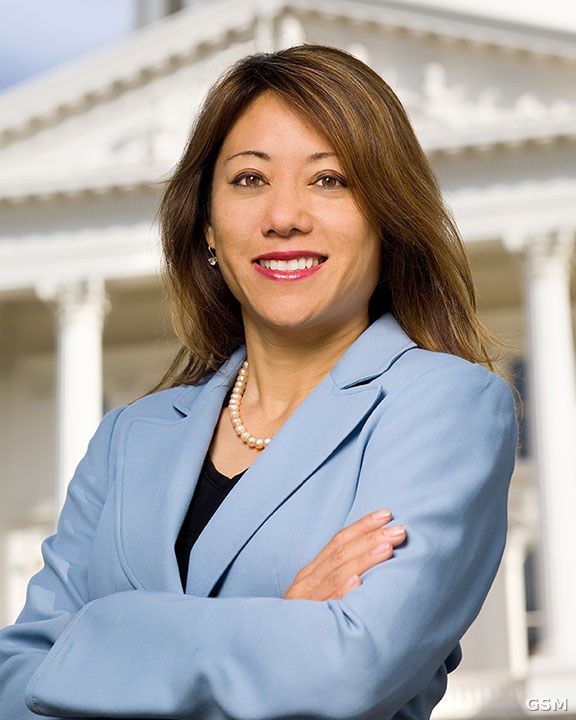
Photo: 马世云官方肖像(加州财务长办公室官方照片,公共领域,经 Wikimedia Commons)