U.S. Supreme Court Hears Catholic Preschools' Challenge to Colorado Preschool Funding Rules
The U.S. Supreme Court heard oral arguments on November 3 in St. Mary Catholic Parish v. Roy, a case in which Catholic preschools under the Archdiocese of Denver are challenging Colorado's universal preschool program for refusing them a religious exemption. A decision is expected by summer 2027.
Colorado's universal preschool program (UPK), created in 2022, funds up to 15 hours of weekly preschool education — worth more than $6,000 per school year for each child — at licensed public or private schools that agree to an "equal opportunity mandate" requiring them to serve students regardless of sexual orientation or gender identity, among other things.
St. Mary Catholic Parish, along with more than 30 other Catholic preschools in Denver, requires employees and admitted families to affirm a biblical ethic regarding gender and sexuality. The parish's application and request for a religious exemption were denied, despite other schools receiving exceptions for secular reasons such as enrollment preferences. In August 2023, St. Mary was joined by St. Bernadette Catholic Parish, the Archdiocese of Denver and two parents in a federal lawsuit alleging their exclusion violates the Free Exercise Clause of the First Amendment. A federal district court sided with Colorado in January 2024, and the U.S. Court of Appeals for the 10th Circuit upheld that ruling last year. The Supreme Court agreed to take the case this April; the defendant is Lisa Roy, executive director of the Colorado Department of Early Childhood, and St. Mary is represented by the Becket Fund for Religious Liberty.
The Southern Baptist Convention's Ethics & Religious Liberty Commission (ERLC) joined two amicus briefs supporting the petitioners. "Colorado's nondiscrimination mandate puts religious preschools in jeopardy. They must either violate their religious convictions on biblical sexual ethics or lose out on a public benefit that could result in lower enrollments or even closure of their school," said Zack Pruitt, ERLC vice president of public policy and general counsel. "The ERLC is proud to be on a brief supporting St. Mary Catholic Parish in this case."
The legal questions concern two precedents: Carson v. Makin (2022), in which the Court ruled that a state funding private education cannot exclude religious schools purely because of their religious exercise, and Employment Division v. Smith (1990), under which neutral, generally applicable laws do not violate the Free Exercise Clause — the basis on which the lower courts sided with Colorado. "Colorado has flexibly interpreted the mandate to accommodate important secular interests, but it's called the same law a hard limit when petitioners sought a religious accommodation," said Nicholas Reaves, an attorney representing St. Mary. The U.S. Department of Justice also joined the case in support of the petitioners, with Deputy Solicitor General Sarah Harris arguing there are "two paths to reversal" through either Smith or Carson.
Justice Gorsuch stated that the Constitution "deals in substance, not in shadows." Justices Jackson and Sotomayor questioned whether the schools were discriminated against or were seeking special treatment. Colorado's attorney Helen Norton argued the case is not one of religious discrimination, as UPK does not regulate schools' enrollment criteria so long as they do not violate the equal opportunity requirements, and that Colorado had no intent to discriminate. Justice Alito pointed to Colorado's recent history of Supreme Court religious discrimination cases — a Christian counselor's challenge to the state's conversion therapy law (2026), a Christian website designer case (2023) and a Christian baker case (2018) — in all of which the Court ruled for the Christian petitioners. (Source: Baptist Press)
Source: Baptist Press
Published by GSM · USA (original Chinese edition)
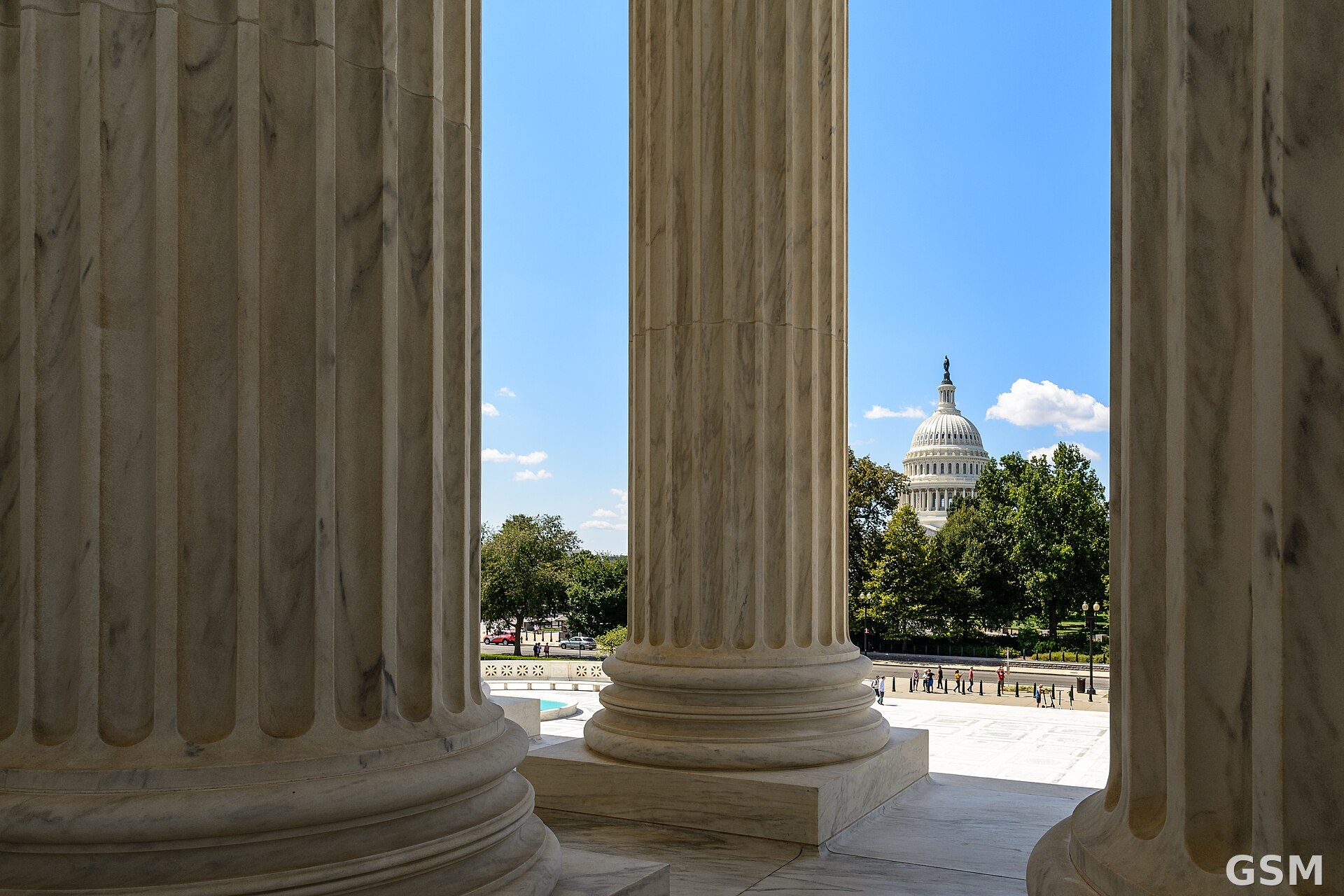
Photo: 图:美国最高法院大楼。dconvertini 摄,CC BY-SA 2.0,经 Wikimedia Commons。 / Photo: The United States Supreme Court Building. Photo by dconvertini, CC BY-SA 2.0, via Wikimedia Commons.