UCLA Writer John Harlow Loses Sight in His Second Eye, 20 Years After the First
LOS ANGELES, California - UCLA Magazine's Fall 2026 issue carries a first-person account by its writer John Harlow, featured as the lead item in UCLA's Daily Highlights briefing on November 4. Harlow, a British journalist who lives in Venice, Los Angeles, and joined UCLA in 2019, suffered a second optic stroke in July 2025 that took most of the sight in his left eye; the same affliction had blinded his right eye 20 years earlier.
In 2006, while working as a reporter for The Sunday Times of London, Harlow ignored a crescent shadow in his right eye and woke the next day to find he had lost 95 percent of its sight. The cause was anterior ischemic optic neuropathy, in which a blood clot blocks blood flow to the optic nerve. Doctors put the chance of recurrence at about 17 percent; on a summer night in July 2025, a clot struck his left eye. He now has no peripheral vision and roughly 20 percent sight remaining in the left eye, and cannot read for more than 15 minutes without a headache. Physicians at the UCLA Jules Stein Eye Institute say the disk at the back of his eye is anatomically narrow, putting him at higher risk; neuro-ophthalmologist Michael Gilhooley is among his doctors. According to the U.S. Centers for Disease Control and Prevention, about 6 million Americans are blind, and some 5,700 Americans lose sight each year to this optic nerve condition.
After losing his sight, Harlow found a new community on campus. Spencer Scruggs, director of UCLA's Center for Accessible Education, says a few dozen visually impaired students and staff are on campus at any given time, and about 7,000 Bruins a year seek accommodations through the center. Itohan Ediae, a fourth-year theater, film and television student born with albinism and nystagmus, walked the school's fashion runway earlier this year. Brandon Shin, class of 2020, lost sight in both eyes by age 12 and now practices jujitsu at the campus recreation center using echolocation. UCLA's human resources staff provided Harlow with a large-key accessible keyboard, the Braille Institute adjusted his phone settings, and text-to-speech tools have kept him writing.
Harlow plans to retire from UCLA at the end of this year. He writes that he no longer wakes each morning terrified of total blindness, and believes life will keep improving as he adjusts.
(Source: UCLA)
Source: UCLA
Published by GSM · USA (original Chinese edition)
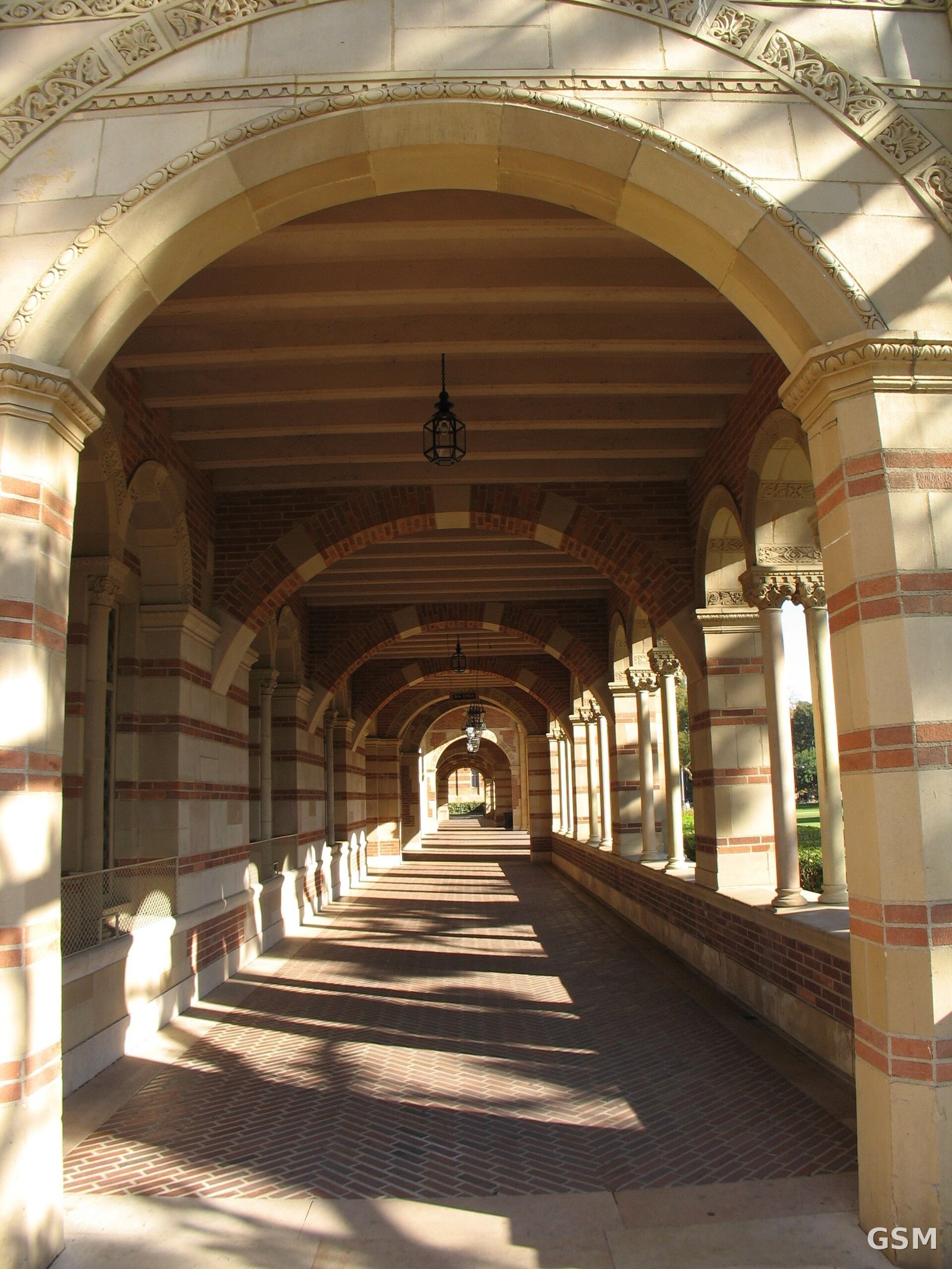
Photo: 图:加州大学洛杉矶分校 Royce Hall 外廊。CC BY 2.0,经 Wikimedia Commons。 / Photo: The arcade of Royce Hall at UCLA. CC BY 2.0, via Wikimedia Commons.