[Feature] 《The 2026 Midterms: Voters, Prices and War》
By The Star, GSM's features desk
Voting took place on November 3, 2026, and counting is still under way. The Associated Press count as of the morning of November 6 showed 405 of the 435 House seats called — 249 for Democrats and 156 for Republicans, with 30 still uncalled; Democrats retook the Senate, 54 seats to 44, with two races uncalled; in Texas, Hinojosa defeated incumbent Governor Abbott. The House popular vote stood at about 60.21 million to 46.84 million in the November 5 count. Those figures have been reported everywhere. This article uses them only as anchors and does not rewrite them.
It does not retell the national headline of control of the two chambers. Instead it reads the election from the layers least reported: state legislatures, ballot measures, county-level movement, races still uncalled, who voted and who did not, and the structure of the money. The thread running through it is the three things voters said mattered most — the cost of living, health care and war. Each party is given equal space, with every statement attributed; the Texas section reports vote facts only; on 2028, only sourced claims are used.
1. The results, in numbers
Senate: seven seats changed hands
Before the election Republicans held 53 seats to the Democrats' 47; Democrats gained a net seven. AP and NBC data on November 5 showed Democrats 54 to Republicans 44, with Mississippi and Alaska uncalled; other trackers that day ranged from 53 to 55. No Democratic seat flipped to Republicans.
In North Carolina, Roy Cooper beat Michael Whatley 58.7% to 39.1%, a margin of 19.6 points — the first flip of the night, called by AP at 8:23 p.m. Eastern; the state's first Democratic senator since 2008, for the seat vacated by retiring Thom Tillis. In 2020 the same seat went Republican by 1.8 points.
In Texas, James Talarico beat Ken Paxton 55.1% to 43.0%, 5,445,121 votes to 4,249,752, a margin of 12.1 points. Talarico is Texas's first Democratic senator since Lloyd Bentsen in 1988; Paxton had beaten John Cornyn in the Republican primary. It was the most expensive Senate race in the country.
In Maine, Troy Jackson beat incumbent Susan Collins 53.8% to 46.1%, a margin of about seven points (another tracker had 53.4% to 46.5%; the gap is consistent). Collins had served since 1996 and was seeking a sixth term. In 2020 the same seat went Republican by 8.6 points.
In the Ohio special election, Sherrod Brown beat incumbent Jon Husted 50.0% to 45.2%, 2,301,042 votes to 2,077,748, for a term ending January 3, 2029. In 2022 the same seat went Republican by 6.1 points.
In Iowa, Josh Turek beat Ashley Hinson 50.5% to 46.4%, 686,487 votes to 630,615. This was the call that locked the Senate majority, made by AP at 11:35 p.m. Eastern, for the seat vacated by retiring Joni Ernst; Iowa's first Democratic senator since 2008.
In Kansas, Adam Hamilton led by about 4.9 points; Kansas last had a Democratic senator in 1932. In South Carolina, Annie Andrews led by about 4.4 points; the seat has been Republican since Strom Thurmond switched parties in 1964.
Two other seats were holds, not flips: in Michigan, Abdul El-Sayed was called the winner by AP at 2:27 a.m. Eastern on November 4, the first Muslim elected to the U.S. Senate, holding a Democratic seat; in Georgia Jon Ossoff was reelected and in the Florida special election Ashley Moody won, both holds.
Governors: five seats changed hands
Thirty-six governorships were on the ballot. Before the election Republicans held 26 states to the Democrats' 24; after it, Democrats held at least 28 to Republicans' 20, with Kansas and Alaska uncalled. AP called it the first Democratic majority of governorships since 2006.
In Texas, Gina Hinojosa beat incumbent Greg Abbott 52.8% to 45.7% (AP, 98% counted). In Georgia, Keisha Lance Bottoms won 54.3% to 45.7%, the state's first Black woman governor; Georgia's last Democratic governor left office in 2003. In Ohio, Amy Acton won 52.3% to 44.4%, the state's first elected woman governor; Ohio's last Democratic governor predated the 2010 election. In Iowa, Rob Sand won 55.5% to 44.5%, ending a decade of Republican control of state government. In Nevada, Aaron Ford beat incumbent Joe Lombardo 51.7% to 44.2%, giving Democrats the governorship and both legislative chambers — a trifecta.
Texas and Nevada were incumbent defeats; Ohio, Iowa and Georgia were open seats. Of the 22 governor candidates endorsed by Trump, 10 won and 11 lost, with Alaska uncalled; of 27 Trump-endorsed candidates challenging Democratic seats, none had flipped one as of 3 p.m. Eastern on November 4 (USA Today analysis).
State legislatures: at least nine chambers changed hands
At least nine state legislative chambers flipped from Republican to Democratic, all in the Democrats' direction; another count put the figure at "as many as 12 chambers" (Axios, via Newsmax; see the sourcing note at the end). Control of the legislature changed in seven states (MultiState, as of 6:45 p.m. Eastern on November 4): New Hampshire and Wisconsin flipped both chambers; Michigan (House), Minnesota (House, previously tied 67–67), Pennsylvania (Senate), North Carolina (House) and Texas (House) each flipped one chamber. Alaska, Arizona and Georgia were uncalled at the time.
In New Hampshire, Democrats took the House with 292 seats and the Senate 15–9; Republican Governor Kelly Ayotte was reelected, but the loss of both chambers ended the state's Republican trifecta. In Wisconsin, Democrats flipped three Senate seats for 18 in total and all eight targeted House seats, 53–46, ending a Republican legislative majority held since 2011; Governor David Crowley (Democrat) won. In Pennsylvania, Governor Josh Shapiro claimed a Senate split of 26–24, ending 32 years of Republican control of that chamber; the state has a Democratic governor and both chambers for the first time since 1994, and its first trifecta since 1992.
In Arizona, Governor Katie Hobbs was reelected; Democrats could flip both chambers, which would be the state's first trifecta since 1966 and its first full legislative control in 60 years. In Michigan the House flipped and the Senate was held, with Governor Jocelyn Benson (Democrat) winning, forming a trifecta. In Minnesota the House was won by Democrats after a 67–67 tie and the Senate held, with Governor Amy Klobuchar (Democrat) winning, forming a trifecta. In North Carolina the House flipped — Republicans 71 to Democrats 49 before, Democrats 70 of 120 seats after — while the Senate stayed Republican, moving the state from Republican control to divided government. In Texas the House flipped, the first Democratic control since Republicans took it after the 2002 election, while the Senate stayed Republican. In Georgia the House was leaning Democratic; a flip would be the first Democratic control since before the 2004 election, and was uncalled.
Trifectas: Democrats added Michigan, Minnesota, Nevada, Pennsylvania and Wisconsin; Republicans lost Georgia, Iowa, Ohio and Texas (National Conference of State Legislatures; another count says five states, including New Hampshire). Democrats hold trifectas in 22 states to Republicans' 18 (Newsmax, citing AP). Democrats broke or blocked Republican supermajorities in nine chambers across eight states: Florida, South Carolina, Indiana, Missouri, Iowa, Ohio, Kansas and North Carolina. If current leads hold, Democrats would control 51 of the country's 99 legislative chambers, up from 39. Katie Owens Hubler, the NCSL's director of elections and redistricting, called it the largest single-election shift in state-government party power since 2010.
Ballot measures: voters deciding directly
California had 14 statewide propositions (preliminary results of November 4, with mail ballots still being counted). Proposition 39 (requiring voter identification) was rejected, about 59% voting no (AP: 58.6% no to 41.4% yes, about 60% counted). Proposition 40 (a one-time 5% tax on assets over $1 billion, 90% for health care) was still uncalled: as of the evening of November 5, AP's live count had No at 4,733,204 votes and Yes at 3,928,206, No leading by about 55%, with AP not yet calling it. Proposition 3 (making a temporary income tax on high earners permanent, for schools and health care) passed with 58.7%. Proposition 1 (a $11.25 billion housing bond) passed with 59% in favour; Proposition 37 (a $25 billion low-interest homebuyer loan programme) passed with 61%; Proposition 2 (raising the rainy-day fund cap) passed with 60%. Proposition 44 (community clinic spending requirements) was rejected, about 82% voting no. Propositions 41 and 42 were competing alternatives to Proposition 40: Proposition 42 was leading with 55% support, Proposition 41 trailing (47.5% to 52.5%); either, if passed with more yes votes than Proposition 40, would block Proposition 40 from taking effect. Proposition 5 (changing recall procedures) led by less than one point, the measure most likely to flip as counting continued; Proposition 45 (environmental review rules) trailed by about eight points. In the governor's race, Xavier Becerra (Democrat) beat Steve Hilton, called by AP at 8:12 p.m. Pacific, leading by nearly 28 points.
Elsewhere (Ballotpedia summary): on abortion, Missouri Amendment 3 and Idaho Proposition 1 failed, Nevada Question 6 and Virginia Question 1 passed. On basic rights, Virginia Question 2 (marriage equality), Vermont Proposition 4 (anti-discrimination), Vermont Proposition 3 (unions) and Arkansas Issue 4 (clean water funding) passed. On schools, Alabama Amendments 3 and 4 (oath, prayer, national anthem) passed; Arizona Proposition 142 (banning DEI) failed and Proposition 318 (transgender bathrooms and sports) passed; Nebraska Initiative 442 (sports by biological sex) passed; North Dakota Measure 2 (free school meals) failed. On voting and elections, Alaska Issue 3, Arkansas Issue 1, a Kansas citizenship voting requirement, South Dakota Amendment J and a West Virginia citizenship voting requirement passed; Virginia Amendment 3 (restoring voting rights to people with felony convictions) passed; Montana I-194 (banning corporate donations) passed. On voter identification, nine states had measures requiring photo ID or citizen-only voting; all but two passed, including Ohio Issue 1 with 65.3%, while Arizona Proposition 144 was on the edge of rejection, 53.2% no to 46.8% yes with about 85% counted.
On data centres, a little-reported layer: of 41 local referendums, 40 produced results favouring limits on data-centre development — 27 approved restrictions and 13 rejected pro-development proposals. The approved limits included five full bans (California, Florida, Ohio), 12 partial bans (Kansas, Maine, Ohio), three six-month pauses in Maine and two zoning measures in Adams County, Ohio. All 18 municipalities in Ohio that voted on the issue passed limits. The only pro-development result was the rejection of one review requirement in Harwood, North Dakota.
Races still uncalled
Mississippi Senate: Democrat Scott Colom leads Republican incumbent Cindy Hyde-Smith. As of the afternoon of November 5, AP's live count had Colom at 466,775 votes to Hyde-Smith's 464,962, a lead of 1,813, with 99.83% of precincts reporting; AP has not called it. The lead has moved repeatedly as counting continued: it was 43 votes on election night and 1,724 in the morning batch of November 5. About 3,600 mail ballots can still arrive, affidavit ballots are being verified, local certification is due November 13, and the state has no recount law.
Alaska Senate: Democrat Mary Peltola leads Republican incumbent Dan Sullivan by 637 first-choice votes, with about 75,000 ballots still uncounted; the ranked-choice tabulation is set for November 18. Preliminary ranked-choice modelling from the ballots counted so far puts the two near a tie, with Sullivan slightly ahead after transfers — a preliminary model, not a result.
The Alaska and Kansas governor's races were also uncalled: in Kansas, Holscher led Masterson 50.3% to 49.7%; in Alaska, Kreiss-Tomkins led Wilson 49.2% to 29.2%, according to NBC's projection at 12:30 p.m. on November 4. In the House, 42 seats were uncalled as of the early hours of November 5 (NBC); the number of Democratic flips was moving — 32 in USA Today's evening count of November 4, 31 by Decision Desk HQ — each a snapshot at a different time.
Early voting: 57.53 million ballots, a record
The University of Florida's Election Lab counted 57,530,789 early votes as of 6:40 p.m. Eastern on November 2 — 31,872,117 in-person early votes and 25,658,672 returned mail ballots. Final early voting in the 2022 midterms was 45,920,446; 2026 was about 11.6 million more, an increase of about 24% to 25%, which AFP called a midterm record. The most early votes came from Texas (over 7.7 million) and Florida (over 5.4 million). There is no verified final total turnout yet; NBC's Decision Desk estimated that overall turnout as of 6:30 p.m. on Election Day was tracking close to 2022.
By party registration (27 states that publish it): Democrats about 43% to 44%, Republicans about 31% to 32%, unaffiliated or minor-party about 25%. Party registration is not the same as vote choice, as multiple sources note.
By age — data others used little: nationally, voters aged 18 to 29 made up about 8% of early voters and those aged 30 to 39 about 9%, with under-40s about 17% in total; about 9.1 million under-40s voted early or by absentee ballot, including nearly 3.5 million aged 18 to 29, up 59% on the same point in 2022. State snapshots show voters 65 and older making up more than half of early ballots in most states: Michigan 60.5% aged 65 and over and 5.5% aged 18 to 29; Florida 56.9% and 2.8% aged 18 to 24; Ohio 56.5% and 3.5%; California 52.9% and 4.0%; Georgia 41.4% and 5.2%. In Georgia, about 310,000 voters aged 18 to 29 cast early ballots, about 11% of 2.8 million early ballots; voters 50 and older made up nearly 65% of early ballots; in the first nine days of early voting, in-person voting by under-30s rose 54% on 2022, and young Black voters rose 80%. In the four Dallas–Fort Worth counties (Dallas, Tarrant, Collin, Denton), as of October 28, turnout among registered voters 65 and older was about 50.5%, against 18.4% for those aged 18 to 29 — about 2.7 times higher.
The structure of the money
Federal Election Commission figures for the 12-month period (as summarised): congressional candidates raised $1.49 billion and spent $851.9 million; political action committees raised $4.61 billion; outside groups spent $2.51 billion independently, including $1.33 billion by conservative groups, $880 million by liberal groups and $302.6 million by nonpartisan or single-issue groups.
Small donations differed sharply by party: Democratic congressional candidates received $588.7 million in donations under $200, against $140 million for Republicans; small donations were 44% of Democratic fundraising and 34% of Republican fundraising; donations of $2,500 or more were 37% of Republican fundraising and 25% of Democratic fundraising. By candidate: Talarico raised $75.3 million in small donations against Paxton's $5.37 million; Ossoff raised $66.1 million against Mike Collins's $2.72 million. ActBlue (the Democrats' main online fundraising platform) grew from 4.9 million donors to about 6.6 million; WinRed (the Republicans' main platform) had about 1.5 million donors this cycle; Talarico alone attracted about as many ActBlue donors as all Republican candidates and committees combined drew through WinRed. ActBlue reported processing $833 million in the third quarter of 2026, its best non-presidential quarter ever, up 29% on the third quarter of 2022.
On large donations: Elon Musk gave $158 million to the Senate Leadership Fund in September, about 58% of that fund's income for the month; the fund has spent $358.7 million. Talarico raised over $134 million across the cycle, including a record $64 million in the third quarter, with about 97% of donations at $100 or below; Ossoff raised $109.2 million, with over 98% of third-quarter donations below $100 and an average of $38. VoteHub's analysis warned against treating fundraising as a decisive predictor of results: "Campaign finance is not the clearest signal of November performance."
2. What voters said
The AP Voter Poll was conducted by SSRS for AP, ABC, CBS, CNN, Fox News Media, NBC and Versant, covering more than 100,000 voters in 50 states — Alaska from October 19 to November 3, other states from October 22 to November 3.
On issues: about nine in ten voters called the cost of living a "critical" or "important" factor in their House vote, and about six in ten of those backed Democratic House candidates. Government corruption tied the cost of living at the top: about half of voters called government corruption and the cost of living "crucial" to their House vote; in NBC's exit poll, about nine in ten respondents called each a critical or important factor. Preliminary AP/NBC voter-poll data (November 4) put the share calling each issue a critical or important factor at: government corruption 90%, cost of living 89%, the Iran war 74%, immigration enforcement 73%, artificial intelligence and data centres 56%. About four in ten voters called the economy the country's most important issue, and about three in ten named the state of democracy.
Pre-election polls for comparison: an AP–NORC poll of October 8–12 (1,119 adults, margin of error ±3.9 points) found 85% calling the economy and 84% the cost of living the most important issues; 74% disapproved of Trump's handling of the economy and 79% of his handling of the cost of living; 64% disapproved of Trump overall; eight in ten wanted major change or a complete overhaul in how the country is run. A Reuters/Ipsos poll found 47% of registered voters calling the cost of living the most important factor in their vote, and 73% saying the cost of living was heading in the wrong direction. A Gallup poll of October 29 found the economy and health care tied at 50% as "extremely important", followed by the Iran conflict at 47%, income inequality at 44%, gasoline prices at 42% and immigration at 40%.
On who is blamed for prices and war, in poll numbers only: about two-thirds of voters said Trump's own policies fuelled inflation, against about half blaming Biden's policies in the 2022 midterms. Consumer prices rose 3.7% over the past 12 months, up from a 3% inflation rate at the start of Trump's second term. About six in ten voters called the U.S. military action against Iran a "wrong decision"; about six in ten said government immigration enforcement had "gone too far", and a similar share disapproved of Immigration and Customs Enforcement's performance. Eighty-six percent of Americans said the war harms the cost of living, including 76% of Republicans. About three-quart-fourths of voters said they felt "angry" or "dissatisfied" with the direction of the country, and only about one-fourth "satisfied" or "enthusiastic". About six in ten voters supported a larger government role in lowering health-care costs, and about six in ten believed artificial intelligence will harm society, fearing job losses and financial instability. On economic trust, Trump led by seven points in 2024; in 2026 Democrats led by six.
Age and ethnicity, in cross-tabs: voters aged 18 to 29 backed Democratic House candidates 72% to 25%; ages 30 to 44, 60% to 36%; ages 45 to 64, 51% to 47%; ages 65 and over, 48% to 51%. First-time voters aged 18 to 24 backed Democrats 76% to 21%. In 2024, voters aged 18 to 29 backed Trump 55% to 42%. About nine in ten Black voters backed Democratic House candidates, up from about eight in ten backing Harris in 2024; Black women backed Democrats almost unanimously; only about one in ten Black men backed Republicans, down from about one in four backing Trump in 2024. Hispanic voters backed Democratic House candidates by about six in ten, against about one-third for Republicans; in 2024 about four in ten Hispanic voters voted for Trump. About seven in ten Hispanic voters said Trump's policies had worsened the U.S. economy.
Moderates and low-income voters: eight in ten moderate voters said Congress was doing "not enough" to check presidential power. Among voters earning under $50,000, 39% said inflation caused severe hardship, against 15% of high earners; more than half of low-income voters chose Democrats in 2026, while the group split evenly between Trump and Harris in 2024. Six in ten voters under 30 said they voted specifically against the president; about seven in ten voters wanted Congress to do more to check presidential power.
Data centres also entered voters' calculations: an NBC poll found 23% of voters saying data centres played a "key" role in their vote, and 33% calling the issue key. A University of Massachusetts Amherst poll in September found only 11% of Americans favouring a data centre being built where they live, and 65% opposed. In Shelby County, Tennessee (Memphis, home of Musk's Colossus data centre), the Democratic vote share rose from 71% to about 85%.
3. What each party said
Democrats
House Democratic Leader Hakeem Jeffries, expected to become Speaker, told CNN: "We campaigned on affordability, we won a decisive victory on affordability, and now we have a responsibility to govern on affordability." He also said: "You will have a Congress that understands we don't work for the president." And: "We will fight for the heartland of America." The House Democratic Caucus will meet next week and publish its agenda; the new majority's focus is "affordability and accountability". In the same interview Jeffries said Democrats still had a responsibility to ensure "wrongdoers in the Trump administration are held accountable".
Senate Democratic Leader Chuck Schumer, confident of becoming majority leader, called the result a "generational" realignment, while warning his party had no blank cheque to legislate beyond what Americans want: "Voters did not give us the majority to do whatever we want." In his victory speech he told Americans who backed Democrats five words: "Relief is on the way." On November 5, at a Washington forum hosted by the Center for American Progress, he said lowering costs must be the top priority and affordability "must be the most important thing". Schumer told reporters Democrats would work to lower prices while investigating when they believed the government had acted unlawfully.
The Democrats' consensus agenda for the new Congress (Reuters, interviewing newly elected and returning members): make Affordable Care Act plans more affordable, reverse some of Trump's cuts to Medicaid (the government health programme for people on low incomes), and end tariffs and the Iran war. Democratic plans (Wall Street Journal, via Newsmax): revisit Trump's large tax-and-spending law, including Medicaid work requirements, food-aid cuts and tax provisions favouring businesses and wealthy Americans; restore expanded Affordable Care Act subsidies, address housing costs, consider changes to Social Security financing (including raising the payroll-tax income cap); challenge Trump tariffs, address energy prices and seek an end to the Iran war (ABC).
Divisions inside the party (Reuters): beyond broad agreement on "affordability", Democrats disagree on whether voters authorised vigorous investigation of Trump and his family, impeachment or embracing progressive priorities such as Medicare for All. Reuters quoted an unnamed Democratic leader: "I have not had a single member of the House Democratic Caucus talk to me about impeachment." Accountability work will be led by Jamie Raskin (Maryland), the Democrats' leader on the House Judiciary Committee, and Robert Garcia (California), the Democrats' leader on the House Oversight Committee.
Senator Chris Van Hollen (Maryland Democrat, who has hinted he may run for president in 2028) said Democrats need to pursue several goals at once, including holding the government accountable for "serious corruption", working to end the Iran war and uniting behind a positive economic agenda for working-class Americans. Democratic National Committee Chair Ken Martin said the result reflected a broader shift among the groups that helped Trump win the White House. Labour activist Saru Jayaraman (who advocates raising the federal minimum wage) said Democrats should "show their cards" and put forward the policies they want to form their presidential platform: "What better way to win the 2028 election than to pass these bills in the House and Senate, put them on the president's desk and see whether he signs them?" Illinois Governor JB Pritzker, speaking at the Center for American Progress event, said medical debt and student debt were also issues Democrats should address at the federal level, and that oversight and affordability should be Congress's main focus next year.
Democratic strategist Doug Sosnik (Reuters) said: "Last night's results, Democrats of every stripe can find affirmation in." He added that progressives and moderates would both claim their ideological path had been vindicated, and that a fierce intraparty fight would come as the 2028 race formally began.
Republicans
President Donald Trump, asked about Vice President Vance's claim that the Iran war cost Republicans the election, said it was "basically true" but that he had no regrets. He told reporters the Iran war had "raised gasoline a little in the short term", but that he believed fighting to stop Iran advancing nuclear weapons was worth it. After the Texas governor's race, he posted on social media calling Abbott a "RINO" (Republican in name only). On election night he had urged voters to pretend he was on the ballot; the day after the election he visited the White House ballroom construction site and talked about non-election matters (USA Today live coverage, November 4).
Vice President JD Vance wrote on social media: "We lost because of the war." He added: "The president himself said so last night." According to Blaze Media's summary of his long social-media post, Vance said Republicans lost because many voters who backed Trump and Vance in 2024 turned out this time and voted Democratic; polls showed the top reasons for switching were ending the war, focusing on the cost of living and inflation, America First, and changing the relationship with Israel. He defended Rachel Campos Duffy, warned against an expected "whitewash" and amnesty proposals, and urged supporters to turn their anger into electing like-minded Republicans.
Senator Ted Cruz of Texas (Republican, openly interested in a 2028 presidential run, not up for reelection before 2030) wrote in a long social-media post on November 4: "Texas is blue. Those are hard words to say. But today, at least today, Texas is blue." "As of today, I am the only remaining statewide elected Republican in Texas. Those are words I never thought I would say." He also wrote: "2026 was not just a blue wave; it was a blue tsunami. It was a shellacking. It was not just a bad 2006 midterm. It was a Watergate-level repudiation." Cruz said: "Tariffs made everything too expensive, and the Iran war dragged on too long." "Voters are angry, and elected Republicans have not done enough to address their very real pain." He called on Trump to end the war still under way, and called the newly elected Senator Talarico to congratulate him. Cruz also said: "Texas will turn red again." "We will rebuild as a true blue-collar party, not by embracing socialism, but by being true free-market conservatives." He warned Democrats would "overreach" and "go too far", possibly advancing what he called a "radical transgender agenda", and that "many Americans will be hurt. Texans will be hurt." He said Republicans had lost key voters — blue-collar voters, evangelical Christians, farmers and ranchers, young people and Hispanics — because the party had not done enough to address their pain.
House Speaker Mike Johnson of Louisiana (Republican) had said for weeks that the polls were wrong and Republicans would "defy history" and keep the House majority; he has now said he will not run for House minority leader (CNN).
Among Texas Republican voters (Washington Examiner reporting, via Newsmax), at least some blamed Trump and congressional Republican leaders for the defeats; some also blamed Senate Majority Leader John Thune of South Dakota and Speaker Johnson; the factors they named included Trump tariffs, rising consumer prices, the Iran war and tough immigration enforcement; some called for a leadership change before the 2028 presidential election. Steve Meng, a 35-year-old grocery-store clerk, said: "In 2028, I want to say to the Republican Party: get rid of Trump and Vance and move on."
CNN's analysis (not a quotation) held that Trump made the campaign overwhelmingly about himself; that he intervened in Republican primaries, producing candidates who were harder to elect (a repeat of 2018); that late in the campaign he dismissed affordability concerns and repeatedly focused on unpopular topics such as the Lincoln Memorial reflecting pool; and that Republicans still plainly dared not blame him.
4. Texas
The numbers
Governor: Hinojosa 5,230,929 votes to Abbott's 4,524,955 (AP, 99% of precincts reporting). Hinojosa is Texas's first Latino governor; the first Democratic governor since Ann Richards was elected in 1990 (Richards served 1991–1995); Democrats won a Texas statewide election for the first time since 1994. Abbott called Hinojosa to congratulate her at about 10 p.m. Central on election night, saying: "After looking at all the details from every county in the state, I decided to call to congratulate her on winning the Texas governor's race… Mathematically, we cannot win this election." Hinojosa takes office on January 19, 2027.
Senator: Talarico 5,445,121 votes to Paxton's 4,249,752, 55.1% to 43.0%. Lieutenant governor: Vikki Goodwin beat incumbent Dan Patrick 51.7% to 45.7%. The attorney general's office went to a Democrat; Jon Rosenthal won the Railroad Commission, becoming the first Jewish candidate elected to statewide executive office in Texas. Democrats were positioned to win every statewide office on the ballot and had a chance to take control of the Texas House (USA Today, November 4).
Texas House: Democrats gained at least 18 seats (unofficial results); control was uncalled; a flip would be the first Democratic control since Republicans took it after the 2002 election. Republicans were expected to keep the Texas Senate (Texas Tribune, via Daily Caller).
Abbott's background: a three-term governor who won his first three governor's races by double-digit margins; he began the year with more than $100 million in funds; from July to late September he outspent Hinojosa on advertising by a wide margin (a USA Today opinion article put the ratio at 6 to 1; another count put it at 5 to 1 — different measures; see the sourcing note).
County by county
All 254 Texas counties moved in the Democrats' direction; not one moved toward Republicans. The median shift was 17.7 points; the smallest was King County at 6.6 points (the Republican advantage falling from +91.1 to +84.5); the largest was Starr County at 71.8 points. Twenty-eight counties Trump won in 2024 voted for Talarico in 2026. The figures are unofficial results from the Texas Secretary of State (as of 11:48 a.m. Eastern on November 4; some counties not fully counted).
Border counties: Starr County went from Trump leading by 16.0 points in 2024 to Talarico leading by 55.8 points; Zapata moved 63.1 points; Maverick 59.5 points; Webb, Hidalgo and Cameron (each with over 50,000 Senate votes) moved 49.5, 49.3 and 44.3 points respectively. Brewster County (home of Big Bend National Park): Abbott led by nearly nine points in 2022, Trump by 13 points and Cruz by over 10 points in 2024; in 2026 Hinojosa flipped it by eight points and Talarico won it by over 10 points. Starr County: Trump led by 16 points and Cruz by two points in 2024; in 2026 Hinojosa led by nearly 50 points and Talarico by nearly 55 points. Maverick County: Cruz led by three points in 2024; in 2026 Talarico led by 45 points.
Suburbs and big cities: Collin County went from Trump +11.1 to Talarico +12.1; Denton from +13.1 to +8.4; Williamson from +2.5 to +20.3; all three voted for Trump in 2024 and for Talarico in 2026. Tarrant County, home of Fort Worth, flipped (Trump +5.1 to Talarico +19.2); Harris moved 27.4 points toward Democrats, Bexar 25.7, Dallas 23.3 and Travis 19.2. Fort Bend moved 27.6 points (only 100 of 202 precincts reported).
Rural counties: all 171 rural counties in the state moved toward Democrats in the governor and Senate races; in the governor's race rural Texas moved more than eight points toward Democrats on 2022, and in the Senate race 7.5 points on 2024 (2024 was a presidential year, with a different turnout pattern from a midterm, so the two cannot be directly compared); rural voters were about 10.5% of the electorate, down from 11.3% in the 2022 midterm. All 16 border counties together moved more than eight points toward Democrats.
The four Rio Grande Valley counties (Cameron, Hidalgo, Starr, Willacy): Talarico and Hinojosa won about 60% to over 70%; in Hidalgo County Talarico won over 72% and Hinojosa over 70%; in Cameron County Trump won 52% in 2024, while in 2026 the Trump camp won 30% and Hinojosa 70% (Domingo Garcia, president of LULAC Adelante PAC, via FOX 7 Austin); Webb County (Laredo) moved 26 points, with Paxton at 25% against Trump's 51% in 2024; in Maverick County Trump won 59% in 2024, while in 2026 Paxton won 28% and Talarico and Hinojosa 72%. According to LULAC, about 1.6 million Latino voters voted in Texas, nearly double the 900,000 in the last midterm; counties with Latino majorities gave 72% of their votes to Democrats.
State House seats in the Rio Grande Valley: Janice Lopez (San Benito state representative) lost the HD-37 seat to Oziel Ochoa, flipping it back to the Democrats; Denise Villalobos (Republican incumbent state representative, Corpus Christi) lost; Kristian Carranza beat Jorge Borrego to win HD-118 (southeastern San Antonio suburbs); Julio Salinas (a progressive backed by Bernie Sanders) beat MAGA Republican Gary Groves in McAllen to win HD-41.
Why it flipped: sourced claims only, from both sides
From Democrats and related analysis: a return of Latino voters. Latinos make up about 30% to one-third of Texas voters (Brandon Rottinghaus, a Texas political scientist; USA Today). Trump won 55% of the Texas Latino vote in 2024, up 13 points on 2020 and 27 points on 2016, a record for a Republican presidential candidate, and won all four Rio Grande Valley counties, ending a century of Democratic control of the region. Pre-election polls: an Equis Research poll in October showed Talarico leading Paxton 58% to 33% among Latino voters and Hinojosa leading Abbott 59% to 35%; a BSP Research poll for UnidosUS showed Talarico leading among Latino voters 65% to 31%, and in the Rio Grande Valley 74% to 24%. The AP Voter Poll showed about six in ten Hispanic voters in the Texas Senate race backing Talarico and about three in ten backing Paxton; in 2024 Hispanic voters in the state were far more divided between Trump and Harris.
Rottinghaus's analysis is that Democrats traditionally won about 60% of the Latino vote in Texas, fell to near 50% in the 2024 cycle, and saw the figure recover this year; high support in majority-Latino communities was the main driver of Talarico's vote total; and the result shows Texas becoming more politically competitive, with Latino voting patterns, suburban communities and changes in traditionally Republican rural counties together driving the Democratic success. On issues, the Equis Research October poll showed rising prices and immigration enforcement as the two issues Latino voters cared about most. A Pew survey found 61% of Latino respondents saying their economic situation had worsened since Trump took office, and 68% saying Latinos in the U.S. were worse off than a year earlier (noted when cited as an analytical question, not an established fact, about why the shift happened).
On suburban voters, John Barrett, a political science professor at LeTourneau University, said large numbers of traditionally Republican suburban voters voted Democratic this time, as did Latino voters. On data centres, Hinojosa campaigned on freezing new data-centre construction until the legislature passed protections, and ending the state's tax breaks for such facilities; Texas holds more than a quarter of planned U.S. data-centre capacity to 2030; a Le Monde county analysis found Democratic votes above 40% in the two Amarillo counties (no Democrat stood in 2024), the Republican vote down five points in the Abilene county while still winning 70%, and in Reeves County west of Pecos (home of a joint Chevron–Microsoft project) the Republican vote down 20 points on 2024, with a Democrat elected.
On public schools and immigration enforcement, Toluwani Osibamowo, an investigative reporter with the Texas Newsroom (KUT Austin video explainer), said factors in low rural Republican turnout and the flipped votes included Abbott's school voucher programme and the data-centre building boom, and that culture-war issues did not win voters this time as they had before. Since Trump took office again in January 2025, Immigration and Customs Enforcement has arrested more than 50,000 people in its Harlingen and San Antonio areas of responsibility, including about 20,000 in the Harlingen area (covering most of the Rio Grande Valley) (Data Deportation Project arrest data, via Texas Observer); Texas Observer said ICE had particularly targeted the region since Trump returned to office, and that enforcement and the cost of living were jointly the region's most prominent election issues.
From Republicans: Trump posted on social media calling Abbott a "RINO". Cruz said: "Texas will turn red again." "We have not suddenly become a bunch of tofu-eating, gun-banning, pinko commie liberals in ballet skirts. That is not us. Texas is still Texas." Barrett said: "She will not be able to force any legislation through the state legislature… That means there will be divided government, and they will have to compromise." "I don't know that Latino voters are going to be loyal voters for anybody. I think these are going to be purple voters, voters that can be won." Republicans will keep the Texas Senate (Texas Tribune, via Daily Caller). A Republican consultant (KUT video explainer) called the night a "thorough repudiation" of Republican power at the state and national level, noting losses even in congressional and county districts drawn last year to favour Republicans.
5. What it means for the 2028 election
History: sourced claims only
The Brookings Institution (commentary, August 28, 2025) wrote that in 22 midterm elections since 1938, the president's party lost House seats in 20, with special circumstances in the two exceptions (2002, after the 9/11 attacks, when President Bush's approval rating was 63% on Election Day); presidential approval strongly affects midterm House results; and in the past thirty years, whenever the president's net approval (approve minus disapprove) was negative in the year before a midterm, his party lost House seats. The same article wrote: "Midterm results do not predict the winner of the subsequent presidential election. Democrats gained 26 House seats in the 1982 midterm, raising Democratic hopes, but that did not save Walter Mondale from a crushing defeat to Ronald Reagan in 1984. Conversely, Democrats losing 54 seats in 1994 seemed to put Bill Clinton's presidency in jeopardy, but he then beat Republican nominee Bob Dole by eight points."
Kyle Kondik of Sabato's Crystal Ball (University of Virginia Center for Politics) said: "Midterms should be viewed separately from presidential elections… Midterms do not necessarily predict presidential election results." "The president is not on the midterm ballot, and turnout is larger in presidential campaigns." Democrats' midterm losses in 2010 did not stop Obama being reelected in 2012; Republicans were down in both 2018 and 2020, but clearly more competitive in 2020 than in 2018; even a very bad Republican performance in 2026 does not necessarily mean anything for 2028; many voters who do not vote in 2026 will vote in 2028.
Alan Abramowitz and Norman Ornstein wrote in the Washington Post on August 15, 2010: "Midterm elections are driven largely by short-term factors, including the president's popularity and the state of the economy. They therefore say little about long-term trends and have no predictive value for the results of subsequent presidential and congressional elections. Presidents whose parties suffered major midterm losses — Harry Truman in 1946, Ronald Reagan in 1982 and Bill Clinton in 1994 — all won reelection easily two years later." Further historical figures: Clinton lost 54 House seats and eight Senate seats in 1994, Obama lost 63 House seats and six Senate seats in 2010, and both were reelected easily two years later; Trump's Republicans lost 40 House seats and gained a net two Senate seats in 2018.
What divided government means for the rest of Trump's term
Trump has two years left in office; with Democrats controlling both chambers, the U.S. enters a period of divided government (USA Today, October 20). The two obstacles are the Senate filibuster and Trump's veto; overriding a veto requires a two-thirds majority in each chamber (290 votes in the House, 67 in the Senate, counting all members voting). Democrats have promised to focus on affordability and hold the Trump administration to account; Republicans have vowed to keep advancing Trump's priorities in his final two years, including border security and domestic fossil-fuel production. The new Congress convenes in the first week of January (Reuters). House Democrats could impeach Trump a third time, but the Senate lacks the two-thirds majority needed to convict; two impeachments did not stop him; whether Democrats would want to remove their favourite opponent, hand the presidency to Vice President Vance and give him a two-year head start in 2028 is also a question — this is the view of a USA Today opinion article of October 27, 2026, and is attributed as such.
The governors elected on November 3 will oversee the 2028 presidential election in their states. Texas holds 40 electoral votes (USA Today Texas analysis).
Names mentioned for 2028: sourced mentions only; no one has confirmed running
On the Democratic side, Reuters reported on November 5 that Democrats were turning to what could be one of the most crowded and unpredictable presidential primaries in decades; no Democrat had emerged as a clear favourite; potential candidates include sitting governors and senators, many of whom have spent recent months cultivating donors, visiting early nominating states and raising their national profiles. Reuters contacted representatives of the nine best-known potential candidates; none confirmed running. The names mentioned (Reuters, via American Bazaar): former Vice President Kamala Harris (who lost to Trump in 2024), California Governor Gavin Newsom, Kentucky Governor Andy Beshear, former Transportation Secretary Pete Buttigieg and New York Representative Alexandria Ocasio-Cortez. Senator Chris Van Hollen has also hinted he may run for president in 2028 (Reuters). Democratic strategist Scott Ferson estimated that at least 30 Democrats were discussing a possible presidential run with people around them. Democrats gather in Denver on November 12 (hosted by Majority Democrats), where intraparty ideological divisions are expected to be on the agenda.
On the Republican side, the field is smaller, led by Vice President JD Vance and Secretary of State Marco Rubio (Reuters); Trump is barred by law from seeking a third term. Senator Ted Cruz of Texas makes no secret of his interest in running for president in 2028 (USA Today, November 5). CNN's analysis held that the November 3 result was a reason for Republicans to look beyond the Trump administration — beyond Vance and Rubio — for a 2028 nominee; outgoing Georgia Governor Brian Kemp has fewer ties to Trumpism.
On the Democratic internal debate (Reuters): despite the November 3 result, Democrats remain divided as the 2028 race begins over whether to move toward the centre or further left on health care, taxes, policing and foreign policy; Sosnik said progressives and moderates would both claim their ideological path had been vindicated. On the Republican challenge (Reuters): Republican candidates will face a different challenge — how to distance themselves from Trump after the November 3 rejection of his policies; they need to broaden their appeal beyond the president's base while avoiding a break with the "Make America Great Again" populist movement that has defined the party; Trump has dominated politics for a decade and may be unwilling to give up the centre stage, and his continuing hold over MAGA followers could complicate the path for the party's next standard-bearer.
A USA Today analysis of November 5 held that the key test for Democrats is balancing affordability and accountability; some fear that if Democrats do not address the price rises driven by Trump tariffs and the Iran war, the seats won on the cost of living could be lost just as quickly; recent polls show Democratic support below water, but clearly above Trump's.
6. A close in facts
Back to the facts as they stood on November 5, with counting still under way: the Mississippi Senate race led by 1,813 votes and uncalled, with local certification due November 13; the Alaska Senate race led by 637 first-choice votes, with the ranked-choice tabulation on November 18 and about 75,000 ballots still uncounted; California ballots still being counted, Propositions 40 and 5 uncalled, with California certification due December 11; state-legislature and ballot-measure figures still moving.
Early voting set a record at 57.53 million ballots, yet voters 65 and older made up about half of early ballots, voters aged 18 to 29 about 8% — up 59% on the same point in 2022; the age structure of turnout sits alongside the age divide in vote choice. At least nine state legislative chambers changed hands, 40 of 41 local data-centre referendums favoured limits on development, and all 254 Texas counties moved in the Democrats' direction — figures the headlines ignored, and the record this election leaves at state and county level.
Counting continues, certification comes later, and official results are the final word. (The Star)
Related: Jeffries Formally Announces Speaker Bid, Says Retaliation and Impeaching Trump Are Not Priorities; Texas Governor-elect Hinojosa Names Bipartisan Transition Team, With a Former GOP Lawmaker as Co-Chair
Reference: election counts and voter surveys published by the Associated Press, NBC, Reuters, USA Today, the National Conference of State Legislatures, Ballotpedia and the University of Florida Election Lab
Published by GSM · USA (original Chinese edition)
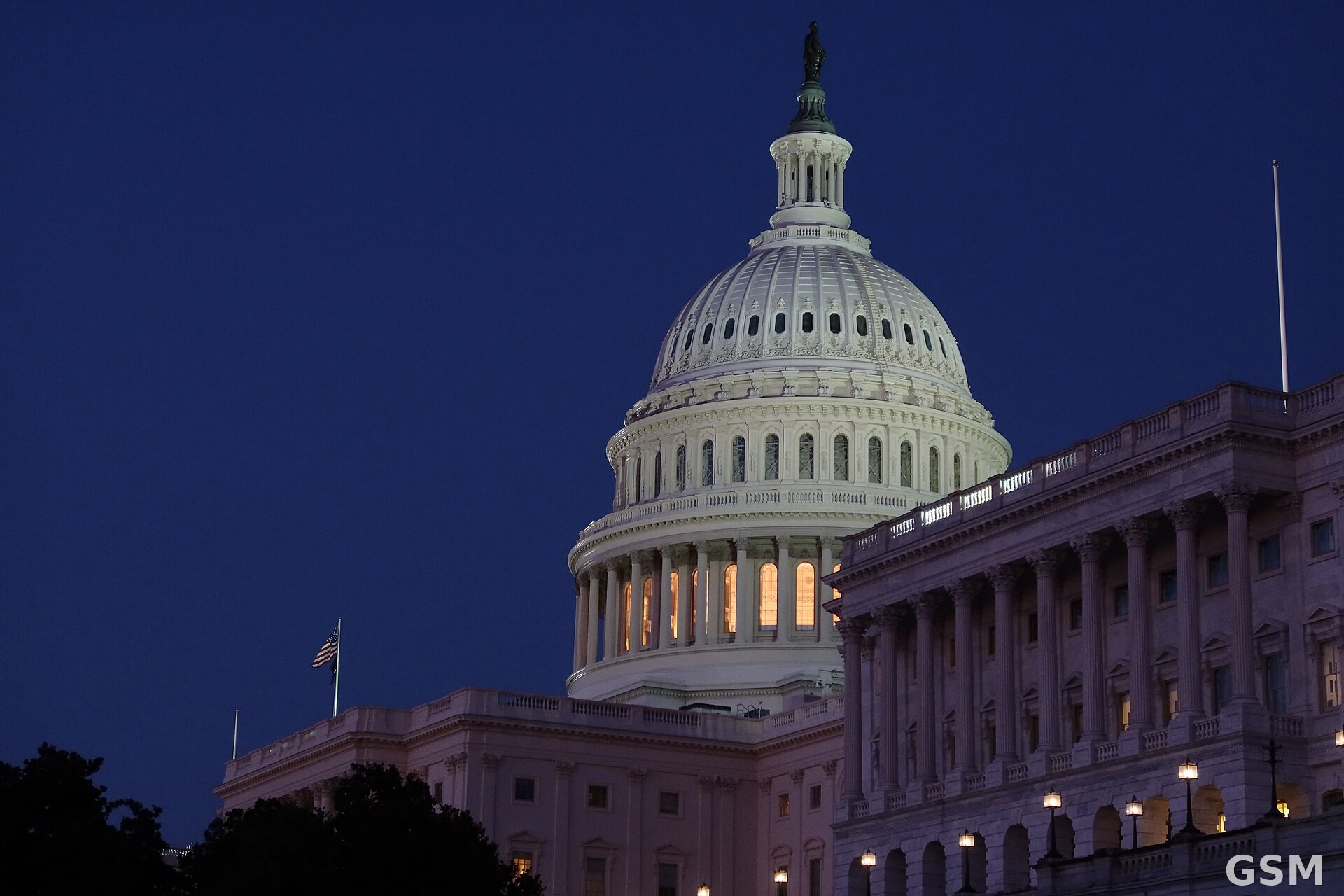
Photo: 图:美国国会大厦穹顶夜景。本届中期选举后,美国参众两院控制权易手。图片来源:Wikimedia Commons,peakfocus.agency,CC BY 4.0 / Photo: The dome of the U.S. Capitol at dusk, Washington. Image: Wikimedia Commons, peakfocus.agency, CC BY 4.0