
Webb Telescope Records 104 Magnified Stellar Events in the Dragon Galaxy About 6.5 Billion Light-Years Away, More Than Doubling the Previous Record of 44 in the
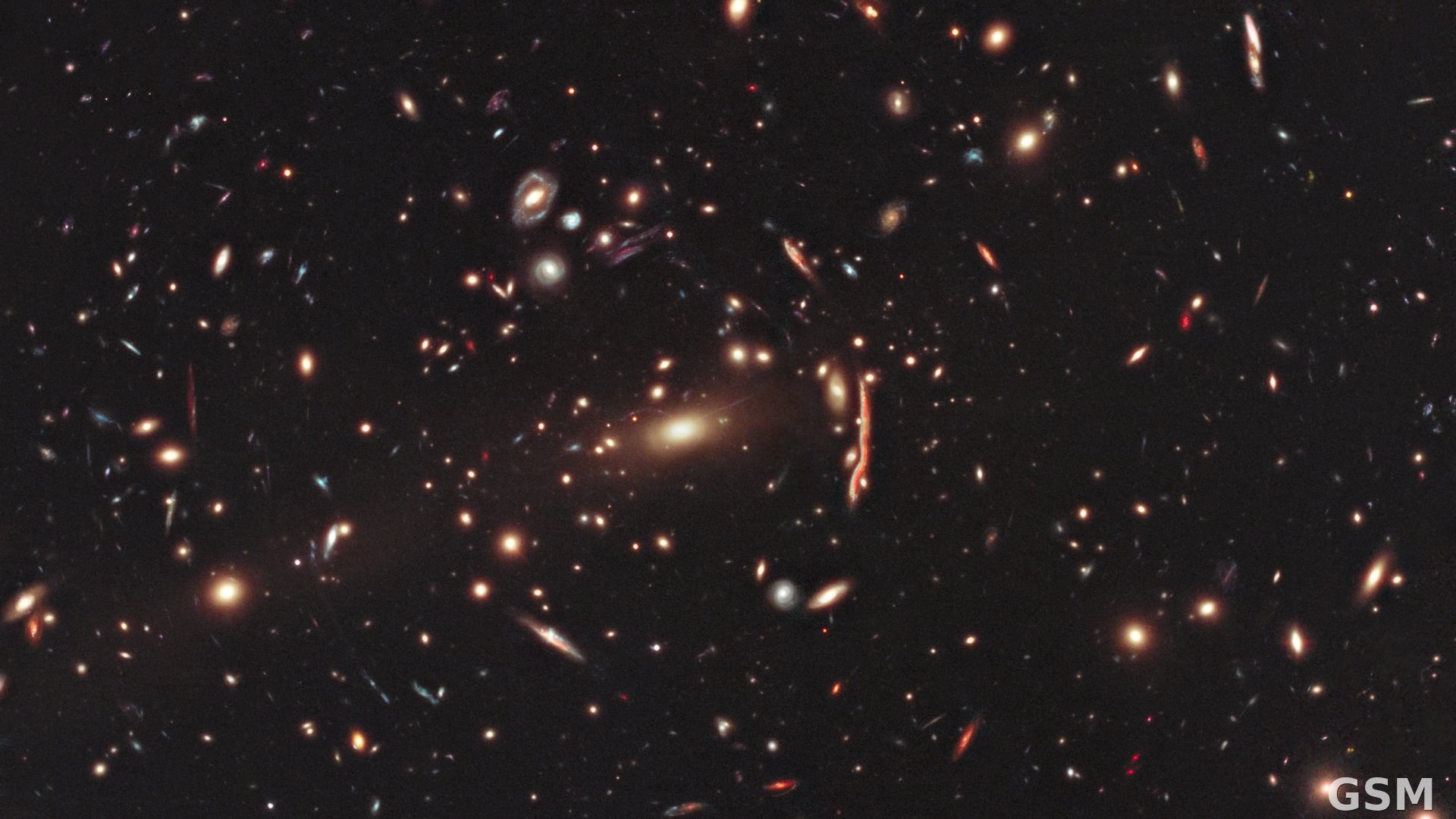
Using the James Webb Space Telescope (JWST), a team of astronomers has identified 104 magnified stellar events in a galaxy known as the Dragon, located around 6.5 billion light-years away — more than doubling the previous record of 44 such detections in the same galaxy. The paper, led by José María Palencia of the Institute of Physics of Cantabria, was published on September 30 in Astronomy & Astrophysics and reported by Phys.org on November 8.
The light from the Dragon galaxy, at redshift 0.725, is stretched and magnified by the massive galaxy cluster Abell 370, with part of the galaxy drawn into the Dragon arc. Along caustics, where lensing is strongest, stars of the cluster — and possibly dark matter — break the caustic into microcaustics; as individual stars in the background galaxy drift across them, their brightness can rise to hundreds or thousands of times normal levels before fading again within days to weeks. Comparing JWST images collected from 2022 to 2024, correcting for slightly different viewing angles and removing unrelated bright objects and other contaminants, the team merged repeated detections across filters and observations into a catalog of 104 unique caustic crossing events, which it described as the largest sample of highly magnified star candidates identified in a single galaxy.
Only the most luminous stars can be caught this way, which means the detections are almost always supergiants, in blue and red varieties. The team's color analysis showed roughly equal numbers of the two, a ratio of 1, which the paper said agrees with expectations for a relatively evolved, still star-forming system. Counting events on each side of the critical curve, the team found both sides the same far from the curve, but close to it the count dropped on one side while staying the same on the other — a pattern that fit the "fuzzy" dark matter model. The team noted the pattern could also arise from an incorrect location of the critical curve in the lens model, and that applying the method to other strongly lensed galaxies with repeated observations and better lens models can turn it into a tool for studying both ordinary stars and dark matter.
—-
Source: The Astrophysical Journal paper
Published by GSM · USA (original Chinese edition)
Photo: 引力透镜星系深空影像(资料图)。(Wikimedia Commons/公共领域)|A gravitationally lensed galaxy (file photo). (Wikimedia Commons / public domain)
 Nature Communications Study: Smallest Plagioclase Crystals From Seven Andean Volcanoes Share the Same Chemical Signature; Team Names the Pattern the 'Plagioclas2026-11-09
 Hubble Study of 37 Nearby Dwarf Galaxies Finds the Missing Oxygen: Galaxies Keep Only About 11% of the Oxygen Their Stars Made, Retaining Between 4% and 25%2026-11-09