
Blood Multi-Biomarker Panel Discriminates Alzheimer Disease from Healthy Controls: 200 Participants and 12 Markers, Scientific Reports Model Reaches AUROC of 0.9999 with External Validation Still Required
China — Scientific Reports published a blood biomarker study of Alzheimer disease on November 11, 2026, by Li, Sun, Jin and colleagues. The study aimed to screen discriminatory blood biomarkers and evaluate their performance in differentiating patients with established Alzheimer disease from healthy controls.
The study recruited 200 participants, 100 with Alzheimer disease and 100 healthy controls, and measured 12 blood biomarkers, including neurotrophic factors, tau proteins, neuronal injury markers and peripheral inflammatory indices.
Nested stratified ten-fold cross-validation was used to avoid data leakage. L1-penalized LASSO logistic regression served as the primary feature selection method, with a stacking ensemble model constructed for benchmarking. Under the lambda.1se criterion, eight predictive biomarkers were retained. Brain-derived neurotrophic factor, nerve growth factor, neurofilament light and pTau217 were robust markers consistently selected by both pipelines, while pTau231 and S100 beta represented second-tier stable markers.
The LASSO-derived model achieved an out-of-fold AUROC of 0.9999 and AUPRC of 0.9999; the stacking model reached an AUROC of 0.999 and an AUPRC of 0.999. The paper states that all performance metrics were derived from single-centre internal cross-validation and that external multi-cohort validation is mandatory before clinical application. All figures in this report follow the abstract of the paper.
Published by GSM · USA (original Chinese edition)
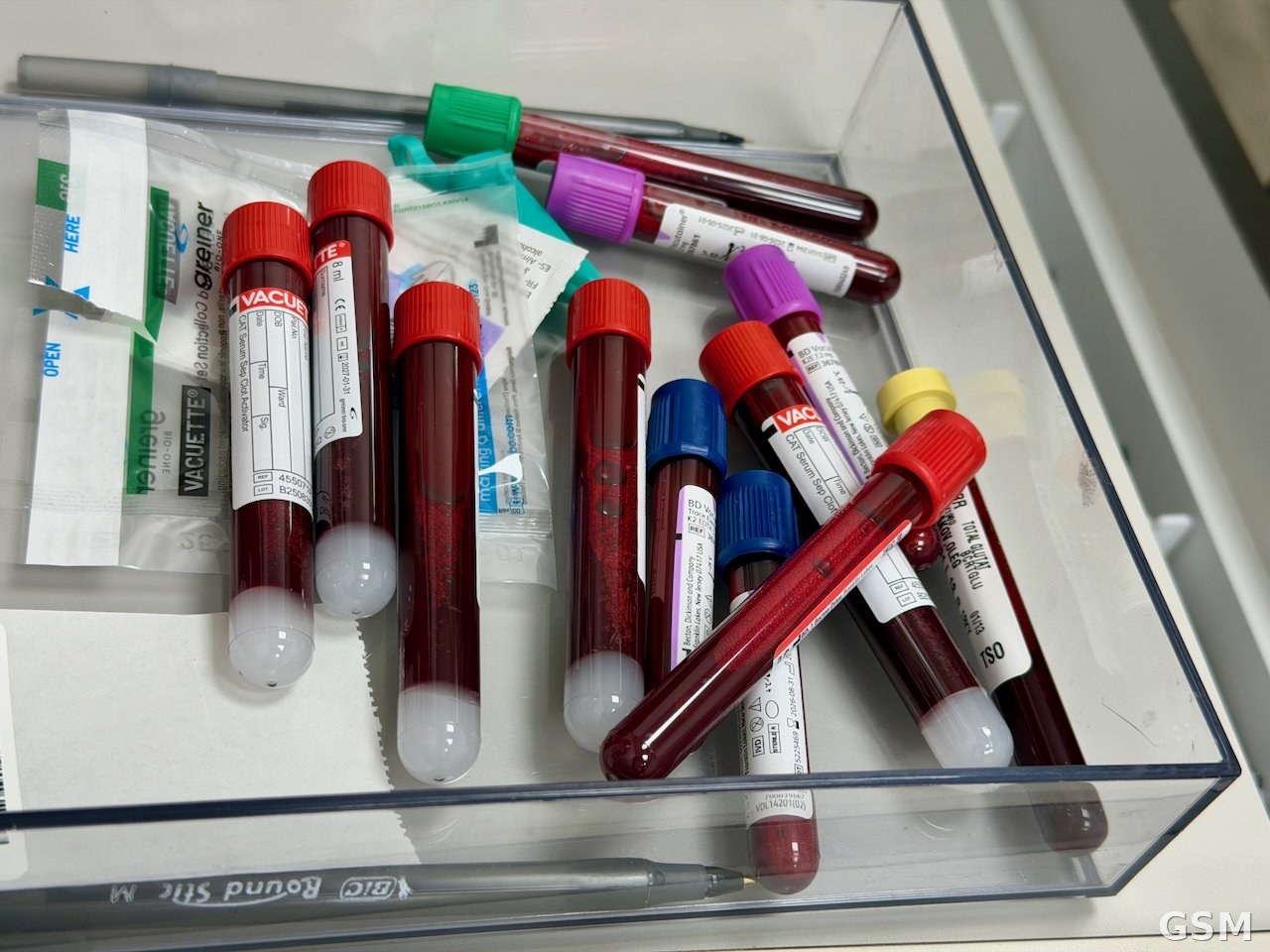
Photo: 图:图中是一排血液检测样本管。图中是血液样本管的实物照片,为血液标志物研究题材通用配图,非本研究样本。Oleg Yunakov,CC BY-SA 4.0,经Wikimedia Commons。 / Photo: file photo. Oleg Yunakov, CC BY-SA 4.0, via Wikimedia Commons.
 Study of Nearly 100,000 Americans Finds Thousands of New Drug-Gene Variants: At Least One Variant in 16 Pharmacogenes in Every Participant, One in Four Had Taken an Affected Medicine2026-11-11
 Dengue Virus Strains Show High Genomic Diversity: 411 Index Cases across 30 Sites in 7 Countries, Scientific Reports Finds All Four Serotypes Cocirculating in Latin America and Asia-Pacific2026-11-11