[Video] CERN's SND@LHC to Build First All-Silicon Neutrino Detector With 1,680 Silicon Microstrip Modules From CMS
The Scattering and Neutrino Detector at the LHC, SND@LHC, is being prepared for the High-Luminosity LHC era and will become the world's first neutrino detector based entirely on silicon technology, CERN reported on November 13, 2026. Located 480 metres downstream of the ATLAS interaction point, SND@LHC is one of only two neutrino experiments that use a particle collider as a neutrino source.
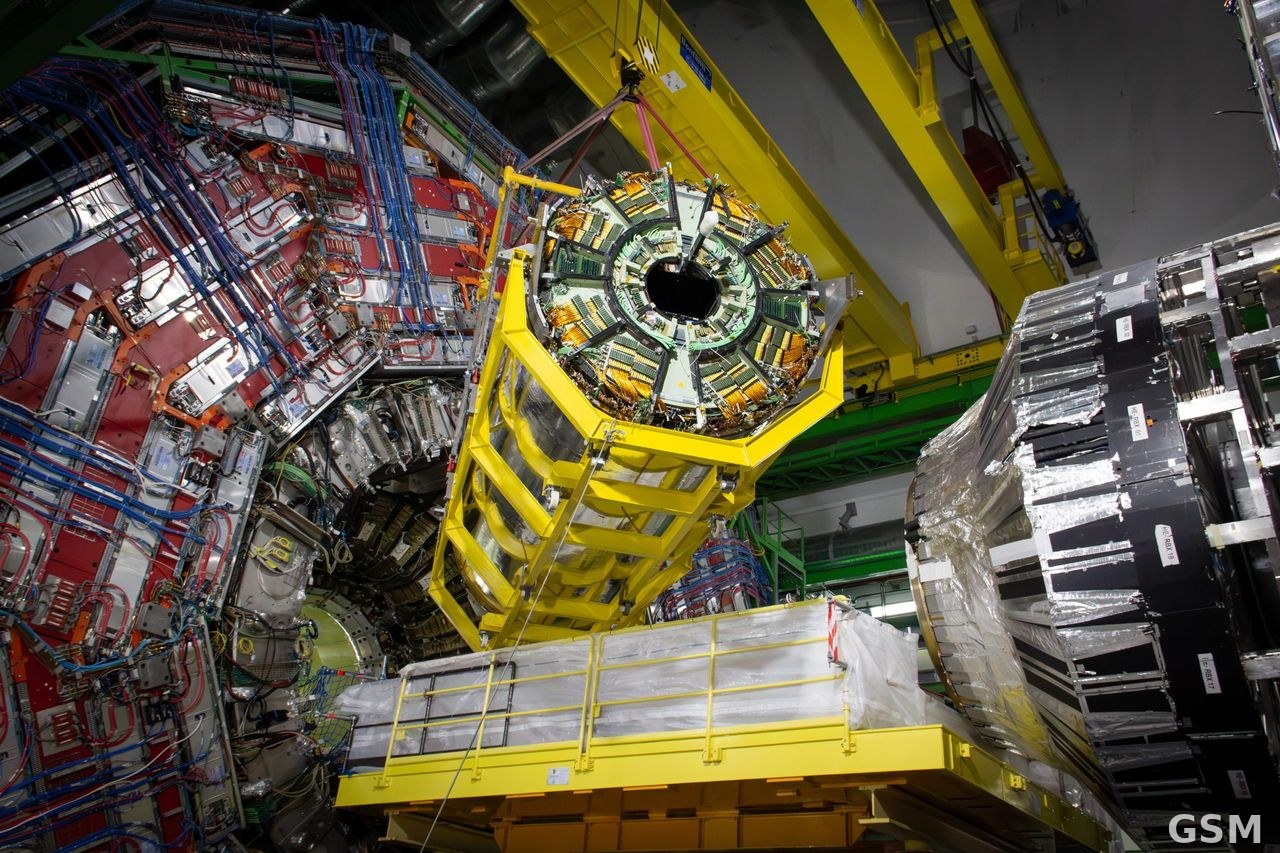
For the upgrade, the collaboration will replace its nuclear emulsion films with silicon sensors. SND@LHC has inherited 1,680 silicon microstrip modules from the outer barrel of the CMS Tracker, which CMS can no longer use because of the high radiation expected during HiLumi LHC, but which remain well suited to the more distant SND@LHC site. The silicon modules offer high spatial resolution combined with real-time readout.
The researchers are also developing a magnet to distinguish neutrinos from anti-neutrinos, essential for observing the tau antineutrino, the only particle in the Standard Model yet to be detected. A prototype of the upgraded detector has been developed and is being tested at CERN with particle beams. SND@LHC has taken data throughout Run 3 of the LHC, which began in July 2022, and has already published the first studies of muon neutrino interactions and observed electron neutrinos.
Source: CERN
Published by GSM · USA (original Chinese edition)
Photo: 图中是长停机期间从 CMS 实验中取出的硅径迹探测器,它将被改用于 SND@LHC 实验。来源:CERN, The extraction of the silicon tracker from the CMS experiment during Long Shutdown 3 which will be repurposed for the SND@LHC experiment, CERN official image。