Finland: Paired 300-Year Scots Pine Chronologies 250 km Apart Show Blue Rings Persist at Varrio in Finland but Fade at Iskoras in Norway
A study published in Tree Physiology on November 14, 2026, presents the first direct comparison of blue ring formation in Scots pine at two northern Fennoscandian treeline sites about 250 km apart, using paired 300-year chronologies. Blue rings are wood anatomical anomalies formed by incomplete lignification of latewood tracheids, providing a direct record of disruptions during the final stages of wood formation, and their formation is temperature sensitive.
Blue ring frequency was consistently higher at Varrio in Finland (67 degrees N) than at Iskoras in Norway (69 degrees N), despite strong synchrony in major blue ring years and a coherent long-term decline at both sites. Blue rings largely disappeared from Iskoras after the early twentieth century, whereas they persisted at Varrio. Daily temperature analyses suggest an association with short-lived late-season cooling, with the largest differences between blue ring and non-blue ring years occurring around mid-September.
The differences between sites were not fully explained by measures of cold exposure, the authors said. Instead, blue ring formation appears to depend on the temporal alignment between cooling events and a vulnerable phase of latewood lignification, so similar cooling may trigger failure in one population but not another. The team, led by Liliana Siekacz, includes researchers from Adam Mickiewicz University, Umea University, the University of Turin and the University of Helsinki.
Published by GSM · USA (original Chinese edition)
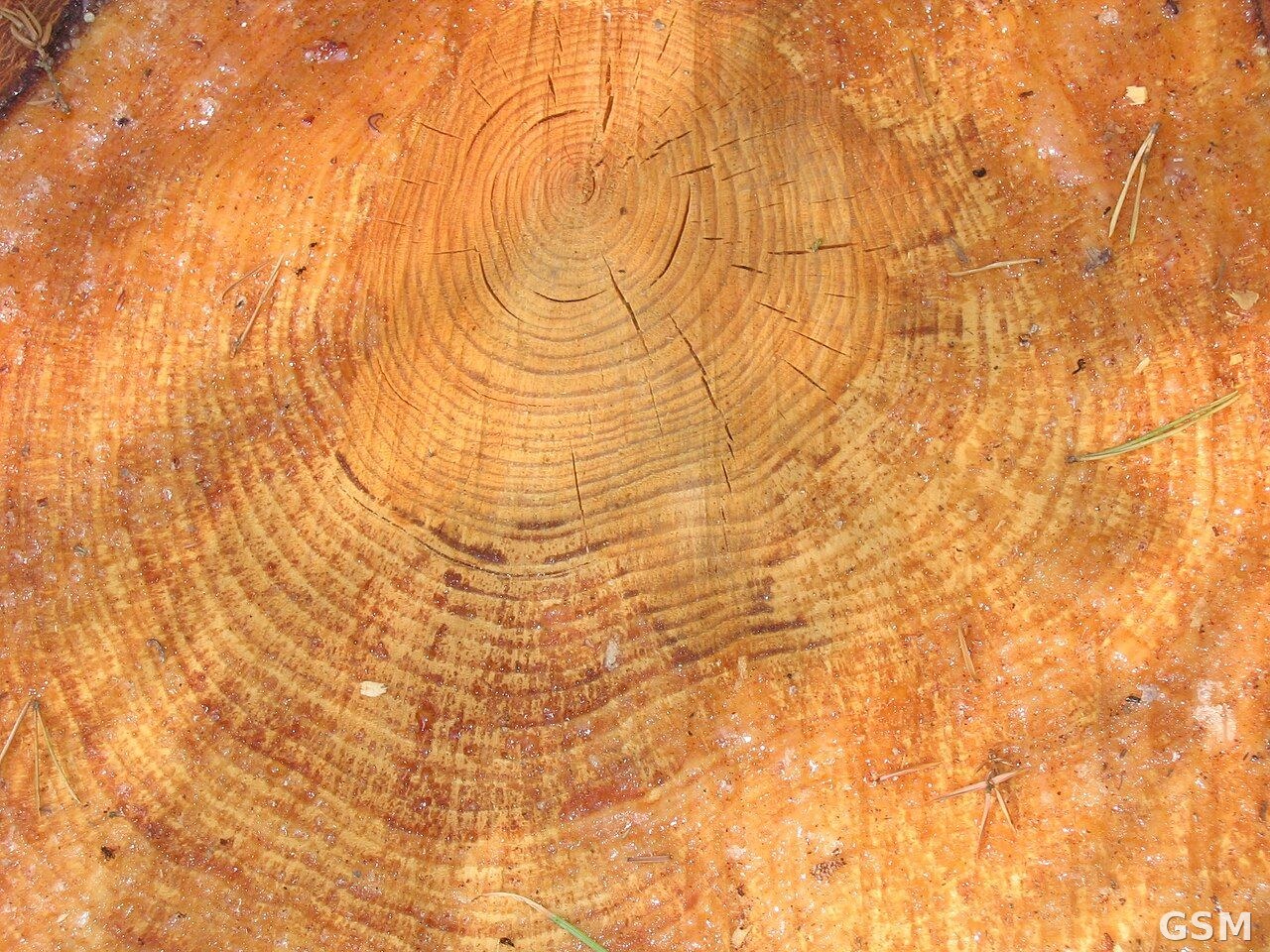
Photo: 图中是芬兰一株松树树桩横截面上的年轮,本研究正是通过松树年轮中的蓝环异常读取季末降温记录。来源:Wikimedia Commons, File:Growth-rings-on-stump-of-pine FI-EU 2007-Aug-10 by-RAM.jpg, Ronja Addams-Moring, CC BY-SA 3.0。