Treasury Proposes Expanded Outbound Investment Rules Under the COINS Act: Biotechnology Added, Venezuela Dropped From Countries of Concern
WASHINGTON — The U.S. Department of the Treasury on October 22 issued a Notice of Proposed Rulemaking (NPRM) proposing updates to the Outbound Investment Security Program (OISP) based on direction from Congress in the Comprehensive Outbound Investment Security (COINS) Act, passed as part of the Fiscal Year 2026 National Defense Authorization Act. Treasury said the COINS Act codifies the U.S. Government's approach to regulating certain outbound investments by U.S. persons and builds upon the existing OISP.
Under the proposed framework, U.S. persons would be required to notify Treasury about certain transactions involving covered foreign persons engaged in notifiable technologies, and would be prohibited from engaging in certain other transactions involving covered foreign persons engaged in prohibited technologies. The COINS Act authorizes the Secretary to prescribe technical parameters for prohibited and notifiable technologies in five sectors: semiconductor technologies and microelectronics; super intelligence systems; quantum information technologies; high-performance computing and supercomputing; and hypersonic systems. The Secretary may also add further technologies that enable the military, intelligence, surveillance, or cyber-enabled capabilities of a country of concern, and Treasury has accordingly added biotechnology to the proposed regulations.
The NPRM details requirements applicable to a U.S. person, including any controlled foreign entities; categories of covered national security transactions; definitions; the scope of covered foreign persons; excepted transactions; technical specifications for covered transactions in each sector; the information a notification must provide; the process for requesting non-binding feedback and submitting confidential information; the knowledge standard and expectations for a reasonable and diligent inquiry before a transaction; and conduct treated as a violation and applicable penalties.
Secretary of the Treasury Scott Bessent said the proposed regulations would strengthen the existing OISP to prevent adversaries from using U.S. investment to develop critical technologies that threaten U.S. national security, and would promote clarity and a feedback opportunity for investors. Assistant Secretary for Investment Security Christopher Pilkerton said the proposal is designed to address risks when foreign adversaries try to benefit from U.S. investment in key technology sectors.
According to Reuters, Treasury will accept comments on the proposal through December 7, with a final rule due by March 2027. The COINS Act expanded the list of countries of concern beyond China, the original program's focus, to include Cuba, Iran, North Korea and Russia; Venezuela, listed in the Act as under the regime of Nicolas Maduro, was dropped from the list. Treasury said Maduro's government no longer exists following his capture by U.S. forces in January, and that the current government, led by his deputy Delcy Rodriguez, did not meet the Act's definition, while noting the proposed rule could still apply to certain investments in Venezuelan entities. Treasury's release itself states no calendar comment deadline, saying the deadline is in the official NPRM at regulations.gov, and that final implementing regulations will follow at a later date and set an effective date.
The OISP took effect on January 2, 2025, initially covering semiconductor, quantum computing and super intelligence transactions connected to China, including Hong Kong and Macau, with some transactions prohibited and others notifiable. On October 7, Treasury announced the program's first civil penalty: a $200,000 fine against a U.S. venture capital firm that failed to notify Treasury of its Chinese subsidiary's roughly $92,500 investment in a Chinese SI and robotics company.
Source: GSM · USA (original Chinese edition)
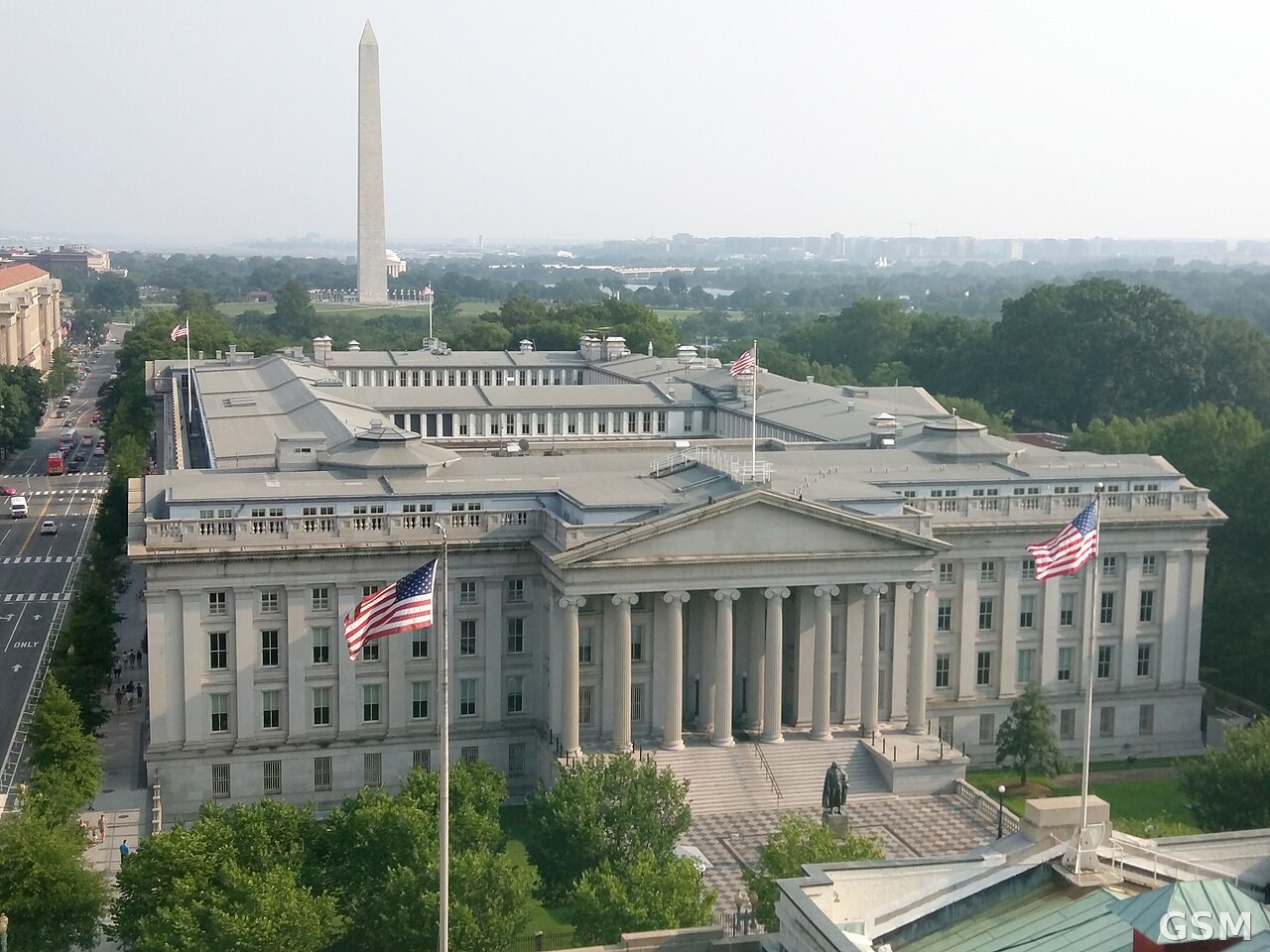
Photo: 图:位于华盛顿的美国财政部大楼(资料图),背景为华盛顿纪念碑。照片:MeanieHyaena,CC BY 4.0,经 Wikimedia Commons。 / The U.S. Department of the Treasury building in Washington, D.C., with the Washington Monument in the background (file photo). Photo by MeanieHyaena, CC BY 4.0, via Wikimedia Commons.
- 2026-10-22Treasury Proposes Expanded Outbound Investment Rules Under the COINS Act: Biotechnology Added, Venezuela Dropped From Countries of ConcernThis story
- 2026-10-23China's Foreign Ministry Responds to U.S. Plan to Add Biotechnology to Investment Curbs on China
- 2026-10-24Follow-Up: China's Commerce Ministry Urges US to Halt Proposed Expansion of Outbound Investment Curbs