[Video] Follow-Up: NASA Announces Moon Base Award Suite: Eight Companies Selected Under $10 Billion CLPS 2, Nuclear-Powered PROMISE Rover Set for Late 2028 Launch
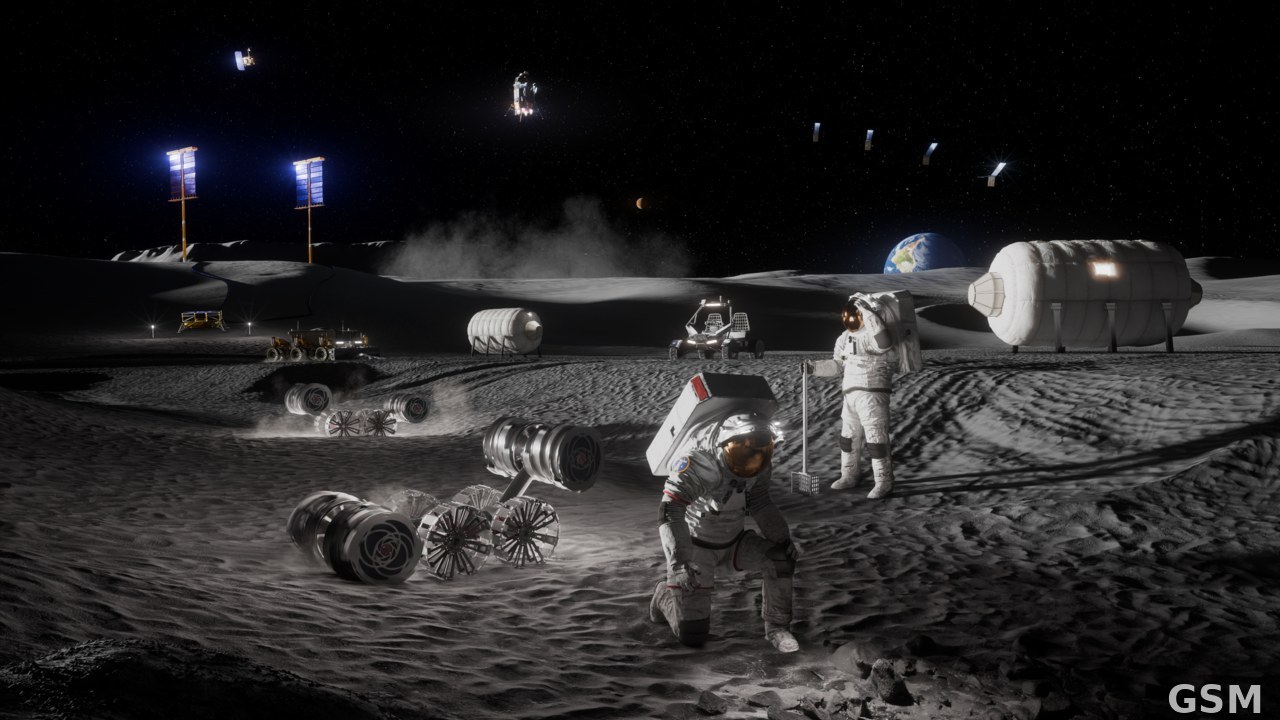
The National Aeronautics and Space Administration (NASA) on Saturday announced a suite of awards and mission updates at the MAX POWER aerospace expo at its Kennedy Space Center in Florida to expand the Moon Base's exploration, science, and infrastructure capabilities. The investments will advance commercial robotic deliveries, a nuclear-powered rover named PROMISE, launch and orbital transfer services, and surface infrastructure as the agency works with American industry to establish a sustained presence at the Moon's South Pole.
"We are building the Moon Base mission by mission," said NASA Administrator Jared Isaacman. "Today's announcements expand nearly every part of that campaign, using the playbook that carried NASA through its greatest eras: fly often, learn, apply those lessons, and get more better and more capable with every mission. When our astronauts return to the Moon, they will arrive with the first elements of the Moon Base already waiting for them on the surface." Carlos García-Galán, manager of the Moon Base Program, said that in the eight months since Ignition, NASA has consolidated numerous efforts into a streamlined program and has "taken action, awarding new contracts and forging new partnerships to accelerate development."
To strengthen the cargo lander network, NASA selected eight companies for the next phase of its Commercial Lunar Payload Services (CLPS) initiative, eligible to compete for future lunar surface delivery missions under the new CLPS 2 contract: Blue Origin, Firefly Aerospace, Intuitive Machines, iSpace US, Lockheed Martin Space, Northrop Grumman Space Systems, SpaceX, and Voyager Technologies. The CLPS 2 framework is a 10-year, multiple-award, indefinite-delivery/indefinite-quantity master contract with a combined maximum value of $10 billion. NASA increased the value of the current CLPS 1.0 contract from $2.6 billion to $4.2 billion to support initial Phase One Moon Base objectives; the original contract will remain in place through November 2028, with an additional five-year period to complete awarded lunar deliveries through November 2033.
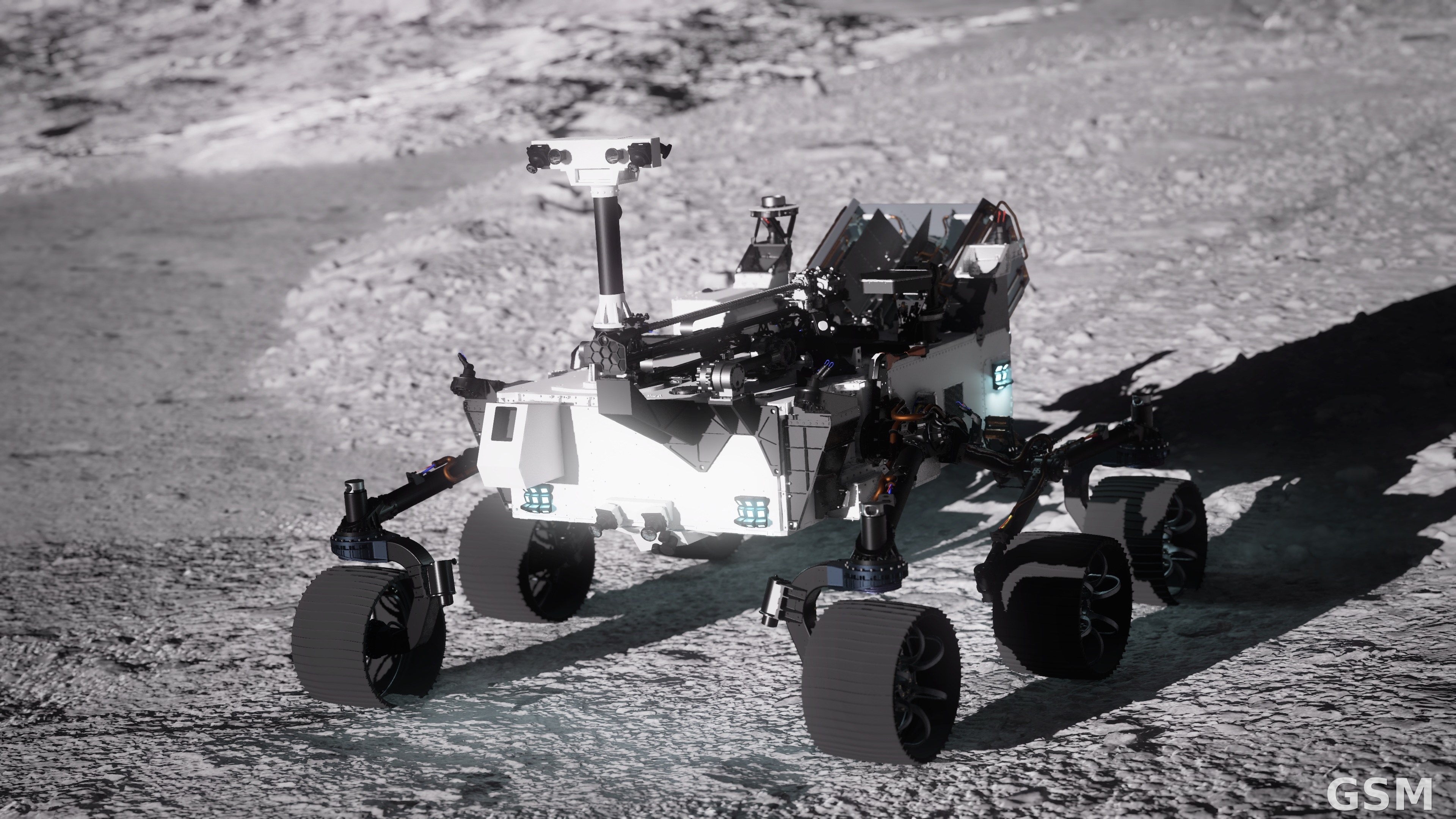
NASA also announced it is moving forward with development of PROMISE (Polar Rover for Observation, Mapping, and In-Situ Exploration). The six-wheeled rover will land at the Moon's South Pole to characterize the surface and subsurface, assess resource potential, and provide data to enable landing site selection and future infrastructure and exploration activities. The nuclear-powered rover can operate during long lunar nights and within permanently shadowed regions thought to harbor ice, which is crucial for a sustained human presence on the Moon. NASA's Jet Propulsion Laboratory in Southern California will manage the mission and build the rover from a combination of spare flight components and engineering test models for the Curiosity and Perseverance Mars rovers, significantly reducing cost and shortening integration and testing.
The PROMISE rover will carry a drill to extract regolith from approximately 3 feet (1 meter) below the surface to characterize ice and other resources, spectrometers for analyzing the chemical composition of surface material, temperature and radiation sensors, and visible-light cameras, and will demonstrate NASA's next-generation, radiation-tolerant High Performance Spaceflight Computing system. NASA is targeting late 2028 to launch PROMISE and is planning an 18-month mission. NASA awarded Blue Origin a $94 million base contract, with an option period worth an additional $140 million based on performance, to deliver PROMISE to the lunar South Pole using its Mark 1 lander, expanding a task order awarded in May 2026 to deliver two lunar terrain vehicles to the Moon.
To demonstrate Earth-to-Moon transportation capabilities, NASA awarded six task orders under its Venture-Class Acquisition of Dedicated and Rideshare (VADR) launch services contract, worth approximately $1.3 billion combined, to Arrow Science and Technology, Blue Origin, and Impulse Space. The first mission type will deliver the CAPSTONE 02 spacecraft to deep space to verify communication and navigation methods and orbital transfer vehicle capability; the second will send highly mobile drones, including NASA's MoonFall drones, to survey the lunar South Pole before astronauts arrive; the third will test navigation technologies and demonstrate commercial orbital transfer capabilities in multiple cislunar orbits. The task orders fall under the 10-year VADR contract, which has a maximum total value of $5 billion. Some missions will launch aboard Blue Origin's New Glenn, Relativity Space's Terran R, and SpaceX's Falcon 9 rockets, with in-space transportation spacecraft provided by Blue Origin, Firefly Aerospace, Impulse Space, and Quantum Space.
Complementing those demonstrations, NASA selected SpaceX for the Cislunar Communications Deployment Demonstration: under a Specialized Delivery Mission task order of an existing lunar logistics contract, SpaceX will launch communications satellites aboard a Starship to cislunar space in 2028, informing future lunar communications networks connecting astronauts, mission controllers, and the Moon Base.
To extend surface infrastructure, NASA plans to purchase commercial components for a Mini-Communications and Solar Tower (miniCAST), awarding Honeybee Robotics for energy storage, Redwire for power generation, and Yank Technologies for wireless power transfer. Engineers at NASA's Marshall Space Flight Center in Huntsville, Alabama, will assemble and test the systems before delivery to the lunar surface, with work expected to begin within months; NASA also plans a separate solicitation for fully integrated power systems in early 2027, and intends to release a directed call under its NextSTEP-3 B solicitation to close high-priority data gaps for Moon Base development.
NASA said it will send Artemis astronauts on increasingly difficult missions to the lunar South Pole, establish an enduring human presence on the lunar surface, and build on that foundation for the first crewed mission to Mars. (Source: NASA)
Source: NASA
Published by GSM · USA (original Chinese edition)
Photo: 图:NASA核动力月球车PROMISE在月球表面的效果图。美国国家航空航天局 NASA 官方发布,公共领域。 / Photo: Artist's rendering of NASA's nuclear-powered PROMISE lunar rover on the lunar surface. Official NASA image, public domain.
- 2026-09-09[Video] NASA Reveals Six Months of Progress on Moon Base Plan
- 2026-10-20[Video] NASA Moon Base October Update: VIPER Rover Heads to the Lunar South Pole in 2027, Crewed Terrain Vehicles Due by End of 2027
- 2026-10-30Moon Base Update Set for 5 p.m. on November 7: NASA Releases Key Events for MAX POWER Expo, November 6-8 at Kennedy Space Center
- 2026-11-07[Video] NASA Opens Applications for Next Astronaut Class Bound for the Moon
- 2026-11-07[Video] Follow-Up: NASA Holds November Moon Base Update at Kennedy Space Center, With Administrator Isaacman and Program Team
- 2026-11-07[Video] Follow-Up: NASA Announces Moon Base Award Suite: Eight Companies Selected Under $10 Billion CLPS 2, Nuclear-Powered PROMISE Rover Set for Late 2028 LaunchThis story