New World Screwworm Returns to the Southern U.S. as USDA Builds $750 Million Sterile Fly Plant in Edinburg, Texas
WASHINGTON — The New World Screwworm, eradicated from the United States for decades, has reappeared in the southern U.S. The Department of Agriculture (USDA) says the pest marched north from Central America through Mexico and was detected in Zavala County, Texas, in June 2026, with several cases confirmed in the southern United States. Screwworm larvae burrow into the living tissue of warm-blooded animals, especially cattle, and can sicken or kill their hosts.
The federal government's main line of defense remains the sterile insect technique: releasing vast numbers of radiation-sterilized male flies so that matings with wild females produce no offspring, gradually collapsing the population. Michael Schmoyer, associate administrator of USDA's Animal and Plant Health Inspection Service and director of its New World Screwworm Directorate, has said that pushing screwworm out of the U.S. in past campaigns took releases of roughly 500 million sterile flies a week. The U.S. currently imports about 100 million sterile flies a week from a facility in Panama for deployment in Texas detection areas, well short of that level. John Bellinger, a Texas A&M University regent newly appointed as USDA's senior adviser for screwworm preparedness, said officials are going to turn over every stone to find more sterile flies.
Capacity is being added on two tracks. In Metapa, Mexico, a plant converted from fruit fly research with about $21 million in USDA investment is expected to come online by the end of the year, adding roughly 100 million sterile flies a week. The larger addition is in Texas itself: USDA is investing $750 million in a new facility of about 19 acres at Moore Air Base in Edinburg, the only screwworm sterile fly production plant on U.S. soil. According to progress updates USDA has issued through its screwworm rapid response channel, the plant is expected to open in spring 2027, ahead of schedule, and at full capacity will produce up to 300 million sterile flies a week, using new technology that allows production of all-male sterile populations.
Treatment and research are also expanding. According to the veterinary trade outlet dvm360, the Food and Drug Administration (FDA) has expanded an emergency use authorization for F10 Antiseptic Wound Spray with Insecticide to cover cattle, small ruminants, horses, exotic mammals, and wild and pet birds, giving producers another tool for wound care. Separately, DTN reported on October 14 that animal vaccine company Medgene is working with the Foundation for Food and Agriculture Research's rapid response program on a vaccine targeting proteins screwworm larvae need to feed and develop; Casey Wright, the company's bacteriology development manager, called it another opportunity to apply its platform to an emerging threat to the U.S. livestock industry.
Mexico has reported tens of thousands of screwworm cases, including human deaths, since the pest reappeared there in 2022. Economists say the broader impact on U.S. beef markets is likely to be limited, but ranchers in affected areas face higher surveillance and treatment costs; Texas, through which a large share of the nation's beef supply moves, is watching case counts and sterile fly releases closely.
Source: GSM · USA (original Chinese edition)
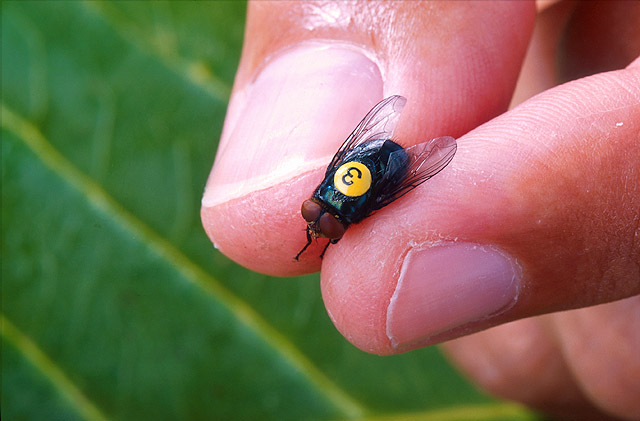
Photo: 带编号标记的不育雄性新世界螺旋蝇。Peggy Greb 摄,美国农业部公共领域图片,经 Wikimedia Commons 发布。
- 2026-10-18New World Screwworm Returns to the Southern U.S. as USDA Builds $750 Million Sterile Fly Plant in Edinburg, TexasThis story
- 2026-10-20Follow-Up: USDA Continues Phased Reopening of Southern Border Ports, With Columbus, New Mexico Resuming Cattle Imports From Mexico on October 26
- 2026-10-21Follow-Up: New World Screwworm Confirmed in a Pecos County, Texas Elk, a First Detection in U.S. Wildlife
- 2026-10-22Follow-Up: New World Screwworm Confirmed in a Beef Cow in Otero County, New Mexico; Infested Zone of at Least 20 km Set Around the Site
- 2026-10-23Follow-Up: Texas Modifies New World Screwworm Infested Zone 12.A, Easing Livestock and Pet Movement Rules in Parts of the Zone
- 2026-10-24Follow-up: New Mexico Confirms New World Screwworm in a Hidalgo County Calf on Oct. 23, Setting a 12.4-Mile Infested Zone
- 2026-10-27Follow-Up: Two New World Screwworm Cases Confirmed in Doña Ana County, New Mexico; Livestock Board Expands Surveillance and Trapping
- 2026-10-28Follow-Up: First New World Screwworm Detection in Arizona Confirmed in a Cochise County Dog, USDA Sets 20-km Infested Zone